






















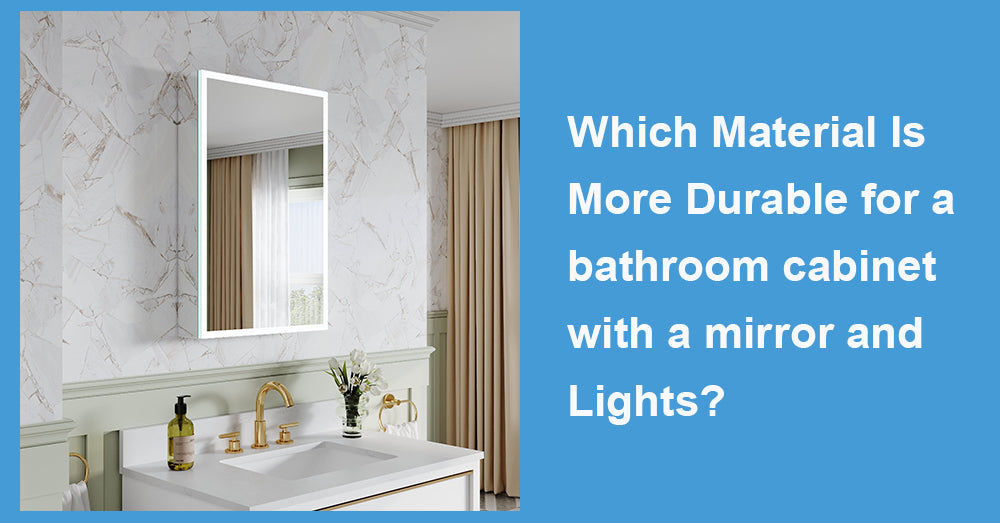
When renovating a bathroom, a "bathroom cabinet with mirror and lights"are almost a must-have: storage, mirror, and lighting all in one, seamlessly addressing the frequent needs of morning and evening routines. Especially a bathroom cabinet with a mirror and lights, it not only enhances aesthetics but also makes makeup application and shaving more convenient. But what most people agonize over before buying isn't size—it's: **Which material is genuinely the most durable?** Bathrooms endure constant humidity, temperature fluctuations, and frequent cleaning. Choosing the wrong material can lead to minor issues like warping and adhesive failure, or significant problems like rust, mold, and light fixture malfunctions. Below, we break down the durability of common mirror cabinet materials based on real-world usage scenarios and provide a set of purchasing conclusions.
Defining "Durability" for Bathroom Mirror Cabinets
Durability for bathroom mirror cabinets goes beyond mere "sturdiness." For lighted models, it encompasses at least four key aspects:
l Moisture Resistance & Mold Prevention: Does the cabinet absorb water, expand, mold, or crack?
l Warpage Resistance: Do the doors warp or the cabinet bulge?
l Corrosion Resistance: Do metal components (hinges, screws, light fixtures) rust?
l Ease of Cleaning & Detergent Resistance: Does the surface withstand scrubbing and resist acids/alkalis?
l Remember: Bathrooms are a "stress test" for materials. Only cabinets that function reliably for years without issues truly qualify as durable.
Cabinet Materials: Which Offers Better Moisture Resistance & Warp Resistance?
1) Aluminum Alloy (or All-Aluminum Mirror Cabinets): Highest Durability Priority
If you prioritize low-maintenance care and seek mirror cabinets that remain stable in humid environments, aluminum alloy/all-aluminum cabinet bodies typically rank in the top tier for durability.
Advantages:
- Non-absorbent, naturally moisture-resistant, unaffected by prolonged vapor exposure
- Won't swell or delaminate like wood-based panels
- Highly scrub-resistant after anodized or spray-coated finishes
Potential drawbacks:
- A somewhat "cold" aesthetic, better suited for modern minimalist or light luxury styles
- Often more expensive than basic materials
- If craftsmanship is subpar, edges may feel noticeably metallic and hard to the touch
Ideal for: Households with enclosed bathrooms, areas prone to high humidity, or frequent hot showers; and those seeking a one-time investment with minimal upkeep.
2) Stainless Steel: Strong structure and corrosion resistance, but it depends on the steel grade and surface finish
Stainless steel is also commonly used for mirror cabinet frames or cabinet bodies, offering overall high durability. The key factors are: whether it's a reliable steel grade (e.g., 304 is more common) and whether welding, bending, and surface treatment are properly executed.
Advantages:
High strength, excellent load-bearing capacity and structural stability
Strong corrosion resistance, suitable for humid environments
Relatively resistant to cleaning agents (Does not mean it can withstand prolonged scrubbing with strong acids or alkalis)
Potential drawbacks:
Fingerprints and water marks are more visible, requiring frequent wiping
Poor material quality, welding, or surface treatment may still lead to rust spots or yellowing
Cost is not low
Suitable for: Those prioritizing "sturdiness" and longevity, seeking a more stable mirror cabinet.
3) Multi-layer Solid Wood Panels: Balanced Option, but Requires Proper Edge Sealing and Moisture Protection
Multi-layer solid wood panels (plywood) offer a "cost-effectiveness + stability" approach for bathroom cabinets. They resist warping better than MDF, but in bathroom environments, success still hinges on: edge sealing, backing panels, coatings, and moisture-proof construction.
Advantages:
Generally more stable than standard MDF
Texture and appearance closer to natural wood aesthetics
Relatively manageable cost
Potential drawbacks:
Still vulnerable to prolonged water exposure or edge seepage
Poor edge sealing allows moisture ingress, leading to peeling and bubbling
Significant material and craftsmanship variations—a "wood-like appearance" doesn't guarantee durability
Ideal for: Bathrooms with effective wet/dry separation and good ventilation; those who appreciate wood's warm feel but prioritize reliability.
4) PVC/Foam Board: Strong waterproofing, but "texture and strength" depend on positioning
PVC panels excel in waterproofing and moisture resistance, making them common in budget bathroom mirror cabinets. While durable against humidity, consider load-bearing capacity, deformation, and hardware mounting methods.
Advantages:
Excellent waterproofing, resistant to mold
Easy to clean, stain-resistant surface
Potential drawbacks:
Lower-end products may be flimsy with poor load-bearing capacity
Screw fastening strength may diminish after repeated removal/reinstallation
May degrade under prolonged high-temperature/intense light exposure (generally not a major concern in bathrooms)
Suitable for: Budget-conscious users with high bathroom humidity seeking simple, effective moisture protection.
5) MDF/Particleboard: Not recommended as a primary choice for "durable" applications
This isn't to say MDF is unusable, but bathroom conditions are too harsh for it. Its main issue: once the edge sealing breaks or water seeps in, swelling becomes very noticeable and is difficult to reverse.
Conclusion: If "long-term durability" is your priority, consider MDF/chipboard mirror cabinets only as a backup option or if the craftsmanship is exceptionally solid and the bathroom has thorough wet/dry separation.

Door Panels & Surface Finishes: Scrub Resistance Matters More Than You Think
Common bathroom mirror cabinet door finishes include: lacquer, PET laminate, melamine board, metal spray coating, etc.
From a "durability" perspective, the key isn't the finish name, but:
l Water vapor resistance: Are edges sealed tightly?
l Cleaning agent resistance: Does it corrode, fog, or fade easily?
l Scratch resistance: Are marks visible after daily bumps, fingernail scratches, or cleaning tool friction?
If your household frequently uses cleaning agents, prioritize metal spraying/high-quality laminates/scrub-resistant surfaces. Avoid prolonged exposure to strong acidic or alkaline cleaners.
Hidden Durability Points in Lighted Mirror Cabinets: Hardware and Electronics
Many mirror cabinets fail not due to the cabinet itself, but because hinges rust, doors warp, lights flicker, or switches break. Beyond materials, consider:
l Rust-proof hinges/screws: Prioritize higher rust-resistance ratings for hardware in humid environments.
l Light strips and drivers: Focus on heat dissipation and moisture-proof design to prevent water vapor from entering the electrical compartment.
l Power supply and switch placement: Ideally, implement zoned protection to minimize direct exposure to moisture.
l Mirror anti-fog and back panel moisture resistance: The structure behind the mirror and the back panel also impacts long-term stability.
l Bottom line: Even the finest cabinet materials will lose durability points if paired with subpar hardware and electrical components.
Final Material Selection Conclusions: Choose Based on Your Bathroom Conditions
l High humidity/dark bathroom/pronounced spring dampness: Prioritize Aluminum Alloy (All-Aluminum) > Stainless Steel > PVC
l Desire wood style but also durability: Select Multi-layer Solid Wood Panels, while closely inspecting edge sealing, moisture-proof coating, and backing structure
l Limited budget but moisture concerns: PVC is an option, but pay attention to load-bearing capacity and hardware fastening
l Seeking Ultimate Durability & Low Maintenance: Lean toward Aluminum Alloy/Stainless Steel, while confirming rust-proof hardware and moisture-resistant lighting design
Quick Checklist: 3-Minute "Durability-Focused" Evaluation
Use these points for rapid screening before ordering:
l Inspect Edges: Check for tight edge sealing and exposed base materials
l Examine Backing: Verify moisture-proof treatment and structural integrity
l Inspect hardware: Are hinges and screws labeled rustproof/material-specific?
l Evaluate lighting: Does it feature a separate moisture-proof electrical compartment? Does it emphasize waterproof ratings or moisture-resistant design?
l Assess installation: Does it support secure wall mounting (especially on load-bearing/tiled walls)?
l Bottom line: If you ask "Which material lasts longer?" for bathroom mirror cabinets, aluminum alloy/stainless steel typically offers greater peace of mind, superior moisture resistance, and longer durability. For a wood-like aesthetic, choose reliable engineered wood panels with edge sealing as a must-have for moisture resistance. Selecting the right material, paired with quality hardware and moisture-proof electrical design, ensures your bathroom cabinet with mirror and lights will truly last longer, stay stable, and feel effortless to use every day.







































Leave a comment
This site is protected by hCaptcha and the hCaptcha Privacy Policy and Terms of Service apply.