






















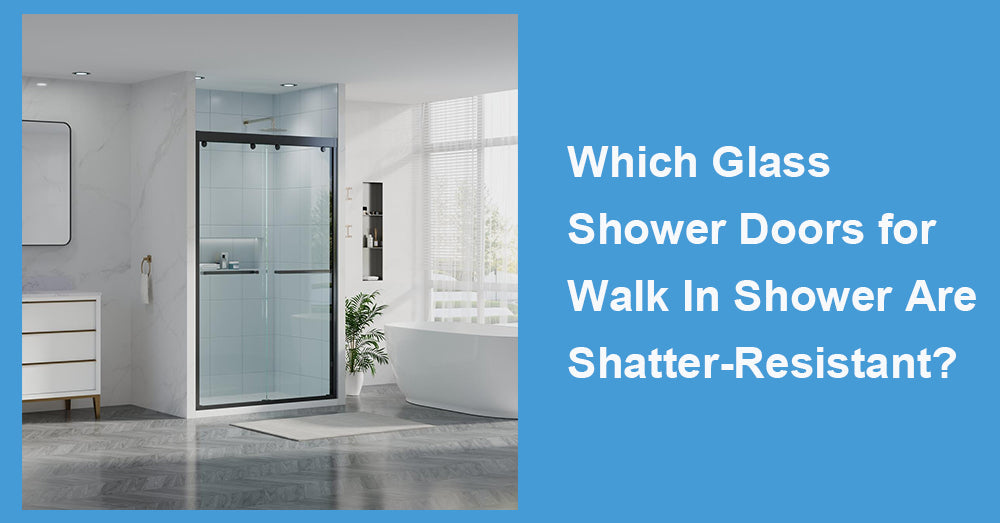
With the popularity of frameless and semi-frameless walk-in shower designs, the safety of glass shower doors for walk in shower has once again become a focus of industry attention. This article summarizes the common types of glass with "anti-shatter" or "anti-shatter" functions in the current market, common thickness and structural selection, relevant standards and testing basis, as well as key dimensions (all in inches) that should be noted in the selection and installation process, providing actionable references for designers, distributors, and end-users.
1. What is "shatter-resistant" glass? Two mainstream technologies
'Shattered' does not mean that glass will never break, but rather that it can minimize the risk of piercing fragments and injury when it breaks. The two most common types of technologies currently are:
Fully tempered glass
Fully tempered glass undergoes rapid cooling after high-temperature heating, resulting in compressive stress and surface tensile stress. Its impact strength is about 4 times that of annealed glass. When broken, it appears as granular fragments, reducing the formation of large, sharp pieces. Industry standards have explicit provisions for heat-treated glass (such as ASTM C1048), and their safety performance is reflected in the labeling. (Source: elitesafetyglass.com/ASTM C1048)
Laminated glass
Laminated glass is made by bonding two or more glass sheets with an intermediate polymer layer (usually PVB). Even if the glass breaks, fragments will adhere to the intermediate film, maintaining overall integrity and significantly reducing the risk of penetrating wounds and splashes. Compared to fully tempered steel, the interlayer is superior in maintaining integrity and is suitable for scenarios with higher safety requirements. (Source: glassdoctor.com)
2. Common thicknesses and applicable scenarios (measured in inches)
The commonly used glass thicknesses for walk-in showers in the market are: 1/4 "(0.25 inch), 3/8" (0.375 inch), and 1/2 "(0.5 inch). The selection criteria are usually based on the type of door (hinged, sliding, or fixed panel), door width, and whether it is a frameless structure:
1/4 "(≈ 0.25") - commonly seen in sliding doors with frames or half frames, an economical solution. If it is fully tempered and certified by ANSI/ASTM, it basically meets the general household safety requirements. (Example: Some retail products are labeled with 1/4 "ANSI Z97.1 certification).
3/8 "(≈ 0.375") - a commonly used thickness for frameless or semi-frameless walk-in, which balances rigidity and slim appearance, and is currently the most cost-effective conventional choice in the industry. Multiple brands have equipped the range of 68-72 inches wide, a door width of approximately 34 inches, and a walk-in net entrance width of 21.6-25.6 inches with 3/8-inch glass.
1/2 "(≈ 0.5") - Suitable for frameless designs with large open spaces or the pursuit of a high-end feel and better bending resistance. It has a high cost and weight but provides the most significant structural rigidity and safety redundancy. (Source: Industry Information)
3. Standards and Certification: The Key to Buying 'Safety Glass.'
When selecting, the supplier should be checked and requested to provide the following testing or certification information:
ASTM C1048: Specification and requirements for heat-treated glass (including Fully Tempered and Heat Tempered). (Source: elitesafetyglass.com)
ANSI Z97.1/CPSC standard: Test methods and labeling requirements for safety glass, many shower doors are labeled as "ANSI Z97.1 certified". (Source: blog.ansi.org/cpsc.gov)
These standards not only specify the fracture morphology, but also require surface compressive stress, edge quality, and defect sensitivity - which are key to avoiding spontaneous rupture and extending service life.
4. Why do glass explosions or accidental ruptures still occur?
Despite standards and heat-treatment processes, a few accident reports still show shower doors breaking and causing injuries to personnel. Regulatory and research institutions, as well as media investigations, have identified diverse causes, including edge scratches, installation stress, unqualified glass cutting or heat-treatment defects, and stress concentration caused by slight inclusions on quartz or coating surfaces. Consumer safety agencies have identified relevant emergency cases in several annual reports, reminding the industry and consumers to control the quality of materials and installation strictly. (Source: cpsc.gov/abc3340.com)
5. Industry trend: When to choose a sandwich instead of relying solely on tempered steel?
In recent years, with the higher requirements for safety and integrity in high-end customization, hotels, and medical projects, the penetration rate of laminated glass in shower doors and bathroom partitions has increased. The interlayer not only protects personal safety after rupture, but also provides additional value such as sound insulation and UV blocking; Therefore, for places frequently used by children and older people, hotels and public buildings, and large-sized frameless panels (such as single panel widths exceeding 30-36 "and heights exceeding 72"), it is recommended to prioritize mezzanine solutions.
6. Selection and Installation Suggestions (Practical Checklist)
Require suppliers to provide material certificates that clearly state "Fully tempered per ASTM C1048" or "Laminated safety glass with PVB interlayer" and indicate the thickness (e.g., 0.375 "or 0.5"). (Source: ASTM document)
It is recommended to use at least 3/8 "(0.375") fully tempered steel or sandwich for frameless walk-ins, with a wider width leaning towards a 1/2 "(0.5") sandwich to enhance overall rigidity and safety redundancy. (Source: Industry Product Page)
Avoid edge stress during installation: All cutting edges must be chamfered or otherwise processed, and suitable hinges, positioning holes, and cushioning components should be used to avoid concentrated point loads. Manufacturing and installation defects are high-risk areas for accidents. (Source: cpsc.gov)
For users with a limited budget who need to improve safety, an explosion-proof film can be added to tempered glass to help maintain fragment adhesion to some extent when it ruptures. Still, the effect is not equivalent to that of a sandwich. (Industry common sense)

7. Conclusion: From 'usable' to 'safe to use.'
Overall, the mainstream "shatter-resistant" solutions for walk-in showers in the market are fully tempered and laminated. Full tempered steel, with its high strength and fragmentation upon rupture, meets most household scenarios; the interlayer is more secure in maintaining integrity and reducing penetration damage, especially suitable for large-sized panels and scenarios with higher safety requirements. When purchasing and designing, paying attention to thickness (in inches), certification (ASTM C1048, ANSI Z97.1), and professional processing and installation processes is the key to truly combining "glass aesthetics" with "personal safety".









































Leave a comment
This site is protected by hCaptcha and the hCaptcha Privacy Policy and Terms of Service apply.