






















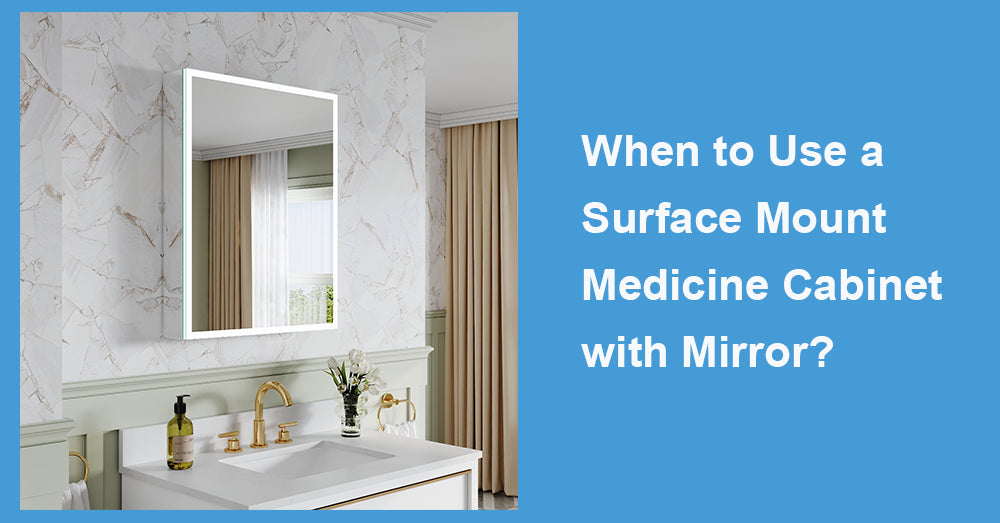
When upgrading bathroom storage, many people's first thought is that "built-in mirror cabinets are more sophisticated." But the reality is: wall structure, pipe locations, budget, and timeline often make built-in options impractical. In these cases, surface mount medicine cabinet with mirror becomes the more stable, faster, and easier-to-implement choice. Below, I'll explain using an independent shopping/renovation approach: when to choose surface-mounted cabinets, how to select the right size, where to install them most effectively, and the most common pitfalls to avoid.
What is a surface-mounted mirror cabinet? What core problem does it solve?
A surface-mounted mirror cabinet is a mirrored storage unit that "hangs on the wall surface" without requiring cavity installation. Its value is straightforward:
No wall demolition or structural changes: No need for wall chiseling, fireproofing barriers, stud reinforcement, or pipe relocation
Short timeline, low risk: Ideal for renovations, rental properties, or users seeking quick bathroom upgrades
Instant storage improvement: Especially ideal for those with cluttered countertops needing to conceal bottles and jars
If you seek "minimal construction + maximum storage," a surface-mounted mirrored medicine cabinet typically offers the best value.
Prioritize surface-mounted mirrored medicine cabinets in these scenarios:
Scenario A: Walls contain pipes/structural constraints preventing safe demolition
Common in older homes, concrete walls, exterior walls, insulated walls, or walls containing plumbing/wiring/ventilation ducts. Recessed installation risks uncontrollable damage. Surface-mounting bypasses these issues entirely.
Scenario B: You're doing a "partial remodel" and want to avoid major demolition work
Only replacing the mirror, light fixture, or hardware without touching tiles or waterproofing? Go surface-mount. Simply verify wall load-bearing capacity and mounting methods. Installation costs and rework risks are significantly lower.
Scenario C: Bathroom walls are too thin for sufficient recess depth
Many recessed units require a specific cavity depth. Thin walls, shallow studs, or brick/concrete backing may prevent installation. Surface-mounted medicine cabinets with mirrors offer adjustable depth for greater compatibility.
Scenario D: You need "greater capacity," but the wall cavity width is limited
Built-in installations are often constrained by stud spacing, limiting both width and height. Surface mounting offers more freedom: choose wider, taller, or deeper cabinets for enhanced storage.
Scenario E: You want faster results and tighter budget control
If you're calculating total costs: wall demolition, panel replacement, leveling, waterproofing, tiling, finishing, rework risks... easily exceed budgets. Surface mounting focuses spending on "product + installation," offering better control.

The "Real Pros and Cons" of Surface-Mounted Mirror Cabinets—Don't Just Judge by Looks
Pros
Simpler installation: Typically secured with direct drilling (or wall plates/hanging strips)
High adaptability: Can be installed even with poor wall conditions or complex piping
Typically larger capacity: Often holds more than built-in units of the same width
Potential drawbacks (but avoidable through selection)
Cabinet protrudes from the wall: May feel "oppressive" in small bathrooms.
Solution: Choose thinner cabinets or opt for "mirrored + narrow frame" designs to reduce bulk visually
Door swing interferes with traffic flow: Clashes with faucets/fixtures if too close.
Solution: Select appropriate width/opening style (left/right/double doors) and allow lateral clearance
Greater reliance on secure installation, Especially on hollow walls
Solution: Must anchor to studs or use compliant hollow-wall anchors/butterfly screws, and manage weight load
How to choose size and placement? Base it on "usage patterns"
Width: Don't blindly pursue maximum width
Single-occupant master bathroom: 24"-30" is more balanced
Double sinks or multi-user: 30"-48" is more practical
The key isn't width, but ensuring the door doesn't hit the light fixture, wall, or side cabinet when opened.
Depth: Prioritize slim profiles for compact spaces
Surface-mounted depth determines how much it protrudes. If your bathroom hallway is narrow or the mirror cabinet faces the door directly, opt for a slimmer cabinet body.
Installation Height: Balance "Eye Level" + "Access Comfort"
Center the mirror roughly at the primary user's eye height.
Place frequently used items (toothpaste, skincare, shaving supplies) within easy reach.
For households with varying heights, prioritize adjustable shelves and position the frequently used zone on the middle shelf.
Left/Right Positioning: Keep Countertops Clutter-Free
The mirror cabinet's purpose is to remove "high-frequency small items" from countertops. Reserve the messier side of the sink for the direction where opening the cabinet door feels most natural (e.g., right-handed users prefer right-opening doors).
Installation & Moisture Resistance: How to Ensure Durability for Freestanding Units?
Confirm wall type: Hollow drywall vs. solid brick walls require entirely different mounting methods.
Anchor to studs whenever possible: Provides more stable support and prevents loosening over time.
Account for high humidity: Prioritize corrosion-resistant materials, rustproof hardware, and fog-free/easy-clean mirror surfaces.
Allow cleaning space: Leave gaps between cabinet and sink/faucet to prevent water buildup and difficult cleaning.
Quick Reference: Is a Surface-Mounted Medicine Cabinet with Mirror Right for You?
If you meet any 3 of the following criteria, surface mounting is generally your best option:
- Avoid breaking walls, disturbing tiles, or compromising waterproofing
- Uncertain wall structure/hidden pipes
- Seek quick upgrades for storage and bathroom tidiness
- Limited budget; concerned about delays or rework
- Need larger capacity or flexible sizing options
Frequently Asked Questions (FAQ)
Q1: Does surface mounting look "cheap"?
Not necessarily. Opt for designs with "narrow frames + large mirrors + premium hardware" for a high-end wall-mounted furniture aesthetic. Paired with appropriate lighting, the quality becomes very apparent.
Q2: Will it obstruct space in small bathrooms?
The key lies in depth and door opening style. Prioritize slim cabinet bodies in compact spaces, reserve adequate swing space for doors, and opt for double doors when needed to reduce outward swing on one side.
Q3: Can I install it myself?
If you can accurately locate studs, use a level, and understand basic wall mounting rules, many models are DIY-friendly. However, for complex walls or uncertain load-bearing conditions, professional installation is more reliable.
Conclusion
The essence of choosing a surface-mounted medicine cabinet with mirror lies in trading lower construction costs and reduced risks for a faster, more stable bathroom storage upgrade. Don't be held hostage by the notion that "only built-in options are premium"—for most renovation users, true sophistication means keeping countertops clutter-free, ensuring effortless daily access, and guaranteeing long-term stability without loosening or mold growth.







































Leave a comment
This site is protected by hCaptcha and the hCaptcha Privacy Policy and Terms of Service apply.