






















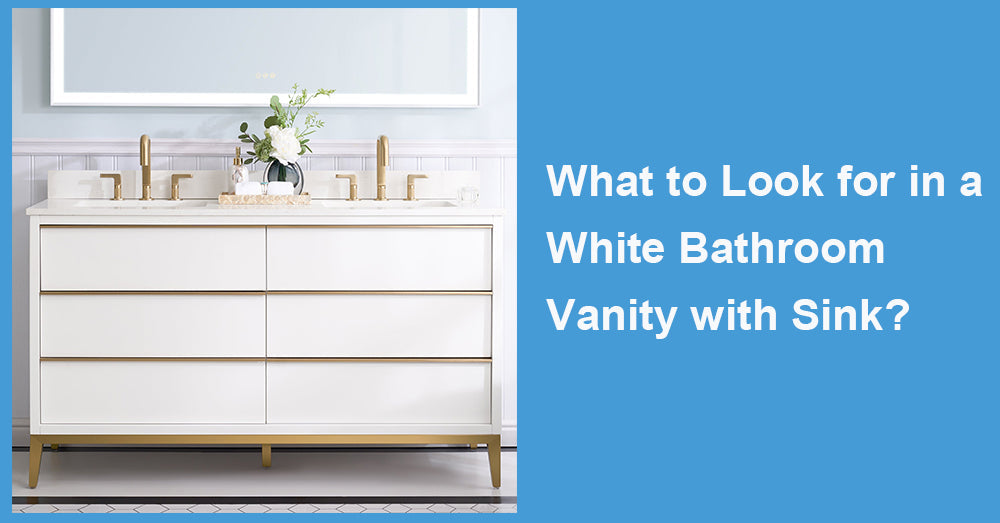
A white bathroom vanity with sink remains one of the easiest fixtures to coordinate during a bathroom remodel, but the strongest purchase goes beyond color. Cabinet width, sink type, countertop material, drawer layout, faucet drilling, moisture resistance, and installation details all affect how well the vanity performs after the room is finished. White cabinetry also continues to fit current design preferences: Houzz reports that white accounts for 20% of upgraded vanity colors, while white countertops lead at 48%. At the same time, sinks are replaced in 73% of bathroom renovations, reinforcing the appeal of buying the vanity and basin as one coordinated package. (Houzz)
1. Start With the Right Vanity Width
Choosing the correct width should come before comparing door styles or hardware. Houzz reports that 47% of upgraded vanities measure 48 inches or less, showing how important compact and midsize formats remain in remodeling projects. Another 19% measure 60 inches, while 14% are 72 inches wide. (Houzz)
A 24-inch white vanity can work well in a powder room. A 30- or 36-inch model provides more practical storage for guest bathrooms, while a 48-inch vanity offers generous single-sink counter space. Larger 60- and 72-inch configurations are more suitable when two sinks or expanded storage are priorities.
Depth matters as well. Standard vanity depth generally falls around 21 to 22 inches, while shallow models may measure 20 inches or less. Vanity cabinet heights commonly range from 32 to 36 inches before the countertop is considered. (Signature Hardware)
Industry judgment: the best vanity is not the largest cabinet that fits the wall. It is the size that preserves comfortable circulation while providing enough usable storage.
2. Check Whether the Sink Is Truly Included
Product titles can be misleading, so buyers should confirm exactly what comes in the package. Some white bathroom vanities include the cabinet, countertop, and sink, while others show the basin in photographs but sell it separately.
An undermount sink is a strong choice for clean, contemporary bathrooms because there is no raised rim interrupting the countertop. It also allows water and debris to be wiped directly into the basin. Integrated sinks reduce visible seams even further and can simplify routine cleaning.
Vessel sinks create more visual impact, but they require additional height planning. Because the bowl sits above the countertop, both the faucet height and overall vanity height must be considered carefully.
Industry judgment: an included sink adds real value only when its dimensions, material, and installation style match the way the bathroom will actually be used.
3. Evaluate the Countertop as Carefully as the Cabinet
A white cabinet does not require a pure white countertop. Warm white, ivory, pale gray, or lightly veined surfaces can add definition while maintaining a bright overall appearance.
Current renovation data shows that white is selected for 48% of upgraded vanity countertops, followed by off-white at 20%. Engineered quartz leads countertop materials at 45%, with quartzite at 20%, granite at 14%, and marble at 13%. (Houzz)
Quartz is particularly practical for buyers who want a consistent appearance and relatively straightforward maintenance. Natural stone offers more variation but may require additional care depending on the material.
For a 30- or 36-inch vanity, restrained veining often creates a cleaner effect than oversized patterns. A 60- or 72-inch top provides enough surface area to support stronger movement.
Industry judgment: on a white vanity, countertop quality often determines whether the finished unit looks generic or intentionally designed.
4. Study the Storage Layout Before Buying
Cabinet doors can make a vanity look spacious while hiding an inefficient interior. Practical storage should be evaluated by drawer depth, shelf position, plumbing clearance, and access to frequently used items.
Deep drawers can hold grooming products, cosmetics, hair tools, and extra toiletries. Door cabinets work well for taller bottles and cleaning products. U-shaped drawers can make better use of space around the drain.
Storage is becoming increasingly specific. NKBA’s 2026 Bath Trends Report highlights configurable vanity modules, custom drawer organizers, electrical integration, charging stations, and dedicated compartments for hair tools, makeup, and medications. (NKBA)
The same research indicates that bathroom planning is increasingly focused on efficient storage and personalized daily routines rather than decorative cabinetry alone. (NKBA)
Industry judgment: useful interior organization will create more long-term value than adding another decorative door or false drawer front.
5. Look Closely at Cabinet Construction
White finishes can hide construction differences in online photographs. Buyers should therefore look beyond the exterior color and check cabinet materials, drawer boxes, edge sealing, hinges, and moisture protection.
Bathrooms expose cabinetry to humidity, splashes, cleaning products, and frequent temperature changes. A durable finish should resist peeling, discoloration, and swelling around vulnerable edges.
Soft-close hardware can improve everyday use, while adjustable hinges make it easier to correct door alignment over time. Full-extension drawers also provide better access to items stored near the back.
Houzz reports that solid wood remains the leading vanity material, selected for 74% of upgraded vanities. (Houzz) That does not mean every vanity must be completely solid wood. Quality plywood, engineered panels, and well-applied finishes can also perform effectively when the cabinet is properly designed for bathroom conditions.
Industry judgment: construction quality matters more than whether a product description relies heavily on the phrase “solid wood.”

6. Confirm Faucet-Hole Compatibility
Before ordering a faucet, check how the vanity top is drilled. Common configurations include a single hole, a 4-inch centerset pattern, and an 8-inch widespread arrangement.
This small specification can create a surprisingly large installation problem if overlooked. A widespread faucet cannot simply replace a single-hole fixture unless the countertop supports the required openings.
Faucets are replaced in 87% of bathroom renovations, making them the most frequently upgraded bathroom feature in the latest Houzz data. (Houzz)
For water efficiency, EPA states that WaterSense-labeled bathroom sink faucets use no more than 1.5 gallons per minute at 60 psi. That represents at least a 30% reduction compared with the standard 2.2-gallon-per-minute flow rate while maintaining required performance. (EPA Nepis)
Industry judgment: faucet compatibility should be checked before checkout, not discovered when the plumber opens the box.
7. Choose a White Finish That Does Not Feel Flat
Not all white vanities produce the same visual effect. Bright white feels clean and architectural, while warmer whites can work better with beige tile, brass hardware, or natural stone.
NKBA reports that 96% of surveyed industry professionals expect neutrals to remain the leading bathroom color direction, with off-white supported by 58% and white by 40%. Transitional and timeless design also leads projected style preferences at 70%, followed by organic and natural design at 65%. (NKBA)
These trends suggest that buyers do not need to create a completely white bathroom around a white vanity. Pale oak accessories, warm beige tile, muted green paint, or brushed metal can prevent the room from appearing sterile.
Matte black hardware can produce stronger contrast, while brushed nickel creates a quieter modern look. Satin or brushed brass can make white cabinetry feel warmer.
Industry judgment: white works best as a flexible design foundation, not as a requirement to make every surrounding surface the same color.
8. Decide Between Freestanding, Built-In, and Floating Designs
Mounting style changes both appearance and daily use. Houzz reports that built-in vanities account for 58% of upgraded installations, freestanding models for 30%, and floating vanities for 11%. (Houzz)
A freestanding white bathroom vanity with sink can simplify replacement projects because it offers a furniture-like look without requiring full wall-to-wall cabinetry. Built-in units can maximize storage and create a more custom appearance.
Floating vanities expose more flooring, which can make a compact bathroom feel visually lighter. They also provide opportunities for under-vanity lighting but require suitable wall support and more careful installation.
Industry judgment: floating vanities create visual space, while freestanding and built-in models often provide greater storage flexibility. The room layout should decide the mounting style.
9. Review Cleaning and Maintenance Details
A beautiful vanity can become frustrating if water collects around the sink or countertop seams. Look at how the basin meets the top, whether the backsplash is included, and whether side splashes are available for corner installations.
A backsplash around 4 inches high is common for protecting the wall behind the faucet. Some designs instead extend tile or slab material from the countertop to the mirror.
White surfaces also reveal makeup, hair, soap residue, and dark dust more quickly than some medium-tone finishes. Smooth surfaces and minimal seams can reduce cleaning time.
NKBA’s latest industry research shows that 91% of respondents consider durability and practicality to minimize upkeep a top material consideration in bathroom design. (NKBA)
Industry judgment: low-maintenance details increasingly carry as much purchasing weight as the vanity’s showroom appearance.
10. Conclusion
Choosing a white bathroom vanity with sink should involve more than finding the right shade of white. Start with the available wall space, then compare cabinet width, depth, sink configuration, countertop material, storage layout, faucet drilling, construction quality, and mounting style.
A 30- or 36-inch vanity can provide an efficient solution for compact bathrooms, while 48-inch models offer more counter and drawer space. Larger 60- and 72-inch options can support double-sink layouts when the room allows.
The best product will combine a durable finish, practical drawers, moisture-resistant construction, an easy-clean countertop, and a sink that works with the intended faucet. Buyers should also confirm exactly which components are included before ordering.
White remains popular because it adapts rather than dictates. Paired with thoughtful proportions and reliable construction, a white vanity can move comfortably between modern, transitional, timeless, and warmer natural interiors. That flexibility, combined with an integrated sink and well-planned storage, is what turns a familiar bathroom fixture into a dependable remodeling choice.









































Leave a comment
This site is protected by hCaptcha and the hCaptcha Privacy Policy and Terms of Service apply.