






















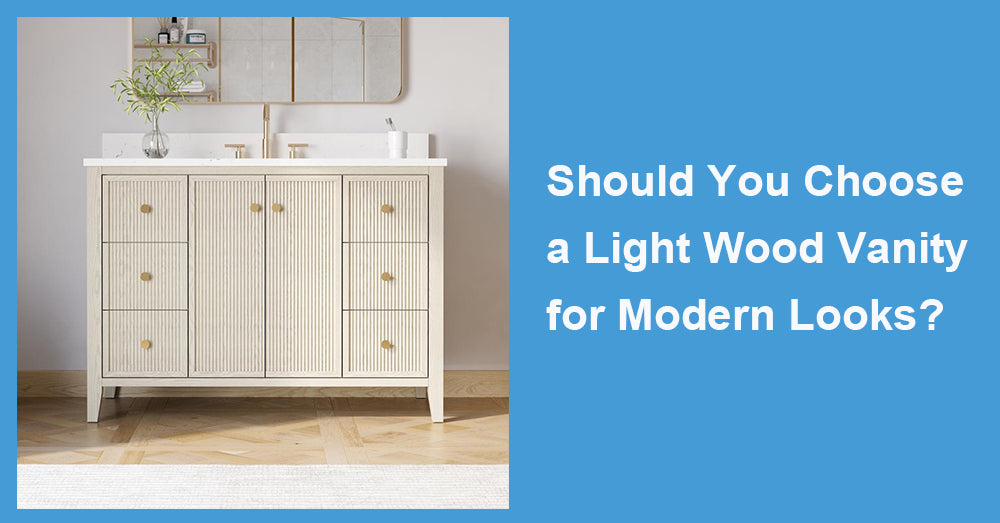
A light wood vanity is one of the strongest choices for creating a modern bathroom that feels warm rather than clinical. Pale oak, maple, and similar finishes soften the hard surfaces typically found around tile, stone, mirrors, and metal fixtures, while still supporting the clean lines associated with contemporary interiors. Recent remodeling data reinforces the direction: wood tones lead vanity colors at 28%, with lighter wood tones representing 11% of all upgraded vanities. Solid wood is also selected for 74% of upgraded vanities, showing that visible grain has become a substantial part of current bathroom design rather than a short-lived decorative trend.
1. Light Wood Fits the Shift Toward Warmer Modern Bathrooms
Modern bathrooms are becoming less dependent on stark white cabinetry and high-contrast black-and-white palettes. Instead, designers are combining simplified forms with natural textures, softer neutrals, and materials that make the space feel more residential.
The National Kitchen & Bath Association’s 2026 Bath Trends Report found that 96% of surveyed professionals expect neutrals to remain the leading bathroom color direction. Off-white received 58% support, while light brown and tan reached 54%. Organic and natural design was identified by 65% of respondents, while contemporary, modern, and minimalist styles were each identified by 57%.
A pale oak vanity fits comfortably at the intersection of those trends. It has enough natural variation to keep a room from looking flat, yet its lighter coloring works with the restrained palette expected from modern design.
Industry judgment: modern bathrooms are moving toward warmth without giving up visual simplicity, which makes light wood particularly well positioned.
2. White Oak Is One of the Most Versatile Choices
White oak has become especially relevant because its grain is visible without appearing overly rustic. Houzz reports that white oak accounts for 23% of upgraded solid-wood vanities, second only to maple at 29%. Birch follows at 12%, while walnut represents 9%.
For a modern bathroom, straight or relatively consistent grain generally produces the cleanest result. Flat-panel cabinet fronts can emphasize this effect by reducing decorative breaks across the vanity.
White oak pairs naturally with warm white quartz, soft gray stone, beige porcelain, brushed nickel, satin brass, and matte black. It also adapts well when surrounding finishes change later.
Maple can produce an even cleaner appearance because the grain is quieter. It works particularly well in smaller bathrooms where visual simplicity is more important than creating a strong furniture statement.
Industry judgment: white oak offers the stronger balance between natural character and contemporary restraint, while maple suits projects that prioritize maximum visual calm.
3. Light Wood Can Make Compact Bathrooms Feel Less Heavy
Cabinet color does not physically increase the size of a bathroom, but it can influence visual weight. A large espresso or black vanity can create a strong horizontal block, especially when the room has limited daylight. A pale wood finish generally feels lighter against white or neutral walls.
Size still matters more than color alone. Houzz reports that 47% of upgraded vanities measure 48 inches or less. Another 19% are 60 inches wide, 14% measure 72 inches, and 13% are larger.
A 30- or 36-inch light wood vanity can work well in a guest bathroom, while a 48-inch model provides additional counter and drawer space without necessarily dominating the room. Regarding larger primary bathrooms, 60- and 72-inch designs allow natural wood to become a substantial architectural feature.
Floating construction can make the effect even lighter by exposing more flooring beneath the cabinet. Floating models account for 11% of renovated vanity installations, compared with 30% for freestanding models and 58% for built-ins.
Industry judgment: in compact rooms, the best modern vanity is usually one that controls visual mass rather than simply maximizing cabinet width.
4. Flat-Panel Doors Strengthen the Modern Look
The cabinet door style can change how a light wood finish is perceived. Detailed molding can push pale oak toward traditional or farmhouse territory, while a flat-panel front immediately creates a cleaner architectural appearance.
Flat-panel doors are selected for 26% of upgraded vanities, while Shaker fronts remain the leading option at 49%. Raised-panel doors account for 15%, and reeded or fluted fronts remain a smaller 3% category.
That does not mean Shaker cabinetry cannot look modern. A slim-profile Shaker door in natural oak, paired with minimal hardware and a simple countertop, can create a transitional-modern result. Flat panels, however, allow the grain itself to become the decorative feature.
Handle-free fronts or small linear pulls can further reduce visual interruption.
Industry judgment: when natural grain is attractive enough to carry the design, additional cabinet ornament is usually unnecessary.
5. Pair Light Wood With a Quiet Countertop
The countertop strongly affects whether a light wood vanity looks sophisticated or overly busy. Current renovation data shows that white remains the leading countertop color at 48%, followed by off-white at 20%. Engineered quartz is selected by 45% of renovators, ahead of quartzite at 20%, granite at 14%, and marble at 13%.
Those preferences work well with pale wood. A white or warm-white quartz top creates enough contrast to define the cabinet without breaking the light overall palette.
For a 30- or 36-inch vanity, restrained veining often looks cleaner than large dramatic stone patterns. A 48- or 60-inch surface can accommodate more visible movement because there is enough countertop area for the pattern to develop.
An undermount sink helps maintain a continuous countertop line, while an integrated basin can create an even more minimal appearance.
Industry judgment: modern vanity design increasingly depends on controlled material contrast rather than dramatic pattern competition.

6. Neutral Walls Let the Wood Grain Do More Work
A light wood vanity does not require an all-white bathroom. In fact, combining natural oak with warm off-white, sand, light taupe, muted sage, or soft beige can create a more layered contemporary interior.
NKBA research shows strong interest in sage, supported by 64% of respondents, and olive at 43%. These colors work particularly well with warm wood because they reference natural materials without producing excessive contrast.
Large-format flooring can also reinforce the cleaner appearance. NKBA found that 80% of respondents expect large-format flooring to remain popular, while 89% anticipate preferences for smaller or fewer grout lines.
The result is a quieter background that allows the vanity grain to provide texture.
Industry judgment: a successful modern bathroom does not eliminate texture; it controls where texture appears.
7. Modern Style Still Needs Practical Storage
A vanity should not be selected solely because the finish photographs well. Drawer layout, plumbing clearance, cabinet depth, and daily storage all affect long-term satisfaction.
A 36- or 48-inch vanity can often support a combination of drawers and enclosed sink storage. Larger 60- or 72-inch models may provide dedicated sections for two users.
Before ordering, buyers should check whether plumbing interferes with full-depth drawers and whether internal dividers can be removed or adjusted. Soft-close hardware, full-extension drawers, and sealed cabinet interiors can make a visually simple vanity considerably more functional.
This emphasis on practical design aligns with broader bath trends. NKBA reports that 91% of respondents consider durability and low upkeep the leading consideration for flooring choices, illustrating how strongly maintenance now influences design decisions across the bathroom.
Industry judgment: modern design has moved beyond minimal appearance alone; products now need to look simple while performing more functions behind the surface.
8. Hardware Can Shift the Vanity From Soft to Architectural
Light wood provides a neutral base for several hardware directions. Matte black creates sharper contrast, while brushed nickel keeps the palette quiet. Satin or brushed brass adds warmth without making the cabinet feel traditional.
NKBA’s latest research shows that matte faucet finishes received 54% support, brushed finishes 51%, and satin finishes 46%, all ahead of polished finishes at 39%.
For a cleaner modern look, repeat the same metal family on the faucet, vanity pulls, mirror frame, or nearby lighting. Exact matching is not always necessary, but too many competing finishes can weaken the visual structure.
Small hardware works particularly well when the wood grain is already expressive. On a 60- or 72-inch vanity, longer linear pulls can reinforce the cabinet’s horizontal proportions.
Industry judgment: hardware should frame a light wood vanity rather than become its main decorative event.
9. Efficiency Can Be Part of the Modern Specification
A contemporary bathroom should perform as efficiently as it looks. Pairing the vanity with a WaterSense-labeled faucet adds a measurable functional benefit.
EPA states that WaterSense-labeled bathroom sink faucets use no more than 1.5 gallons per minute and can reduce water flow by 30% or more compared with the standard 2.2-gallon-per-minute rate without sacrificing performance.
Before selecting the faucet, confirm whether the vanity top is drilled for a single-hole, 4-inch centerset, or 8-inch widespread configuration. Spout reach should also align with the basin so water lands comfortably near the center rather than striking the back edge.
Industry judgment: efficiency is most convincing in modern design when it is integrated quietly into everyday function instead of treated as an added feature.
10. Conclusion
A light wood vanity is a strong choice for modern looks because it combines clean visual lines with the warmth that many contemporary bathrooms now need. White oak offers one of the most versatile combinations of grain, color, and long-term styling flexibility, while maple provides an even quieter option for minimalist interiors.
The strongest results come from treating the vanity as part of a complete material plan. Choose a width that suits the room, keep the countertop relatively restrained, pair the cabinet with warm neutrals or muted natural colors, and use hardware to establish rather than overpower the design.
A 30- or 36-inch light wood vanity can bring openness to a compact bathroom, while 48-, 60-, and 72-inch models can turn natural grain into a larger architectural statement. In either case, storage quality and moisture-resistant construction should carry as much weight as appearance.
Light wood is no longer simply an alternative to painted cabinetry. Current design data suggests that natural finishes are becoming increasingly compatible with modern, organic, and timeless interiors. For remodeling projects that need to feel current today without becoming difficult to update tomorrow, that flexibility makes a light wood vanity a particularly sensible choice.









































Leave a comment
This site is protected by hCaptcha and the hCaptcha Privacy Policy and Terms of Service apply.