






















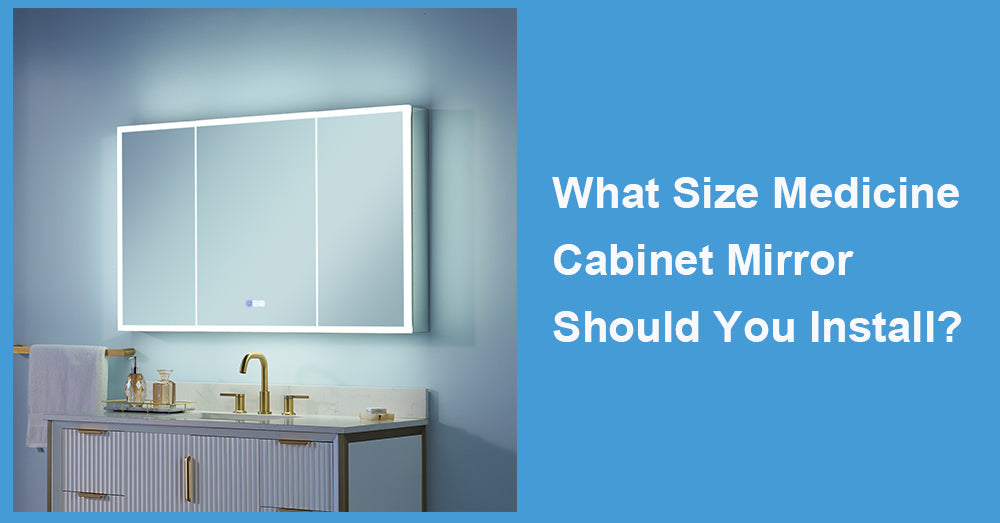
In bathroom renovation or new construction projects, the size selection of medicine cabinet mirror often determines the final user experience earlier than the appearance style and functional configuration. Once the mirror cabinet is installed, its height, width, and depth will be repeatedly perceived during daily washing, care, and organization processes. Industry research shows that dissatisfaction feedback related to mirror cabinets is far more common than feedback on material or functional issues, indicating that "size planning" is the most easily overlooked but crucial step in mirror cabinet selection.
1. Size planning should start from the sink, not from the wall
The size of the mirror cabinet is not an isolated parameter; it must maintain a clear proportional relationship with the washbasin. The standard width of the washbasin is usually 30-48 inches, which is the primary basis for selecting the width of the mirror cabinet.
Industry experience shows that if the width of a mirror cabinet is close to or slightly smaller than the width of a washbasin, the overall visual balance is most balanced. This ratio not only looks more coordinated but also aligns with most people's intuitive usage. A mirror cabinet that is too narrow will reduce the mirror's field of view. At the same time, one that is noticeably wider than the tabletop can visually appear abrupt and even affect the surrounding flow.
2. Reasonable range of common mirror cabinet width
In practical projects, a single-person washbasin is usually paired with a 24-36-inch mirror cabinet; medium-sized washbasins are often paired with 30-40-inch mirror cabinets; a countertop close to 48 inches is more suitable for a 42-48-inch mirror cabinet.
Industry data show that when the mirror cabinet width covers the main operating area of the washbasin, users' satisfaction with daily organization and care is significantly higher. This improvement is not due to the mirror cabinet being "bigger", but rather to the matching of the visible range and operating area.
3. The height determines the upper limit of comfort for the mirror cabinet
The height of the mirror cabinet is another dimension that significantly affects the user experience. Most mature designs control the overall height of the mirror cabinet to 26-32 inches, covering the visual height of most users and providing sufficient space for internal storage.
If the height of the mirror cabinet is insufficient, users are prone to incomplete vision when looking up or down; if it is too high, it will increase the inconvenience of picking up and placing items, and the efficiency of using the upper partition will significantly decrease. Industry experience shows that high imbalance is one of the main reasons why mirror cabinets look suitable but feel awkward to use.
4. The installation height and mirror cabinet size must be considered simultaneously
The size of the mirror cabinet cannot be discussed without reference to the installation height. Even if a mirror cabinet of appropriate height is selected, if the overall installation position is too high or too low, it will still affect the user experience.
Usually, the bottom of the mirror cabinet should be a certain distance above the countertop of the washbasin to avoid direct contact with water vapor and splashes. At the same time, the central area of the mirror cabinet should cover as much of the main users' line-of-sight height range as possible. For multi-member families, slightly increasing the overall height of the mirror cabinet often makes it easier to accommodate different height requirements.
5. Although the depth may not be noticeable, it is incredibly crucial
Compared to width and height, the depth of the mirror cabinet is more easily overlooked, but its impact on spatial perception is straightforward. Industry data shows that when the depth of the mirror cabinet exceeds a specific range, users are more likely to feel pressured while washing, especially in small and medium-sized bathrooms.
Most mature designs control the depth of the mirror cabinet to 5-6 inches, which can meet the storage needs of most daily toiletries and care tools without significantly occupying space. For bathrooms with more compact spaces, further controlling the depth can improve overall comfort.
6. Different size requirements for single basin and double basin
In a dual-washing-station layout, the logic for selecting the mirror cabinet size may vary. A common practice is to use a large-sized mirror cabinet with a width covering two basin areas; Another approach is to equip each basin with an independent mirror cabinet.
Industry experience shows that integrated mirror cabinets are visually more uniform but require higher installation accuracy and lighting coordination; independent mirror cabinets are more flexible in use and allow easier size selection to meet individual needs. Regardless of the chosen method, the core principle remains that the width of the mirror cabinet should cover the main operating area of the corresponding basin.
7. The influence of embedded and wall-mounted on size perception
The installation method of mirror cabinets can also affect people's subjective perception of size. Embedded mirror cabinets often appear thinner and lighter, even when their actual size remains the same, because they are flush with the wall. This allows embedded mirror cabinets to obtain larger internal space without increasing the sense of pressure, if conditions permit.
Wall-mounted mirror cabinets require more careful control of size, mainly depth and frame proportions, or they may visually appear bulky.
8. Balance between size and internal structure
The value of the mirror cabinet's size is reflected not only in its external proportions but also in the usability of its internal structure. A reasonable size should support an efficient internal compartment layout, rather than creating a large amount of space that appears to exist but is challenging to use.
Industry research shows that under the exact external dimensions, a mirror cabinet with a well-designed internal structure achieves significantly higher practical storage efficiency. This also indicates that size selection should be considered synchronously with internal planning.
9. Derive the rationality of size from the long-term usage cycle
Mirror cabinets are usually fixed components with low replacement frequency, and once installed, their size will have a long-term impact on the user experience. Industry data shows that high-quality, reasonably sized mirror cabinets can often provide stable service for more than 10 years under normal usage conditions.
Therefore, instead of pursuing "just enough to fit" in size, it is better to reserve a moderate margin to adapt to changes in future usage habits.

10. Conclusion on Size Selection from an Industry Perspective
From an industry perspective, there is no universal standard answer for the size selection of medicine cabinet mirrors, but it always follows several core logics:
Based on the washbasin, not the wall;
Strike a balance between width, height, and depth;
Make a comprehensive judgment based on the installation method and user group.
The truly suitable size is often not selected from a parameter table but rather a natural result of understanding space, usage habits, and long-term needs. This planning-based size selection is one of the most valuable long-term decisions in a bathroom renovation.









































Leave a comment
This site is protected by hCaptcha and the hCaptcha Privacy Policy and Terms of Service apply.