






















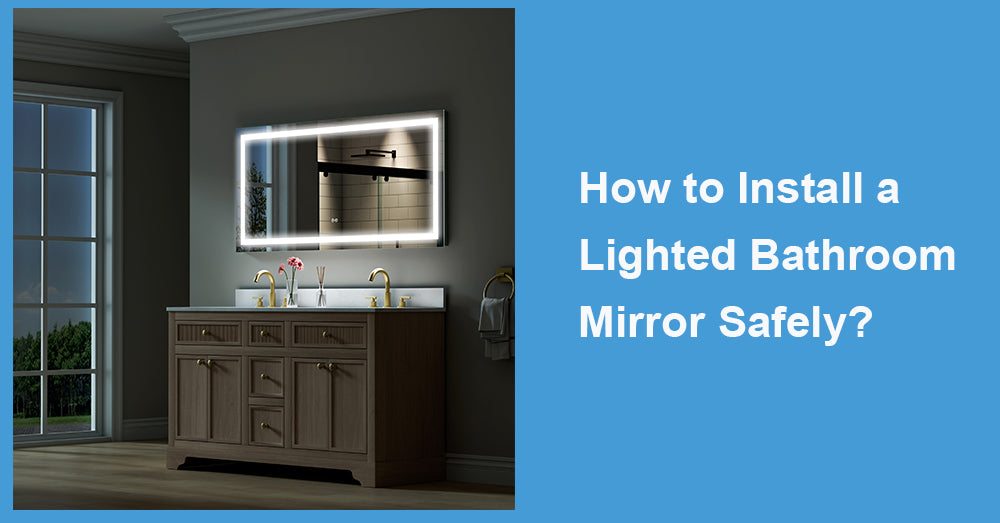
In the process of bathroom renovation or functional upgrade, lighted bathroom mirror are gradually becoming one of the most common configurations. Compared to ordinary mirrors, lighted bathroom mirrors integrate multiple factors, including lighting, electrical, and structural installations, and their installation safety is directly related to the stability and reliability of long-term use. Industry research shows that most electrical issues in bathrooms stem from inadequate planning in the early stages, rather than from the product's quality. Therefore, the proper and safe installation of lighted bathroom mirrors is a professional task that requires careful consideration.
1. Safety planning before installation is more important than the construction itself
In practical operations, many installation risks do not occur during installation but stem from inadequate preliminary planning. Bathroom mirrors with lights are classified as fixed electrical equipment, and it is essential to ascertain the dimensions, weight, power requirements, and wall structure conditions of the mirror before installation.
Industry experience indicates that temporary adjustments to lines in the absence of precise power supply planning are often the primary source of future hidden dangers. Therefore, before installation, it is essential to confirm whether a stable power supply is available and whether the power supply location is at a reasonable height, avoiding direct contact with water sources or high-humidity areas.
2. Evaluation of wall structure and load-bearing capacity
Bathroom mirrors with lights are typically heavier than regular mirrors, as they contain internal circuit components and metal structures. Before installation, confirm whether the wall is solid or a lightweight partition. For lightweight partitions, relying solely on surface fixings often fails to provide long-term stability.
Industry data indicates that bathroom mirrors that are not properly fastened to load-bearing structures are more prone to loosening or even falling off over time. Therefore, during installation, priority should be given to securing the mirror to a wall stud or a solid structure, and appropriate fasteners should be selected based on the mirror's weight.
3. Reasonably determine the installation height and location
The installation height of a bathroom mirror with a light not only affects the comfort of use but also impacts the lighting effect and safety. Generally, the bottom of the mirror should be a certain distance above the countertop of the washbasin to prevent moisture and splashes from directly affecting the mirror surface and electrical components.
From a usage perspective, the central area of the mirror should align with the primary user's eye level. Industry experience indicates that, in multi-member households, appropriately raising the overall height of the mirror can accommodate users of different heights.
4. Safety principles for electrical connections
The core risks of bathroom mirrors with lights are primarily concentrated in the electrical connection process. The bathroom is a highly humid environment, which demands higher standards for the sealing and protection of the electrical system. All wire connections should be located on the back of the mirror or inside the wall to avoid exposure.
During installation, ensure the power supply is completely disconnected and use connection methods that comply with the specifications. Industry research indicates that improper connection methods or neglecting grounding treatment are significant factors leading to subsequent failures.
5. The practical significance of moisture-proof and waterproof design
Even if the bathroom mirror with light has a certain level of protective design, improper installation can still compromise its moisture resistance. For instance, if there is a noticeable gap between the back of the mirror and the wall, moisture can easily accumulate, affecting the lifespan of the internal components.
Therefore, after installation, it is essential to check whether the mirror body is firmly attached to the wall. If necessary, appropriate sealing measures should be taken to reduce the risk of moisture infiltration. This detail is particularly crucial during long-term use.
6. Lighting testing and functional verification cannot be omitted
After completing the installation, power-on testing is an indispensable step. It is necessary to check whether the lighting is uniform, whether the switch or touch function responds normally, and whether there are any abnormal flickering or delays.
Industry experience shows that conducting a comprehensive functional test immediately after installation can identify potential issues early on, thus avoiding rework after the walls are completely enclosed or decoration is finished.
7. Safety inspection for anti-fog and additional functions
Many bathroom mirrors with lights incorporate anti-fog or sensor functions, and these systems typically rely on back heating or sensing modules. After installation, confirm that these functions do not cause abnormal temperature increases or unstable reactions under normal operating conditions.
From a safety perspective, all additional functions should operate without affecting the core lighting and electrical stability.
8. The impact of the installation method on long-term maintenance
A reasonable installation method not only affects safety but also relates to the convenience of later maintenance. If the back of the mirror is completely sealed, maintenance costs will increase significantly once repairs are needed. The industry recommends reserving sufficient space for potential maintenance while ensuring safety and aesthetics.
This kind of early planning often demonstrates its value years later.
9. The trade-off between professional installation and self-installation
For some users, installing a bathroom mirror with lights on their own holds certain appeal. However, industry data indicates that for bathroom equipment involving electrical connections, it is more controllable to have experienced professionals complete the installation, as the overall risk is more manageable.
In the overall bathroom renovation project, incorporating the installation of illuminated bathroom mirrors into the professional construction scope is usually more conducive to system safety and long-term stability.

10. View installation safety from a long-term use perspective
Bathroom mirrors with lights are fixed configurations with a low replacement frequency. Once installed, their safety will remain consistent throughout the entire usage cycle. Industry research indicates that the impact of installation quality on equipment lifespan is often comparable to that of the product's inherent quality.
From an industry perspective, the core of safely installing a lighted bathroom mirror lies not in construction speed but in the completeness of preliminary planning, structural judgment, and detail execution. Only by making sufficient preparations in these aspects can the lighted bathroom mirror truly fulfill its function and value in long-term use.









































Leave a comment
This site is protected by hCaptcha and the hCaptcha Privacy Policy and Terms of Service apply.