






















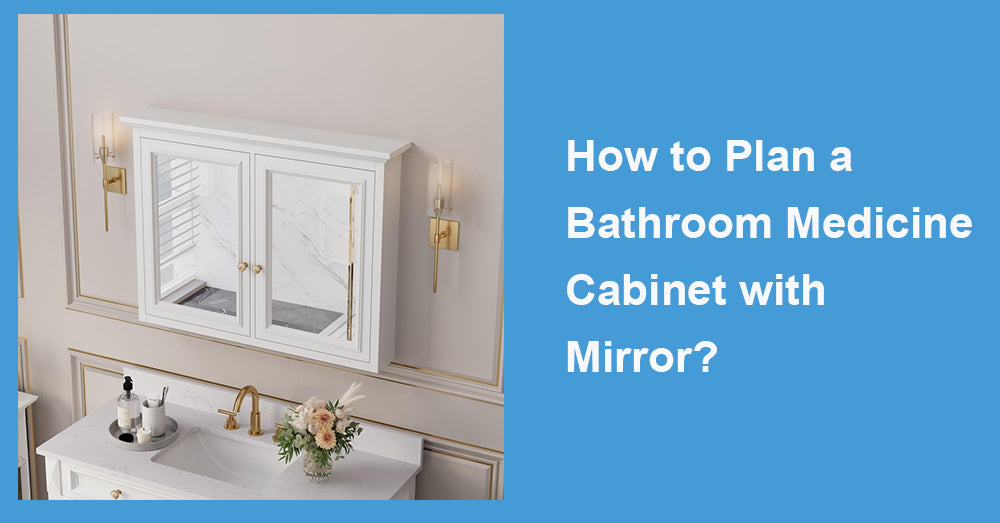
In bathroom renovation or new construction projects, the bathroom medicine cabinet with mirror is often considered a component to be decided later. However, from an industry perspective, it is precisely one of the core elements that requires planning. The mirror cabinet not only serves the dual function of providing a mirror surface and storage space, but also directly affects the wall structure, electrical layout, daily usage efficiency, and long-term maintenance costs. Industry research shows that in bathroom cases where the user experience is unsatisfactory, inadequate planning for the mirror cabinet is one of the most common and easily overlooked issues.
1. Mirror cabinet planning should precede style and brand selection
Many planning mistakes stem from the fact that mirror cabinets are considered only after the walls have been completed, and the countertop dimensions have been set. This sequence often leads to limited dimensions, compromised functionality, and even affects the overall proportion. Industry experience shows that mirror cabinet planning should be at least on par with the washbasin, wall structure, and lighting scheme, rather than treated as an independent decorative accessory.
Clarifying the installation form, size range, and functional requirements of the mirror cabinet during the early planning stage can significantly reduce the cost of adjustments later.
2. Derive the proportion of the mirror cabinet from the size of the washbasin
The first step in planning a mirror cabinet is to determine the width of the washbasin. Common washbasin widths typically range from 30 to 48 inches. If the width of the matching mirror cabinet is close to or slightly narrower than the countertop width, the overall visual effect will be more stable and better aligned with the flow of use.
In terms of height, the mirror cabinet is mostly between 26 and 32 inches. This range can cover most users' line of sight while providing ample internal storage. When planning, it is essential to note that reasonable margins should be reserved for lighting fixtures, wall decorations, or ventilation facilities in the upper and lower spaces, to avoid the mirror cabinet appearing to "fill the entire wall from top to bottom.
3. Depth control is the key to comfort
In mirror cabinet planning, depth is often more easily overlooked compared to width and height, yet its impact on the user experience is straightforward. Industry data shows that when the depth of a mirror cabinet exceeds a specific range, users are more likely to feel cramped during grooming, especially in small and medium-sized bathrooms.
Most mature designs keep the depth of the mirror cabinet within 5–6 inches, which can still meet the storage needs for daily toiletries and grooming tools without significantly occupying space. For bathrooms with limited space, further reducing the depth is actually more beneficial to the overall experience.
4. Whether it is embedded or wall-mounted, the structure needs to be determined first
The installation method for the mirror cabinet is closely tied to the wall structure and the construction phase. The embedded mirror cabinet achieves a flush appearance with the wall by being embedded into the wall, offering significant advantages in visual appeal and space utilization. However, this method requires higher standards for wall thickness, internal pipeline positioning, and construction, often necessitating planning at the early stages of renovation.
Wall-mounted mirror cabinets offer greater installation flexibility, making them suitable for projects with limited structural conditions or local upgrades. When planning wall-mounted mirror cabinets, special attention should be paid to the frame proportions and overall thickness to avoid a visually bulky appearance.
5. The internal structure should be designed around usage habits
The planning of mirror cabinets should not only focus on "how much can be stored", but more importantly, on "how to store more efficiently". Industry research shows that a well-designed internal compartment often enhances the user experience more than simply increasing spatial capacity.
Adjustable shelves are a crucial element in the design of sophisticated mirror cabinets, as they enable flexible layout adjustments for items of varying heights, thereby reducing space waste. During the planning phase, it is advisable to consider family members' usage habits in advance, such as whether electric care equipment is frequently used and whether taller bottles need to be accommodated.
6. The mirror surface and lighting should be considered as a system
When planning a bathroom medicine cabinet with a mirror, the quality of the mirror and the lighting configuration are inseparable. A high-quality mirror can reflect light accurately, reduce visual distortion, and create a more natural, stable lighting effect. Multi-layer silvered mirrors perform more reliably in high-humidity environments and are less prone to aesthetic issues.
In terms of lighting, mirror cabinets with integrated LED light sources are becoming a mainstream choice. A reasonable lighting layout can reduce facial shadows and improve the accuracy of daily care and tidying. The color temperature is usually in the range of 4000K–5000K, which is closer to natural light and contributes to long-term comfort.
7. Electrical and safety planning cannot be postponed
With the continuous integration of mirror cabinet functions, the importance of electrical planning has become increasingly prominent. Features such as built-in sockets, defogging systems, and sensor lighting all require a stable power supply. In a high-humidity environment like the bathroom, the moisture-proof and sealing design of the electrical structure is directly related to long-term safety.
Industry experience demonstrates that completing power supply reservations and line planning during the initial phase of renovation is significantly safer than making repairs later and is also more conducive to maintaining overall cleanliness and appearance.
8. Infer the rationality of planning based on the long-term usage cycle
Mirrored cabinets are typically fixed components with low replacement frequency, and once installed, the cost of adjustment is relatively high. Industry data shows that high-quality mirrored cabinets can often last for more than ten years under normal usage conditions. Therefore, in the planning stage, the goal should be long-term use rather than short-term visual effects.
Only by integrating dimensional proportions, structural forms, internal layouts, and functional configurations into the planning framework can frequent compromises in the later stages be avoided.

9. Summary of planning logic from an industry perspective
From an industry perspective, the success of a bathroom medicine cabinet with a mirror design does not lie in the superposition of functions or a complex appearance, but in a precise understanding of spatial conditions, usage habits, and structural constraints. A truly mature bathroom solution often manifests in seemingly basic details that depend heavily on early planning.
In the bathroom renovation, the mirror cabinet should not be the last component considered, but rather one of the key nodes to include in the planning list from the very beginning.









































Leave a comment
This site is protected by hCaptcha and the hCaptcha Privacy Policy and Terms of Service apply.