






















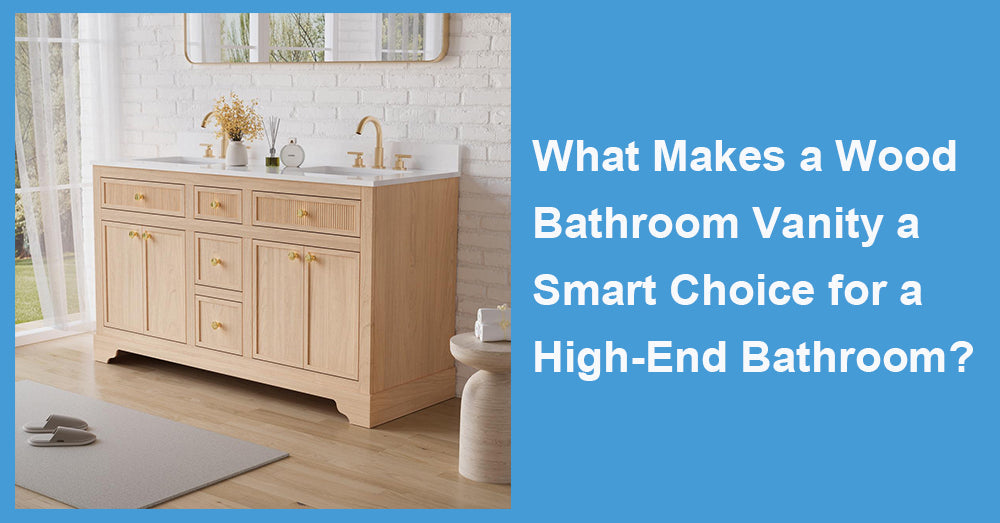
A wood bathroom vanity earns its “high-end” status when it delivers two things at once: a richer, more natural visual presence and the kind of durability that still feels solid years later. The secret is not simply “wood vs. not wood.” Long-term satisfaction comes from choosing the right wood species, construction method, finish system, countertop pairing, and installation details—especially in a room that regularly swings between dry and steamy. This article breaks down what actually makes a wood vanity a smart investment for a luxury bathroom, using measurable references and practical decision points.
1. Wood Looks High-End Because It Adds Depth, Not Just Color
Luxury bathrooms often feel expensive when surfaces have “layered depth”—subtle grain variation, warm undertones, and a sense that materials are authentic rather than printed or coated to mimic something else. Solid wood and high-quality wood veneers naturally deliver that visual complexity. Unlike flat-painted panels, real grain catches light differently throughout the day, which makes the vanity feel more “architectural” and less like a cabinet box.
There’s also a value argument: bathroom upgrades consistently rank as meaningful remodeling investments. The 2025 Cost vs. Value Report shows a “Bath Remodel | Universal Design” recouping 61% of cost on average (Source: JLC, 2025 Cost vs. Value Report). While ROI varies widely by scope and local conditions, it supports a practical takeaway: a thoughtfully selected vanity is not just décor—it’s part of a remodel category that often retains meaningful value.
2. Durability Starts With Species: Why Hardness and Density Matter
A vanity takes daily wear: drawers sliding, doors closing, accidental impacts from hair tools, and constant cleaning. One useful comparative metric is the Janka hardness rating, which measures the force required to embed a steel ball into wood (Source: PreciseBits Janka reference explaining the test method). Harder woods tend to resist dents and surface damage better.
Common domestic hardwood benchmarks include:
· Hard Maple: 1,450 lbf (Source: Bruce Hardwood Janka rating overview)
· White Oak: 1,360 lbf (Source: Bruce Hardwood Janka rating overview)
· Red Oak: 1,290 lbf (Source: Bruce Hardwood Janka rating overview)
These numbers don’t guarantee perfection, but they help you compare species in a practical way. In high-use bathrooms—kids, frequent guests, or daily heavy routines—choosing a harder species (or a construction that protects high-wear areas) can meaningfully reduce long-term cosmetic damage.
Smart buyer move: ask what the face frames, doors, and drawer fronts are made of—not just the “vanity is wood” marketing line.
3. High-End Wood Vanities Succeed When They Respect Humidity Physics
Bathrooms create moisture swings that wood must survive. Wood expands and contracts as moisture content changes—this is normal and predictable.
Furniture engineering guidance notes that wood shrinks and swells the most in the tangential direction, about half as much in the radial direction, and only about 0.1%–0.2% longitudinally (Source: Purdue Extension FNR-163, “The Shrinking and Swelling of Wood and Its Effect on Furniture”). This is why well-made vanities use construction strategies that allow movement without splitting or warping.
Humidity targets matter, too. Many indoor air quality references recommend maintaining indoor relative humidity ideally between 30% and 60% (Source: EPA Indoor Air Quality Tools for Schools Reference Guide, PDF). Bathrooms routinely spike above that range during showers; the goal is to return to a stable baseline via ventilation.
What “high-end construction” looks like in real life
· Doors designed to stay stable (quality joinery, solid frames, and panels that can move)
· Drawer boxes that remain square under humidity changes
· Back panels and mounting rails are built to resist racking
· Finishes are designed as moisture barriers, not just color
4. Construction Quality: Solid Wood vs. Veneer vs. Engineered Panels (The Truth)
A luxury vanity isn’t automatically “solid wood everywhere.” In fact, many premium cabinetmakers use a smart mix:
· Solid hardwood for door frames and drawer fronts (beautiful and strong)
· Wood veneer over stable cores for large flat panels (helps reduce warping and cracking)
· High-grade plywood in cabinet boxes for strength and screw-holding power
The key is stability and joinery, not a simplistic materials checklist. A vanity that uses stable cores correctly can outperform a poorly designed “all solid wood” cabinet that moves unpredictably in a humid room.
What to ask (and what it signals)
· Is the cabinet box plywood or particleboard? (Plywood often holds fasteners better and resists edge blowout.)
· Are drawers dovetailed, doweled, or stapled? (Stronger joinery tends to survive years of use.)
· Are the doors solid wood frames with a floating panel? (This is a classic movement-friendly design.)
5. Finish System: The Real Difference Between “Looks Great Now” and “Looks Great in 5 Years”
In a bathroom, the finish is your first defense line. Even beautiful wood can fail early if the finish absorbs moisture or breaks down under cleaning chemicals.
A high-end finish choice typically has:
· Better water and stain resistance
· Better adhesion and flexibility
· Better repairability (small touch-ups without redoing everything)
Practical durability tips
· Prefer finishes that are designed for wet environments and include clear maintenance guidance.
· Avoid harsh abrasives; frequent gentle cleaning preserves the finish film and slows dulling.
· Wipe standing water around sink edges—repeated pooling is a finish killer, no matter how premium the cabinet is.
Luxury isn’t only the finish sheen; it’s how the finish behaves after hundreds of cleanings and thousands of door cycles.
6. Storage and Function: A High-End Vanity Should Make the Bathroom Feel Calmer
The most expensive-looking bathrooms often look that way because surfaces are uncluttered. The vanity is the main tool for that.
High-end functional features that matter
· Full-extension, soft-close drawer slides (reduce slamming wear and improve access)
· Deep drawers for bottles and hair tools
· Drawer organizers that prevent “everything pile” clutter
· Moisture-tolerant interior coatings (so the inside doesn’t degrade)
These aren’t gimmicks. They solve a visible luxury problem: keeping counters clean and the room feeling composed.
7. Pairing With Countertops: Wood Works Best With Smart Water Management
Where do vanities fail first? Commonly around the sink cutout and countertop seam—where water sits, seeps, and attacks the finish and substrate.
Better long-term pairings
· Countertops and sinks that minimize standing water at seams
· Faucets and aerators that reduce splashing
· Backsplashes that protect the wood from repetitive spray
A well-chosen countertop and sink configuration protects the vanity and keeps the wood looking refined instead of stressed.
8. The “High-End Wood Vanity” Checklist (Copy-Friendly)
Use this short checklist before buying:
Material and durability
· Wood species suitable for daily wear; compare hardness benchmarks like Hard Maple (1,450 lbf), White Oak (1,360 lbf), Red Oak (1,290 lbf) (Source: Bruce Hardwood Janka rating overview).
· Clear documentation on what is solid wood, veneer vs. plywood.
Construction
· Doors built to tolerate movement (solid frame + floating panel is a strong sign).
· Drawer joinery and slides are designed for heavy daily use.
· A cabinet box that holds fasteners well and resists racking (often quality plywood).
Moisture strategy
· Finish system designed for wet environments and easy maintenance.
· Bathroom ventilation habits that push humidity back toward 30%–60% RH baseline (Source: EPA IAQ Tools for Schools Reference Guide, PDF).
· Understanding that wood movement is normal, smart design accommodates it (Source: Purdue Extension FNR-163).
Value logic
· Vanity selection aligned with bathroom upgrade value reality; bathroom remodeling categories can retain meaningful value (Source: JLC, 2025 Cost vs. Value Report).

Closing Thoughts
A wood bathroom vanity is a smart high-end choice when it’s chosen like a long-term fixture—not like a decorative cabinet. The best results come from matching wood species to real wear, selecting construction that respects wood movement, choosing a finish system that stands up to moisture and cleaning, and building storage that reduces visible clutter. When all of that is done well, wood doesn’t just look luxurious on day one—it stays elegant through years of daily use.









































Leave a comment
This site is protected by hCaptcha and the hCaptcha Privacy Policy and Terms of Service apply.