





















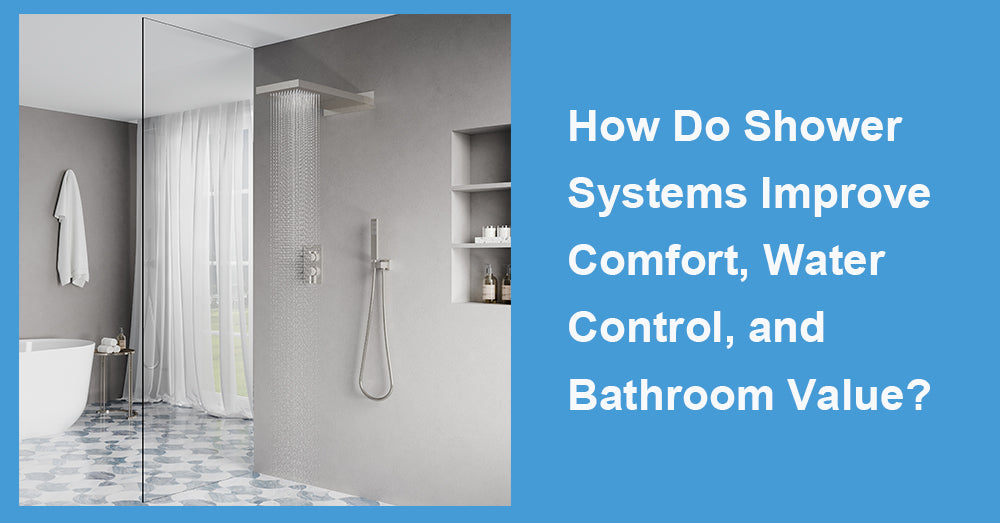
Modern shower systems do more than “upgrade the look.” When they’re specified correctly, they can make daily showers feel noticeably more comfortable, reduce temperature surprises, give you better control over where water goes, and support bathroom improvements that tend to retain meaningful value. The key is understanding what’s actually inside the wall (valves and plumbing logic), what’s happening at the showerhead (flow limits and spray performance), and how multiple outlets behave together.
1. Comfort Starts With Temperature Stability, Not Just More Spray Options
If you’ve ever had the water suddenly turn hot or cold when someone flushes a toilet or runs a sink, you’ve felt the biggest comfort gap between basic setups and well-designed shower systems. That’s why the most important “luxury” upgrade is often the valve type.
Pressure-balance vs. thermostatic control
Many higher-comfort systems use valves designed to automatically compensate for changes in hot/cold supply conditions to reduce scalding and thermal shock risk. ASSE 1016 is a widely referenced standard for “Automatic Compensating Valves for Individual Showers and Tub/Shower Combinations,” intended to control water temperature and reduce scalding and thermal shock risk (Source: Leonard Valve “ASSE Standards – Making Sense of It All” PDF; ASSE 1016 description).
In practical terms:
· Pressure-balance valves react to pressure changes (helpful when other fixtures run).
· Thermostatic valves target a set temperature more directly and can feel “calmer,” especially in longer showers or multi-outlet setups.
Why this matters for daily comfort
Scald prevention is not theoretical. Consumer safety guidance notes that setting water heaters around 120°F may be necessary to reduce the risk of most tap water scald injuries (Source: U.S. Consumer Product Safety Commission, “Avoiding Tap Water Scalds” PDF).
A properly chosen compensating valve plus sane temperature settings is how “high-end comfort” becomes consistent—not just occasional.
2. Water Control: Real Improvement Comes From Better Distribution and Better Rules
A shower system typically improves control in two ways:
1. How the water is mixed and managed (valve quality, diverters, and sometimes multiple control zones)
2. How the water is delivered (showerhead, hand shower, body sprays, rain head)
The flow reality you can’t ignore
There is a federal maximum water use for showerheads of 2.5 gallons per minute (gpm) at 80 psi (Source: eCFR, 10 CFR § 430.32).
That means comfort gains usually come from spray engineering and distribution, not unlimited volume.
WaterSense and performance (not just “less water”)
WaterSense-labeled showerheads must use no more than 2.0 gpm and are designed to deliver a satisfactory shower experience (Source: U.S. EPA WaterSense showerheads page; WaterSense specification PDF).
For many households, that difference matters at scale. An ICC technical article notes the 2.0 gpm WaterSense spec represents a 20% reduction vs. the 2.5 gpm federal standard and cites potential savings of more than 1,200 gallons per showerhead per year, plus about 370 kWh of electricity annually in associated energy terms (Source: ICC “Not just going with the flow…” article).
Even if you don’t choose WaterSense, the takeaway is important: “comfort” can be achieved with smart spray patterns and stable temperature control, not simply higher flow.
3. Why Multi-Function Shower Systems Feel Better (When Designed Correctly)
A well-designed shower system can improve comfort through:
· Coverage: larger pattern rain heads or multi-spray heads can reduce “needle-like” pressure points.
· Targeting: a hand shower improves rinsing, cleaning, and accessibility.
· Consistency: thermostatic control reduces constant handle adjustments.
However, multi-outlet setups can also disappoint if the plumbing is undersized or the valve/diverter logic isn’t thought through. “More outlets” is not the same as “more usable water.”
A practical planning rule
If you want multiple active outlets (for example, a rain head plus a hand shower), you need to confirm:
· the valve supports the intended outlet combinations,
· the plumbing line sizes and pressure can supply the total demand,
· and your local code requirements and product specs align.
If you don’t confirm those details, you can end up with a system that looks premium but feels weak when multiple functions run.
4. Everyday Function: Cleaning, Accessibility, and Less Bathroom Stress
Comfort is not only the shower experience—it’s also what makes the bathroom easier to live with.
Hand showers are a functional upgrade
They help with:
· rinsing hard-to-reach areas,
· cleaning the shower,
· bathing children or pets,
· and supporting limited mobility routines.
When paired with stable temperature control, a hand shower often delivers more real-world value than adding body sprays.
Temperature stability reduces “micro-annoyances”
If a shower forces constant re-adjustment, it feels tiring over time. Compensating valves designed to reduce scalding/thermal shock risk are built specifically to address those sudden changes (Source: ASSE 1016 preview PDF describing reduction of scalding and thermal shock risk).
5. Efficiency Without “Feeling Low-Flow”: What Actually Works
People often worry that efficiency means weaker showers. In reality, perceived performance depends on:
· nozzle design,
· spray pattern density,
· pressure compensation,
· and how evenly water hits the body.
WaterSense programs explicitly require satisfactory performance, not just lower flow (Source: EPA WaterSense showerheads page).
A simple way to protect comfort while improving efficiency:
· choose a well-reviewed showerhead with strong spray coverage metrics,
· keep temperature stable (thermostatic or pressure-balance),
· and focus on distribution (rain + hand shower used smartly) instead of trying to “beat” flow limits.
6. Bathroom Value: Why Shower Systems Can Support Resale Appeal
Bathrooms are high-visibility spaces in a home. Updates that make the bathroom feel clean, modern, and functional often rank among the remodeling categories that retain meaningful value.
The 2025 Cost vs. Value Report lists Bath Remodel | Universal Design with 61% cost recouped (Source: JLC “2025 Cost vs. Value Report”).
A shower system upgrade alone isn’t a full remodel, but it can contribute to the “finished” feel buyers notice: stable temperature control, clean trim, modern functionality, and an upgraded shower experience.
The most resale-friendly approach is avoiding overly niche choices (extreme body-spray arrays, unusual custom controls) and focusing on:
· proven safety and comfort features,
· timeless finishes,
· and easy-to-understand operation.
7. What to Look For Before You Buy
A. Valve standards and safety intent
Look for documentation that references compensating valve standards intended to reduce scalding and thermal shock risks (Source: ASSE 1016 descriptions and preview text).
B. Clear flow specs (and realistic expectations)
· Showerhead flow should align with the 2.5 gpm at 80 psi federal maximum (Source: 10 CFR § 430.32).
· If WaterSense-labeled, it should be ≤ 2.0 gpm (Source: EPA WaterSense; specification PDF).
C. Multi-outlet logic
Confirm whether the system allows:
· one outlet at a time,
· multiple outlets simultaneously,
· or staged use (common in higher-end diverter systems).
This one detail determines whether a “shower system” feels premium or frustrating.
D. Long-term serviceability
The best systems are the ones you can maintain:
· replacement cartridges available,
· clear parts diagrams,
· and reputable support.
A beautiful trim set is meaningless if you can’t service the valve later.
8. A Simple Decision Framework
If you want the most reliable improvement per dollar:
1. Upgrade temperature control first (pressure-balance or thermostatic compensating valve).
2. Choose a showerhead with proven spray performance, not just a large diameter.
3. Add a hand shower for real daily utility.
4. Only add extra outlets (rain head + body sprays) if you confirm plumbing capacity and control logic.

Closing Thought
Shower systems improve comfort when they stabilize temperature and deliver water more intelligently—not just “more water.” They improve control when the valve and diverter strategy match how you actually shower. And they can support bathroom value by making the space feel modern, safe, and effortless to use. Focus on the engineering behind the wall, verify flow and standards in the documentation, and you’ll get a shower that feels high-end every single day.



































Leave a comment
This site is protected by hCaptcha and the hCaptcha Privacy Policy and Terms of Service apply.