






















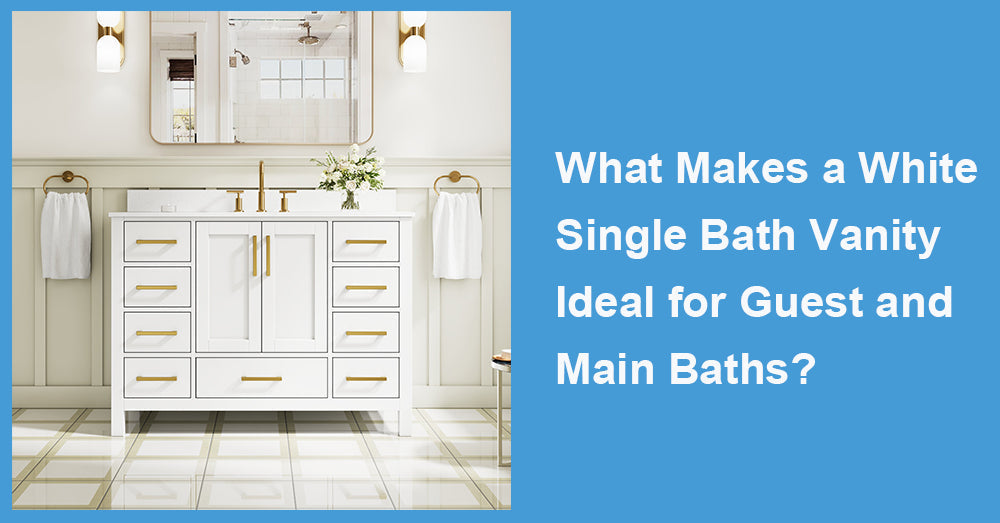
A white single bath vanity works unusually well in both guest bathrooms and main baths because it combines a familiar color, compact plumbing layout, and flexible storage without forcing the room into one design style. Current renovation data helps explain why this format remains relevant. Houzz's 2025 Bathroom Trends Study found that 47% of upgraded vanities measured 48 inches or less, while white accounted for 20% of upgraded vanity colors. At the same time, white remained the leading countertop color at 48%. For bathrooms that need one sink rather than two, a single vanity in the 30-inch to 48-inch range often provides enough counter space and storage without taking over the room.
One Sink Leaves More Room for Storage
The biggest advantage of a single vanity is straightforward: only one basin has to compete with the cabinet interior.
That leaves more room for:
· Full-width drawers
· Side drawer banks
· Adjustable shelves
· Hair-tool storage
· Cleaning supplies
· Extra towels
On a 36-inch or 48-inch cabinet, a single sink can leave significantly more usable storage than a double-sink layout of similar width.
This is especially valuable in guest bathrooms, where the vanity may also need to hold extra toilet paper, towels, and basic toiletries.
In a main bath used primarily by one person at a time, the same storage advantage can be more useful than adding a second basin.
White Makes Smaller Guest Baths Feel Less Crowded
Guest bathrooms are often narrower than main baths, so visual weight matters.
A dark cabinet can become the strongest object in a compact room. White tends to blend more easily with pale walls, light tile, and white or off-white countertops.
For this reason, a 30-inch or 36-inch white vanity can feel less bulky than the same cabinet in black, navy, or deep walnut.
The effect becomes stronger when the room also includes:
· Frameless shower glass
· A broad mirror
· Light flooring
· Warm white walls
· Minimal countertop accessories
The room does not become physically larger, but fewer high-contrast surfaces can make it feel calmer and more open.
A 36-Inch Vanity Is a Strong Middle Ground
For many guest and secondary bathrooms, 36 inches is one of the most practical widths.
It gives enough space for a comfortable single sink without requiring the wall length of a 48-inch cabinet. It also leaves more countertop room than a 24-inch or 30-inch vanity.
A well-planned 36-inch model can accommodate:
· One undermount sink
· A useful drawer bank
· A small counter area on both sides of the faucet
· Storage beneath the basin
· A mirror close to the cabinet width
Houzz's 2025 data showing that 47% of upgraded vanities remain at 48 inches or less supports the continued importance of these midsize formats.
They fit a wide range of renovation layouts rather than only very small bathrooms.
White Works With More Than One Style
White cabinetry remains useful because the door style, hardware, and countertop can completely change its character.
A white Shaker vanity works naturally in a transitional bathroom. Flat-panel doors can make the same color feel modern. Framed doors and furniture-style legs can move it toward a more traditional look.
NKBA's 2026 Bath Trends Report found transitional and timeless styling leading at 70%, followed by organic and natural design at 65% and contemporary, modern, and minimalist design at 57%.
A white cabinet can fit comfortably into all three.
That flexibility is particularly useful in guest baths, where the room often needs to coordinate with the rest of the home without becoming overly specialized.
White Countertops Keep the Combination Easy to Coordinate
A white vanity is easy to pair with a wide range of tops, but lighter surfaces remain especially common.
Houzz found white countertops in 48% of upgraded bathrooms, with off-white at another 20%. Engineered quartz led countertop materials at 45%, ahead of quartzite, granite, and marble.
For a single vanity, that creates several practical combinations:
· White cabinet with white quartz
· White cabinet with warm off-white stone
· White cabinet with soft gray veining
· White cabinet with beige veining
· White cabinet with a darker top for contrast
In a guest bath, a simple white or lightly veined top is usually easier to maintain visually because it works with almost any wall or floor color.
A Single Sink Gives the Counter More Breathing Room
Double sinks are sometimes treated as automatically better in a main bath, but that is not always true.
Two basins take up more countertop area and create more plumbing beneath the cabinet. A single sink can leave more uninterrupted counter space for skin care, grooming products, a tray, or a small decorative object.
This is particularly noticeable on vanities under 60 inches.
A 48-inch single vanity can provide generous counter space, while a 48-inch double vanity can feel much tighter around each basin.
Industry judgment: In a bathroom used mainly by one person at a time, one well-sized sink can provide more everyday value than two smaller sinks competing for the same cabinet width.
Storage Features Matter More in Main Baths
Guest bathrooms can often function with simpler storage. Main baths usually need more detailed organization.
NKBA's 2026 research highlights growing interest in configurable vanity storage, including:
· Custom drawer dividers
· Hair-tool compartments
· Medication storage
· Makeup organization
· Charging areas
· Electrical integration
A single-sink vanity gives cabinet designers more flexibility to incorporate these features because the drain and basin occupy only one central or offset area.
An offset sink can be especially useful. It may leave enough room for a complete drawer bank on one side while plumbing remains accessible behind doors on the other.

The Mirror Can Change the Role of the Vanity
The same white single vanity can feel very different depending on the mirror above it.
In a guest bath, a simple framed or frameless mirror keeps the room easy to use and easy to coordinate.
In a main bath, a larger lighted mirror can turn the vanity into a more complete grooming station.
NKBA's 2026 Bath Trends Report found that 91% of surveyed professionals consider lighting quality a top bathroom design concern, while 92% support task lighting in the primary bath. Integrated mirror lighting is also gaining attention.
For a 36-inch vanity, a mirror around 30 to 36 inches wide often creates a balanced look, although wall size and lighting placement should determine the final dimensions.
White Is Easy to Refresh Later
One reason white vanities remain practical is that the cabinet does not have to change every time the rest of the bathroom does.
A white vanity installed with brushed nickel hardware can later work with matte black. Beige walls can become muted green. A plain mirror can be replaced with a lighted version. A warm wood shelf can be added without making the cabinet feel out of place.
NKBA's 2026 color data supports this flexibility. Neutrals remain dominant at 96%, while off-white, tan, white, and softer nature-inspired colors continue to play major roles.
White acts as a stable foundation while the surrounding finishes evolve.









































Leave a comment
This site is protected by hCaptcha and the hCaptcha Privacy Policy and Terms of Service apply.