






















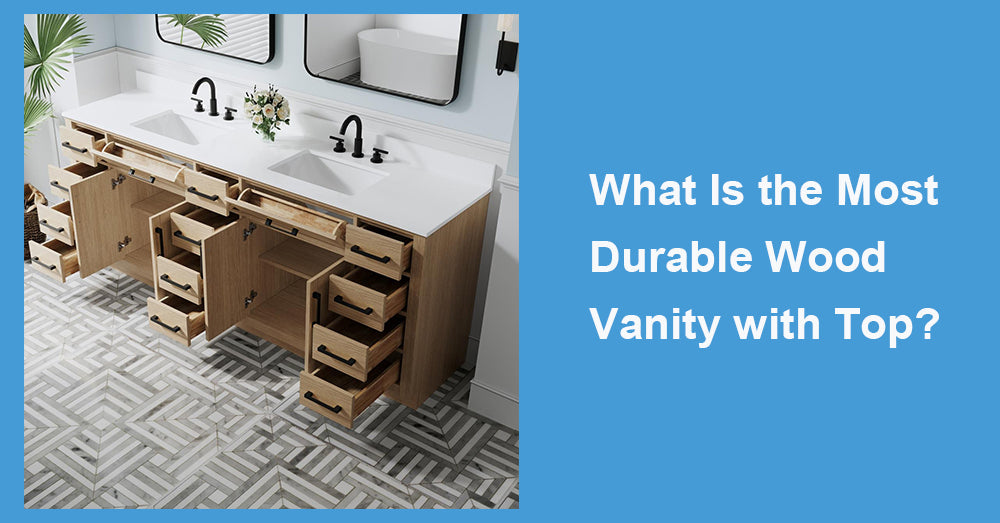
In the bathroom decoration market, bathroom vanities are no longer just basic furniture for storage functions. As consumers increasingly value durability, ease of cleaning, and long-term use experience, "which type of wood bathroom vanities with tops is the most durable" is becoming an important issue when choosing a bathroom vanity.
Recent renovation data highlights the strong market position of wood bathroom vanities. According to the 2025 Houzz Bathroom Trends Study, 74% of renovating homeowners prefer solid wood—far outpacing MDF (10%), plywood (6%), and particleboard (4%). Among solid wood species, maple leads at 29%, followed by white oak (23%), birch (12%), and walnut (9%).

However, if durability is your top priority, looking at wood species alone isn’t enough. The true lifespan of a wood vanity comes down to a combination of factors: structural integrity, wood stability, surface finish, countertop quality, and hardware performance.
Solid wood structure remains the core of durability.
Bathrooms are inherently high-humidity spaces. Steam from showers, water splashes from handwashing, and seasonal humidity shifts can all take a toll on wood furniture. Therefore, a durable wood vanity must start with a stable, well-engineered structure.
According to market data, solid wood remains the most preferred material for bathroom vanities among consumers. Hardwoods like maple and white oak stand out not only for their exceptional structural integrity, but also for their ability to deliver diverse visual styles through custom stains and finishes.
For consumers, instead of simply pursuing the "hardest wood", it is better to pay attention to whether the bathroom vanity adopts a reasonable frame structure and whether the boards are reliably connected. For common sizes such as 36 inches and 48 inches, a stable vanity structure is equally important.
The countertop material also plays a crucial role in the overall durability of the vanity.
If the vanity forms the backbone of a vanity, the countertop is what faces the demands of daily use.
Consumers' current choices of countertop materials have shown a very clear trend. According to Houzz data in 2025, 45% of consumers who update their bathroom countertops choose engineered quartz, which has become the most popular countertop material; Quartzite, granite, and marble account for 20%, 14%, and 13%, respectively.
This data indicates that pairing wood vanities with quartz countertops is becoming a major preference in the market.
Why?
Firstly, engineered quartz stone can provide a stable and uniform appearance. Secondly, the contrast between white and light colored countertops and wooden vanities is easy to form, which can adapt to modern, transitional styles, and some traditional bathroom designs.
In terms of color, 48% of the new bathroom countertops in the 2025 bathroom renovation project will be white, while the remaining 20% will be in beige or other near-white tones.
Therefore, for consumers seeking a balance between durability and design versatility, a solid wood construction paired with engineered quartz countertops is a compelling choice.
The hardware system is also key to long-term durability.
Bathroom vanities are opened and closed countless times a day, putting constant stress on hinges and drawer slides. Soft-close mechanisms prevent doors and drawers from slamming, which not only dampens noise but also reduces wear. For a solid wood vanity built to last, high-quality hardware isn’t an optional upgrade—it’s essential to its overall durability.
WELLFOR: Improving the durability of bathroom vanities through "material combination"
In line with this market trend, WELLFOR integrates solid wood construction, stable paneled framing, quartz countertops, and premium hardware into its bathroom vanity designs.
For example, some of WELLFOR's bathroom vanity products use solid wood frames and high-quality plywood structures, paired with quartz countertops and BLUM soft-closing hardware. This design concept is not simply pursuing a certain material, but considering long-term performance from three aspects: vanity structure, countertop, and daily operation.
For consumers, this combination aligns perfectly with current market trends: they desire the organic warmth of a natural wood vanity, paired with a low-maintenance countertop for effortless daily cleaning. Additionally, they expect doors and drawers to operate smoothly for years to come.
More importantly, WELLFOR offers a comprehensive range of standard vanity sizes—from 24 to 84 inches—allowing homeowners to find the perfect fit for their space without compromising their bathroom’s functionality or layout.
Five criteria for choosing the most durable wooden bathroom vanity
Based on comprehensive market data and wood performance research, if consumers are looking for a countertop wooden bathroom vanity that can be used for a long time, they can focus on the following five points:
First, examine the vanity’s overall construction.
Prioritize solid wood frames, dimensionally stable panels, and solid joinery.
Secondly, look at the wood and surface treatment.
Maple, white oak, birch, and other popular woods in the market. According to Houzz data in 2025, maple and white oak accounted for 29% and 23% of solid wood bathroom vanity choices, respectively.
Thirdly, look at the table.
Engineering quartz is currently the most popular bathroom countertop choice for consumers, accounting for 45%.
Fourth, look at the hardware.
Soft-closing drawers and vanity doors have become mainstream configurations, receiving 78% and 75% of consumers' choices, respectively.
Fifth, check the size and installation environment.
Even if the material is good, if the size of the bathroom vanity is unreasonable and the installation is not level, the long-term use experience may still be affected.
Conclusion: The most durable is not a single material, but a well-designed system
The bathroom decoration market is further moving from "good-looking" to "user-friendly and durable". According to Houzz data in 2025, the national median expenditure for bathroom renovation projects is $13000, and the median expenditure for large bathroom renovations is even higher at $22000, indicating that consumers are still willing to invest a higher budget for bathroom upgrades.
In such a market environment, a truly durable wooden bathroom vanity with a countertop is not simply a combination of "solid wood" and "quartz countertop", but requires a balance between wood, cabinet structure, moisture-proof design, surface treatment, countertop, and hardware.
Based on current consumer preferences, combining a stable solid wood frame, high-quality engineered panels, quartz countertops, and soft-close hardware offers a time-tested, durable solution. The core product configuration offered by WELLFOR aligns perfectly with this trend.
For consumers planning to renovate their bathroom, instead of pursuing short-term trends, it is better to choose a bathroom vanity with a stable structure, reliable materials, suitable size, and easy long-term maintenance - this is the true answer to determining which wooden bathroom cabinet with a countertop is the most durable.









































Leave a comment
This site is protected by hCaptcha and the hCaptcha Privacy Policy and Terms of Service apply.