






















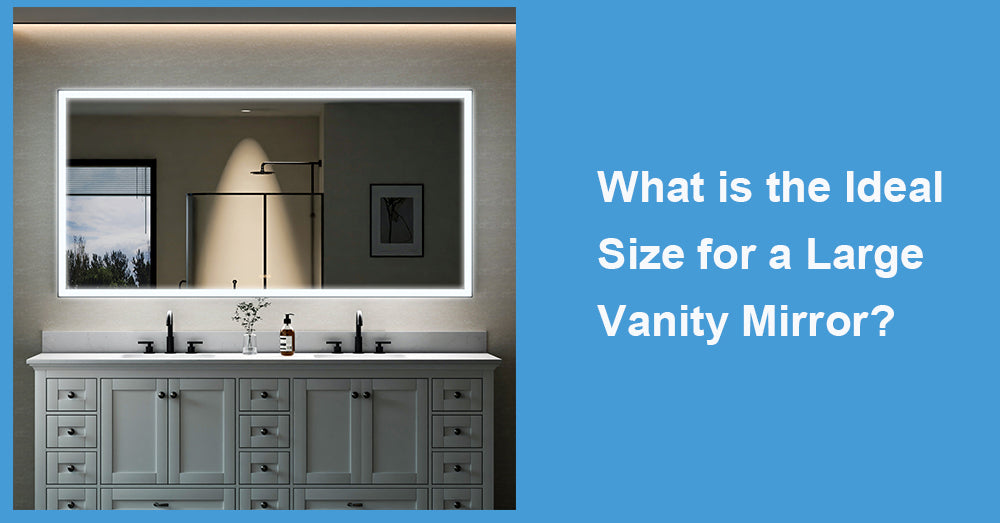
In modern bathroom design, the large vanity mirror has become a defining visual and functional element, shaping both lighting performance and spatial perception. As bathroom renovations continue to prioritize brighter, more open layouts, mirror sizing is no longer just an aesthetic decision—it directly impacts usability, lighting efficiency, and perceived room scale. With overall home improvement spending projected to reach around $518 billion by 2026, design decisions like mirror sizing are increasingly guided by performance as much as style.
Why mirror size matters more in modern vanity design
A vanity mirror does more than reflect—it defines the entire sink wall experience. In many bathroom upgrades, mirrors are now designed to extend to the full vanity width rather than serve as a small, centered accent.
Industry renovation data shows that larger-scale bathroom components are becoming more common, with vanity widths clustering heavily in functional sizes: about 47% of vanities are 48 inches or smaller, while larger installations continue to grow in popularity across primary bathrooms.
This shift directly influences mirror sizing, since mirror width is typically designed to align with or slightly undershoot vanity width for visual balance.
The most common sizing rule: mirror width vs vanity width
The most widely used design guideline is simple but effective:
A large vanity mirror should typically be 70% to 100% of the vanity width.
This means:
l For a 36-inch vanity → mirror typically 24–36 inches
l For a 48-inch vanity → mirror typically 36–48 inches
l For a 60-inch vanity → mirror typically 42–60 inches
l For a 72-inch vanity → mirror typically 48–72 inches
Designers often choose near full-width mirrors in modern layouts because they:
Increase light reflection across the entire countertop
Reduce visual fragmentation
Make the sink wall appear wider and more continuous
Standard “large mirror” height expectations
While width is the most visible factor, height determines usability. A large vanity mirror must accommodate multiple users of different heights while maintaining proper reflection angles.
Common height ranges include:
l 30–36 inches for standard installations
l 36–40 inches for taller or more vertical wall emphasis
l 40+ inches for luxury or double-vanity walls
Mirror height is often adjusted based on lighting placement, faucet height, and ceiling clearance rather than strict dimensional rules.
Ceiling height and visual proportion rules
One of the most overlooked factors in mirror sizing is vertical proportion relative to ceiling height. Most residential bathrooms fall within a standard ceiling range, and mirrors must visually balance within that vertical space.
General design logic:
l Leave 4–10 inches between the mirror top and the ceiling or lighting fixtures when possible
l Maintain at least 5–8 inches above the backsplash or the faucet splash zone
l Avoid full-wall mirrors unless the goal is spa-style expansion
Oversized mirrors can visually flatten a space by removing all vertical hierarchy, so controlling proportion is key.

Double vanity sizing: where large mirrors matter most
Large vanity mirrors are most commonly used in double-sink layouts. These setups often require wider mirrors to maintain balance and avoid awkward segmentation.
Typical configurations include:
l One continuous mirror: 60–72 inches or more
l Dual mirrors: each 24–36 inches, centered above each sink
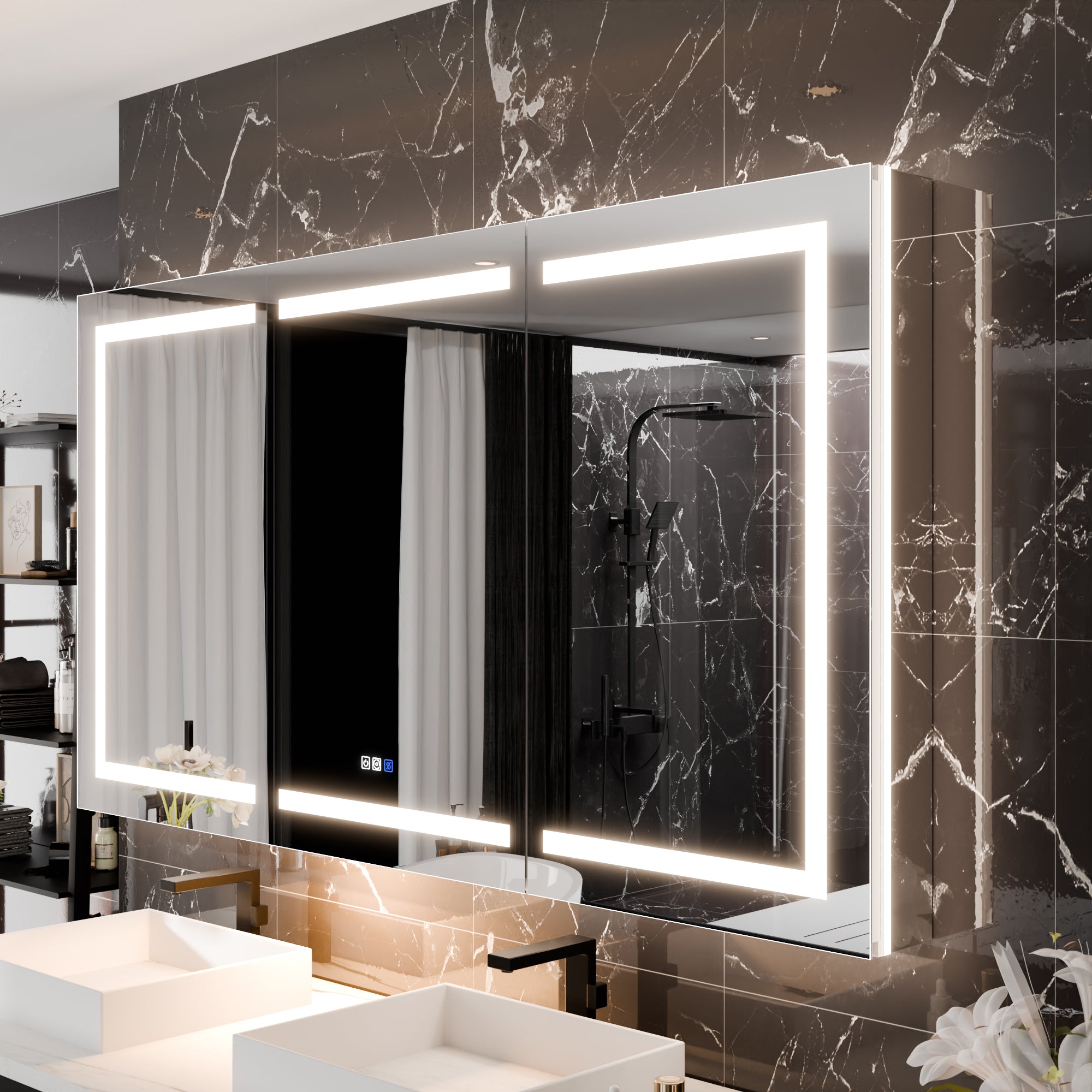
l Split mirror with center lighting feature: mixed sizing for visual balance
Renovation trends show increasing preference for larger, continuous reflective surfaces in primary bathrooms, as they enhance both lighting distribution and perceived space openness.
Lighting interaction: why size affects brightness quality
Mirror size directly impacts how light behaves in the bathroom. Larger mirrors:
l Reflect more ambient and task lighting
l Reduce shadowing on the face
l Improve visibility for grooming tasks
This is particularly important as LED lighting has become standard in modern vanity setups. Even brightness distribution depends heavily on how much reflective surface is available to bounce light evenly across the room.
Clearance and usability considerations
A large vanity mirror must also respect practical movement zones. While mirrors do not require floor clearance, their placement affects how users interact with sinks and counters.
Design guidelines often emphasize:
l Keeping the mirror height aligned with the eye level range of multiple users
l Ensuring mirror edges do not interfere with wall-mounted fixtures or cabinets
l Avoiding overly low placement that causes bending or visual distortion
Proper sizing ensures the mirror enhances usability instead of becoming a visual obstruction.
When “larger” is actually better—and when it is not
A larger mirror is not always the best choice. It depends on room scale, lighting, and design intent.
Larger mirrors work best when:
l The bathroom is narrow and needs visual expansion
l Natural light is limited
l A modern, seamless look is desired
l Double vanities require unified balance
Smaller or segmented mirrors are better when:
l Wall space is broken by windows or cabinets
l Lighting fixtures require separation
l A traditional or framed aesthetic is preferred
Material and safety considerations in large mirrors
As mirrors increase in size, structural considerations become more important. Most modern bathroom mirrors use safety-backed glass with reinforced mounting systems designed for resistance to humidity and vibration.
Large mirrors typically require:
l Secure wall anchoring into studs or reinforced backing
l Anti-shatter safety film is used in many modern builds
l Even weight distribution across mounting brackets or adhesive systems
This ensures stability over time, especially in high-humidity environments.
The bottom line: the ideal size is about proportion, not maximum scale
The ideal size for a large vanity mirror is not a single fixed measurement—it is a proportional relationship between vanity width, wall space, lighting, and user needs. In most modern bathrooms, a mirror that closely matches the vanity width and sits within a 30–40-inch height range provides the most balanced combination of function and aesthetics.
As bathroom design continues to favor open layouts and integrated lighting, large vanity mirrors are becoming less of an accessory and more of a structural design element—one that defines how the entire space looks, feels, and performs every day.









































Leave a comment
This site is protected by hCaptcha and the hCaptcha Privacy Policy and Terms of Service apply.