






















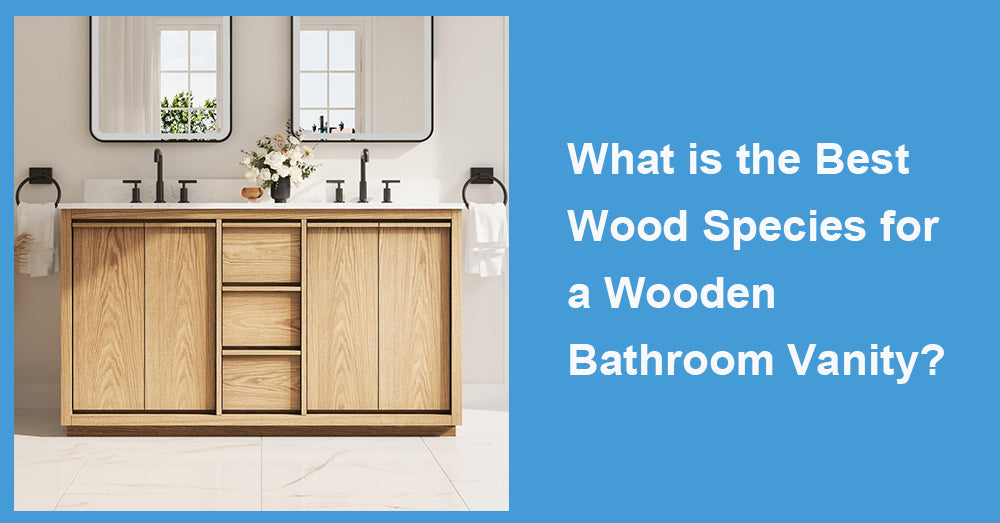
In contemporary bathroom design, the wooden bathroom vanity is gradually shifting from "style embellishment" to a core component that embodies quality and durability. Compared to panels or composite materials, solid wood bathroom cabinets have natural advantages in texture, structural stability, and service life. However, at the same time, as a high-humidity space, bathrooms also have higher requirements for wood.
From an industry perspective, choosing which type of wood is not a simple matter of aesthetic preference, but a professional judgment involving physical properties, environmental adaptability, and long-term stability.
1. What special requirements does the bathroom environment have for wood?
Before discussing specific types of wood, it is necessary first to understand the fundamental challenges that bathroom environments pose to the quality of wooden bathroom.
Long-term humidity fluctuations, temperature differences, and occasional condensation of water vapor can all affect the structure of wood. If the stability of the wood is insufficient, it is prone to warping, cracking, or dimensional changes.
Therefore, when evaluating whether wood is suitable for bathroom use, the industry usually focuses on the following indicators:
dimensional stability
Density and hardness
Tolerance to humidity changes
Is it suitable for moisture-proof surface treatment
These basic conditions determine whether a specific type of wood is qualified for use in bathroom applications.
2. Oak: One of the most mature choices for industry applications
In the practical application of wooden bathroom vanities, oak has always held an important position. Its advantages lie in its dense structure, clear texture, strong resistance to deformation, and the ability to maintain relative stability in environments with significant humidity changes.
From an industry perspective, oak is suitable for a wide range of styles, from traditional to modern. Meanwhile, it has good adaptability to surface coating and can further enhance moisture resistance through multi-layer sealing treatment. This is also an important reason why oak has been widely used in the mid to high-end bathroom cabinet market for a long time.
3. Maple: a representative of stability and delicate texture
Maple wood, with its uniform and delicate texture and good structural stability, has also received attention in the field of bathroom cabinets.
Compared to some rough-textured woods, maple wood appears cleaner and more restrained, making it suitable for modern or transitional bathroom designs.
Industry practice has shown that maple wood, when properly dried and structurally designed, is stable in bathroom environments and is not prone to significant deformation. However, due to its high density, the requirements for processing and painting techniques are also more stringent.
4. Walnut: the visual focal point in high-end bathroom design
Walnut wood is often used in high-end bathroom projects that emphasize texture and spatial temperature due to its deep color tones and natural layering.
From a material perspective, walnut wood has good stability and moderate density and can also withstand bathroom environments when properly treated.
However, from an industry perspective, walnut wood is more commonly used in projects that focus on visual expression, with higher requirements for processing accuracy and maintenance conditions. Therefore, it is better suited for users with higher standards for quality and design integrity.
5. Teak: a special wood with outstanding moisture resistance
When discussing the use of wood in bathrooms, teak is often seen as an "exception".
Due to its high natural oil content, pomelo wood has strong moisture resistance and performs particularly well in high-humidity environments. This feature gives it a unique advantage in high-end bathroom or spa-style spaces.
However, from the perspective of the industry, the cost of teak wood is relatively high, and the processing difficulty is also relatively great, so it is more commonly used in specific projects that emphasize durability and natural style.

6. The industry value of engineered solid wood is increasing
It is worth noting that modern wooden bathroom vanities do not rely entirely on whole logs.
Solid wood materials processed through engineering often have better structural stability than traditional solid wood. This type of material effectively reduces the risk of deformation of wood due to humidity changes through multi-layer splicing and directional structural design.
The industry generally believes that in bathroom environments, engineered solid wood with reasonable structural design is often more reliable and meets long-term usage needs than untreated solid wood.
7. Industry conclusion: Wood suitable for bathrooms is the result of "systematic selection."
From an industry perspective, no type of wood can be "naturally perfect" under all conditions. The wood that is genuinely suitable for a wooden bathroom vanity must meet the stability requirements of the material itself and be matched with the correct processing technology, structural design, and usage environment.
Oak, maple, walnut, and teak each have their own advantages, and the key lies in whether they are used in suitable scenarios. The core of industry judgment is never 'which type of wood is the best', but 'which type of wood is most suitable for this bathroom project'.
Conclusion
In the bathroom, a space with extremely high material requirements, the quality of the wooden bathroom vanity is always based on rational material selection and professional design. With the continuous advancement of wood processing technology and moisture-proof techniques, solid wood bathroom cabinets are no longer a high-risk choice, but a mature product that can achieve long-term stable use through scientific methods. From an industry perspective, what truly deserves attention is not the name of the wood itself, but the material understanding, manufacturing standards, and environmental adaptability reflected behind it. Only when these factors are systematically incorporated into design decisions can wooden bathroom luxury truly balance aesthetics, durability, and long-term value.








































Leave a comment
This site is protected by hCaptcha and the hCaptcha Privacy Policy and Terms of Service apply.