






















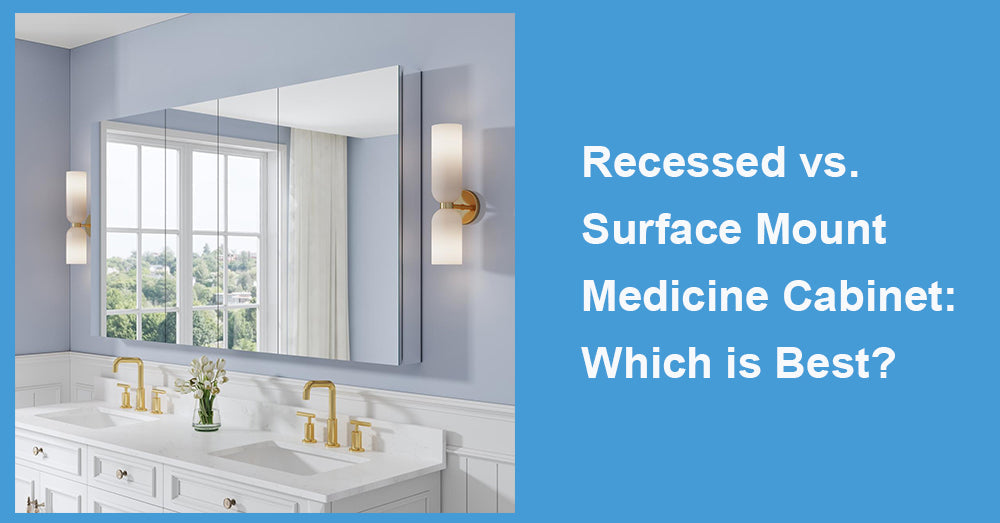
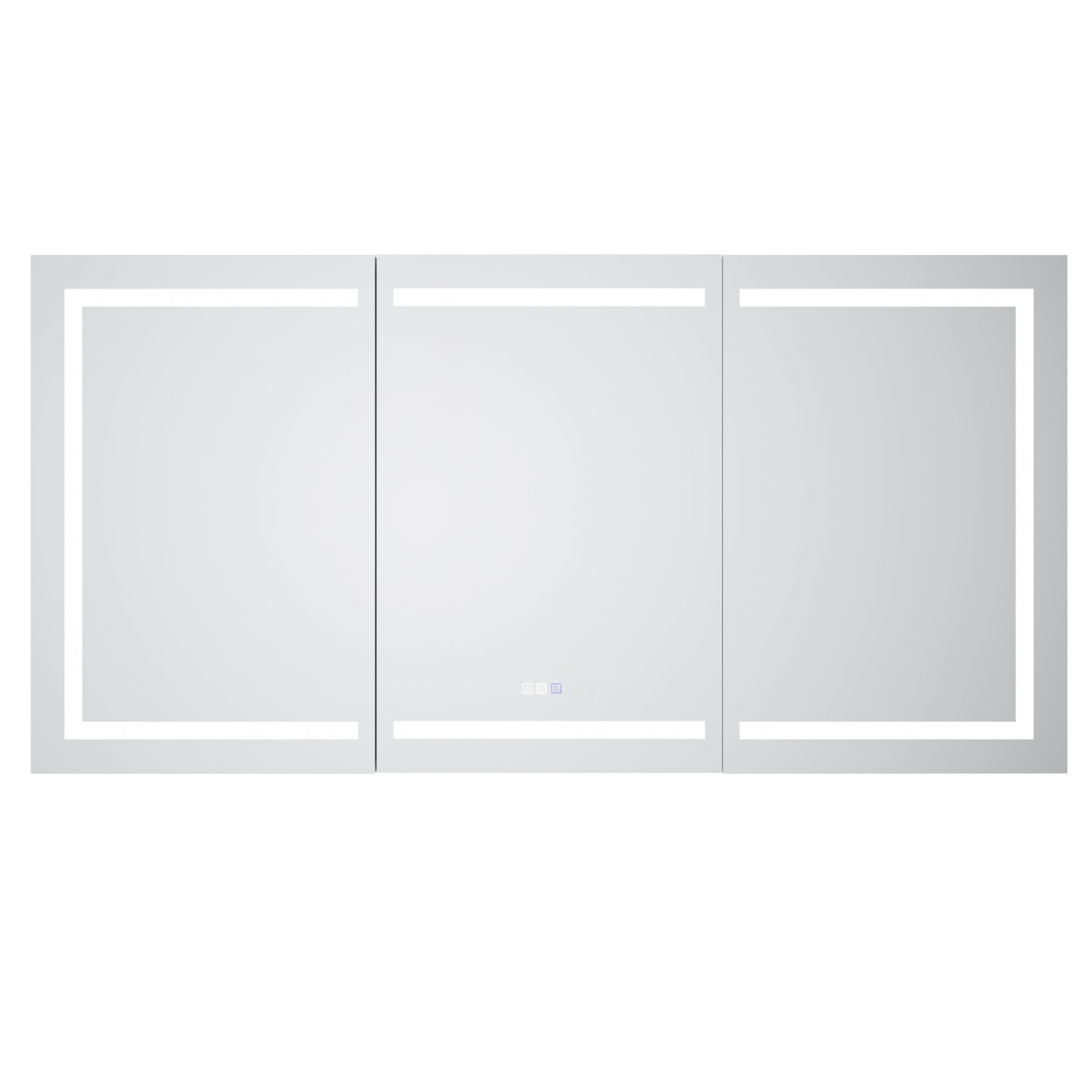
In modern bathroom decoration and renovation, the medicine cabinet is no longer just a simple storage component but an essential element that directly affects space efficiency, visual style, and the long-term user experience. Among them, the recessed medicine cabinet and the surface mount medicine cabinet with mirror are currently the two most common forms on the market.
They have significant differences in structure, installation methods, and design logic, which raises a commonly discussed question: which one is better? From an industry perspective, there is no absolute answer to this question; it should be judged based on spatial conditions and usage goals.
1. Differences in design concepts: hidden integration vs. explicit existence
The core design concept of embedded medicine cabinets is to "hide" the storage function in the wall, keeping the mirror surface relatively flat with the wall surface. This approach is highly compatible with modern bathrooms' pursuit of simplicity, restraint, and visual continuity.
In contrast, surface mount medicine cabinets emphasize structural integrity and a clear sense of presence. The cabinet is directly installed on the wall, making it easier to become a visible element in the bathroom. This form still has a sure market foundation in traditional or transitional style spaces.
From a design-trends perspective, the industry views embedded medicine cabinets as a natural extension of modern design. In contrast, surface-mounted medicine cabinets emphasize practicality and ease of construction.
2. Space utilization efficiency: Who is more suitable for limited areas?
In small and medium-sized bathrooms, space utilization is particularly critical. Embedded medicine cabinets, as they do not occupy additional space outside the wall, appear more lightweight both visually and physically, helping to reduce pressure.
Although surface-mount medicine cabinets can provide the same or even larger internal storage space, their convex structure efficiently amplifies the sense of volume in narrow spaces. Industry practice shows that embedded solutions are often preferred by designers in compact apartment projects.
3. Industry reality of installation conditions and construction difficulty
From a construction perspective, there is a significant difference in the requirements for wall conditions between the two types of medicine cabinets.
Embedded medicine cabinets require sufficient depth inside the walls and avoid structures such as water pipes and wires, which is relatively easy to achieve in new construction projects, but may be limited in some old house renovations.
The advantage of a surface mount medicine cabinet lies in its flexible installation, lower requirements for wall structure, and suitability for projects that require rapid renovation or cannot be opened. Therefore, this type still maintains a stable demand in the actual market.
4. Matching the degree between visual effects and overall style
In modern bathrooms that emphasize integrity and order, embedded medicine cabinets are often easier to integrate into the overall design. The mirror is flush with the wall, making it more like a part of the space rather than an attachment.
The visual presence of the surface-mount medicine cabinet is stronger, and if the design is not handled correctly, it is easy to disrupt the wall proportion. But in some bathrooms that emphasize hierarchy or are more traditional, installing a suitable surface-mounted medicine cabinet can actually serve a decorative purpose.
From an industry perspective, whether it looks good or not does not depend on the form itself, but on whether it is consistent with the overall design language.
5. The difference between storage experience and daily use
In terms of functionality, both types of medicine cabinets can meet basic storage needs, but the experience of details is slightly different.
Embedded medicine cabinets are usually limited by the depth of the wall, and their internal space needs to be properly partitioned to improve efficiency.
Surface mount medicine cabinets are more flexible in depth design, capable of accommodating higher or deeper items, making them more intuitive and practical for some households. Industry data shows that surface-mounted medicine cabinets are still attractive in scenarios with a large number of family members or high storage needs.

6. Industry considerations for long-term maintenance and durability
In terms of long-term use, embedded medicine cabinets are usually easier to maintain cleanliness due to their more stable structure and fewer exposed parts. They are less likely to be damaged by external collisions. But once it needs to be replaced or repaired, its construction cost is relatively high.
Surface-mount medicine cabinets are more convenient to maintain and replace, with flexible disassembly and assembly, which is also one of the reasons why they are often selected in leasing properties or phased renovation projects.
When evaluating durability, the industry often not only focuses on product quality, but also considers the feasibility of future maintenance.
7. Industry Conclusion: There is no 'better', only 'more appropriate.'
From the perspective of comprehensive design trends, construction conditions, and usage requirements, embedded medicine cabinets and surface-mount medicine cabinets are not in competition, but rather two solutions tailored to different scenarios.
Embedded medicine cabinets are more suitable for projects that pursue modernity, visual cleanliness, and spatial efficiency; surface-mounted medicine cabinets have practical advantages in terms of construction flexibility and storage intuitiveness.
The general consensus in the industry is that determining which one is "better" should start from spatial conditions, design goals, and long-term usage plans, rather than simply comparing forms.
Conclusion
In contemporary bathroom design, the choice of medicine cabinet is no longer a simple competition over installation methods, but a decision that comprehensively considers spatial structure, design style, and usage cycle. Embedded medicine cabinets respond to modern design's pursuit of simplicity and order through their concealed integration; surface-mount medicine cabinets continue to demonstrate their value in diverse projects through flexibility and practicality. From an industry perspective, the truly ideal choice is not to follow a particular form, but to find the most suitable solution for a specific space based on understanding the differences between the two.







































Leave a comment
This site is protected by hCaptcha and the hCaptcha Privacy Policy and Terms of Service apply.