






















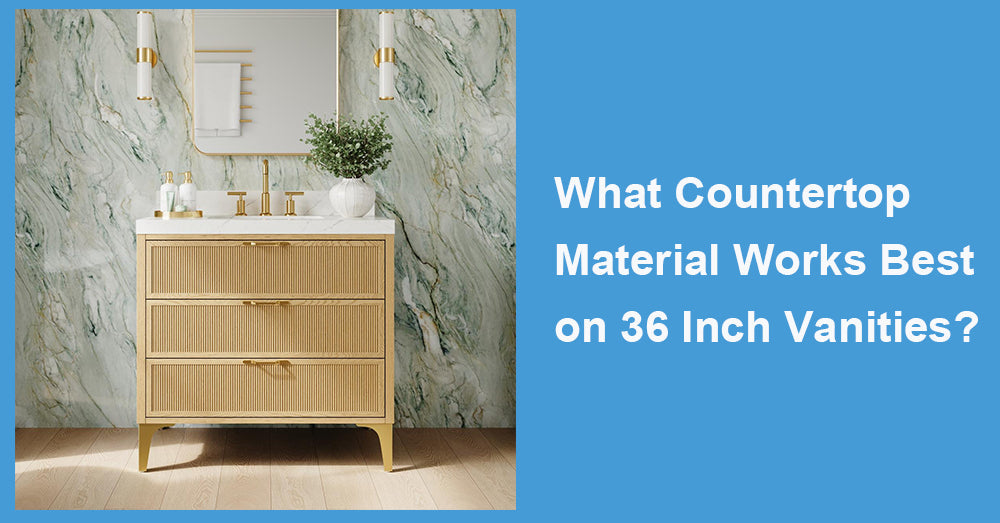
Choosing a countertop for 36 inch vanities looks simple until daily use enters the picture. A 36 inch vanity is wide enough to provide useful counter space, yet compact enough that every stain, chip, seam, and oversized sink becomes noticeable. The best material is therefore not automatically the most expensive one. It is the surface that fits the bathroom’s moisture level, cleaning routine, cabinet structure, and overall design.
For most households, engineered quartz offers the strongest all-around balance. Natural marble brings more character, granite provides dependable durability, and cultured marble keeps the installation straightforward. The right answer depends on what the bathroom needs to handle, not just what looks best in a showroom.
1. Why countertop selection matters on a 36 inch vanity
A 36-inch vanity usually supports one sink, leaving a practical but limited area for soap, grooming products, and everyday accessories. Once the sink cutout and faucet holes are added, the remaining countertop is smaller than the product width suggests.
That makes proportions important. A thick edge, dramatic pattern, or oversized vessel sink can overwhelm the cabinet. A simpler top with a centered or slightly offset undermount sink often feels more balanced.
Bathroom humidity also deserves attention. The CDC recommends keeping indoor humidity no higher than 50% when possible and using bathroom exhaust ventilation to reduce moisture problems. Countertop materials may tolerate water differently, but no surface performs well when standing water is repeatedly left around seams, backsplashes, and faucet openings. (Source: CDC)
Industry judgment: on a 36 inch vanity, installation quality and daily care matter almost as much as the material name.
2. Engineered quartz is the best all-around option
Engineered quartz is usually the safest recommendation for a frequently used bathroom. It provides a consistent appearance, broad color selection, and a nonporous surface that does not normally require routine sealing.
The National Kitchen and Bath Association has repeatedly identified light-colored quartz as a leading choice for bathroom vanities. NKBA also highlights quartz for its durability, stain resistance, and easy-cleaning qualities. (Source: NKBA)
On a 36-inch cabinet, quartz works especially well because its controlled veining does not overpower the smaller surface. White, warm gray, and subtle marble-look designs can make the vanity feel wider while coordinating easily with chrome, matte black, or brushed gold hardware.
Quartz is not indestructible. Harsh solvents and highly abrasive cleaners can damage the finish, and excessive heat should still be avoided. Those limitations are modest in a bathroom, however, where hot cookware is not part of normal use.
For a main bathroom, children’s bathroom, or busy guest bath, quartz is generally the most practical investment.
3. Marble offers beauty but expects more attention
Natural marble gives a 36-inch vanity a more individual, high-end appearance. No two slabs are identical, and even a compact top can become the visual feature of the room.
The trade-off is maintenance. Marble is a calcium-based stone, so acidic products may dull or etch its polished surface. The Natural Stone Institute advises against cleaners containing vinegar, lemon, or other acids on calcareous stone. It also warns that abrasive powders can scratch some stone finishes. (Source: Natural Stone Institute)
This matters in bathrooms because skincare products, cosmetics, toothpaste, and household cleaners may remain on the counter longer than expected. Sealing can help manage staining, but it does not prevent acid etching.
Marble still makes sense in a powder room or lightly used primary suite where appearance carries more weight than low maintenance. A honed finish can also make small etch marks less obvious than a highly polished surface.
Industry judgment: marble is not a poor bathroom material, but it is an intentional lifestyle choice rather than the easiest option.
4. Granite remains a durable natural-stone choice
Granite sits between quartz and marble in the practical hierarchy. It offers genuine natural variation while generally handling daily wear better than marble.
A properly fabricated granite top can work well around an undermount sink, especially when the exposed sink edge and faucet holes are finished carefully. Many granite varieties benefit from periodic sealing, although the exact schedule depends on the stone’s absorption rate and the sealer used.
The Natural Stone Institute recommends using neutral cleaners and following stone-specific care procedures rather than assuming all natural stones behave the same way. (Source: Natural Stone Institute)
The main design concern is scale. Strong speckling or large movement may feel crowded across a 36 inch surface. Quieter granite patterns tend to work better on compact vanities.
Granite is a good fit for buyers who want natural stone without accepting marble’s sensitivity.
5. Cultured marble is practical for an integrated top

Cultured marble is commonly formed into a one-piece vanity top with an integrated sink and backsplash. That construction reduces seams, simplifies cleaning, and can help keep water from collecting around a separate sink rim.
For a 36-inch vanity, this is a useful advantage. The top arrives as a coordinated unit, installation is relatively direct, and there is no need to select a separate slab and sink.
Its weaknesses are mostly cosmetic and long-term. The gel-coated surface may scratch or lose gloss when scrubbed with abrasive pads. Very hot styling tools can also damage some finishes if left directly on the counter.
Cultured marble is best viewed as a value-focused, low-complexity option. It works well in secondary bathrooms, rental properties, and projects where easy installation matters more than natural variation.
6. Solid surface offers clean lines and repairability
Solid-surface materials provide another practical option for 36 inch vanities. They can be fabricated with smooth transitions and nearly invisible seams, which supports a simple, contemporary look.
Minor scratches can often be refinished more easily than damage to natural stone. The surface is also nonporous, making everyday cleaning fairly straightforward.
Visually, solid surface tends to be quieter than marble or granite. That can be an advantage in compact bathrooms where the vanity should support the design rather than dominate it.
The material may not deliver the same luxury perception as natural stone or high-quality quartz, but it performs well for minimalist and accessibility-focused bathrooms.
7. Sink style changes the countertop decision
Countertop material cannot be selected in isolation from the sink.
An undermount sink keeps the top visually open and makes it easier to wipe water directly into the basin. A vessel sink preserves more cabinet space below, but occupies more usable counter area and places greater emphasis on faucet height.
Integrated sinks reduce joints and simplify maintenance, while drop-in sinks are easier to replace but leave a visible rim where residue can collect.
For a 36 inch vanity, an undermount or integrated sink usually creates the cleanest balance. The available counter space is already limited, so bulky sink profiles can make the top feel crowded.
8. The best material depends on how the bathroom is used
For heavy daily use, engineered quartz is the strongest overall choice. It offers the least complicated balance of appearance, cleaning, and moisture resistance.
For a statement powder room, marble provides unmatched natural character. Granite suits buyers who want authentic stone with stronger everyday durability. Cultured marble works well when budget and installation simplicity lead the decision, while solid surface is a smart choice for seamless modern design and easier refinishing.
Current bath design is also moving toward more natural materials, warmer finishes, and smarter storage, according to NKBA’s recent trend reporting. That makes material coordination increasingly important: the countertop should work with the vanity’s wood tone, hardware, flooring, and mirror rather than functioning as a separate decorative layer. (Source: NKBA)
Final Takeaway
For most 36 inch vanities, engineered quartz works best because it combines durability, low maintenance, and enough visual variety to suit both modern and transitional bathrooms. It handles everyday splashes and grooming routines without demanding the level of care associated with marble.
That does not make quartz the only worthwhile option. Marble is compelling when natural beauty is the priority. Granite offers a durable stone surface with individual character. Cultured marble simplifies installation, while solid surface supports a clean, understated look.
The smartest choice comes from matching the countertop to real bathroom habits. A beautiful surface that requires more care than the household will provide is rarely a good long-term purchase. On a compact vanity, practical performance is not separate from good design. It is what allows the design to keep looking good after years of daily use.










































Leave a comment
This site is protected by hCaptcha and the hCaptcha Privacy Policy and Terms of Service apply.