






















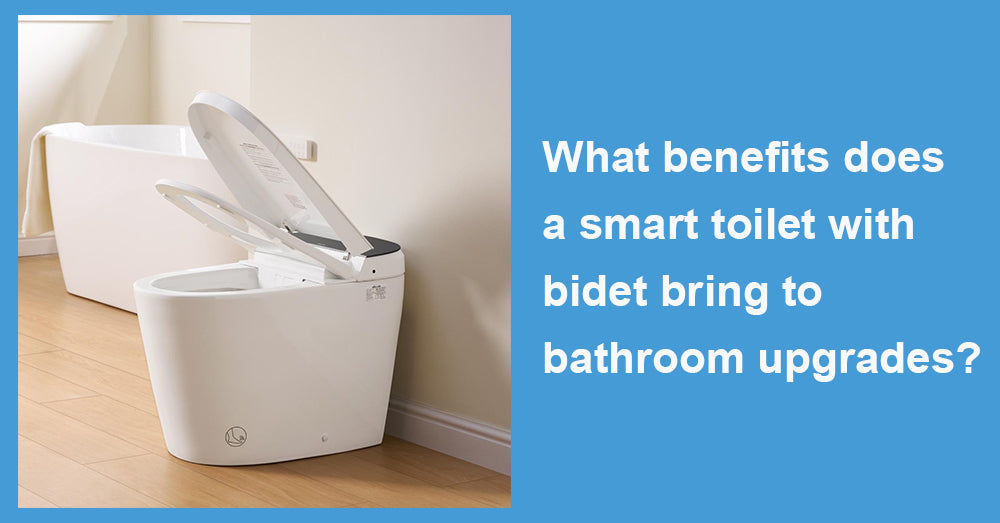
In recent years, with the trend of bathroom upgrading and renovation, intelligence and functional integration have gradually become core keywords. Among them, the smart toilet with bidet is evolving from a "novel option" into a configuration many families are seriously considering for their renovation plans. Compared with traditional toilets or separately installed toilet accessories, integrated intelligent toilet products offer greater system advantages in terms of cleaning experience, comfort, hygiene management, and space utilization.
But for those planning bathroom upgrades, a fundamental question often lies ahead: can this product really deliver substantial improvements? Or is it just a "technology decoration" to increase the budget? To answer this question, it is necessary to examine it from multiple dimensions such as functionality, user experience, and long-term value.
1. Starting from the Changes in Basic Cleaning Methods
The traditional bathroom cleaning method has relied on paper for decades. In contrast, the washing and cleaning provided by innovative toilet systems are increasingly seen by users as more efficient and gentle. According to industry surveys, over 65% of households that have used bidet-enabled toilet products believe that the cleaning experience is significantly better than traditional methods (source: ConsumerReports.com).
From a technical perspective, most smart toilets with a bidet feature adjustable water pressure, water temperature, and cleaning angle, allowing a more controllable cleaning process. This adjustability not only enhances comfort but also reduces discomfort caused by forceful wiping to a certain extent, which is particularly important for long-term use.
2. System Upgrade for Comfort Experience
The definition of comfort is changing in the renovation of functional bathrooms. It no longer depends solely on the size of the space, but is more reflected in the details of each usage process. Intelligent toilet products are usually equipped with heating seat rings, automatic deodorization, adjustable temperature air drying, and other functions, making the entire usage process more coherent.
According to a study on household device usage behavior, heating seat rings are one of the most frequently used and satisfying features for users in winter or low-temperature environments. Nearly 70% of respondents stated that it is "difficult to return to a usage experience without heating seat rings" (source: Statista.com). This seemingly subtle improvement will continue to amplify its value in daily high-frequency use cases.
3. Improve the Overall Hygiene Management Level of the Bathroom
As a high-humidity, frequently used space in the home, the bathroom often directly affects living comfort. A smart toilet with a bidet is not just about being "cleaner" at this point; it also reduces the difficulty of cleaning through structural and functional design.
For example, automatic-flushing nozzles, antibacterial seat ring materials, and seamless or hidden-edge designs all reduce the risk of dirt accumulation. Some products also feature ultraviolet or electrolytic water-cleaning technology for nozzle self-cleaning, automatically completing the basic disinfection process after use. This type of design often significantly reduces the frequency of manual cleaning over the long term (source: HomeAdvisor.com).
4. Potential Assistance for Bathroom Space Utilization
In many residences, the bathroom itself is not spacious, especially in the interior or secondary bathroom. Compared with the traditional "toilet+independent bidet" configuration, the integrated innovative toilet product is more space-friendly.
The typical length of smart toilets is 26 to 29 inches, which is close to the standard toilet size and does not significantly affect the original layout. Meanwhile, the higher level of functional integration reduces the need for additional accessories or structures, making the space look more concise. For bathroom designs that pursue both functionality and orderliness, this is a practical advantage.
5. Consideration of Water Conservation and Long-Term Usage Costs
As bathroom upgrades progress, water resources and energy consumption issues are increasingly included in decision-making. Although innovative toilet products require a power connection, they often offer advantages in water efficiency.
Many models use dual-flush or induction-flush systems, which can effectively reduce unnecessary water consumption compared to traditional single-flush modes. According to data, under reasonable settings, the average water consumption of innovative flushing systems in households can be reduced by about 15%-20% compared to traditional flushing methods (source: EnergyStar.gov).
From a long-term perspective, reducing paper consumption is also an indispensable part, reflected not only in costs but also in reduced convenience of use and increased storage demand.
6. The Actual Value to Different Groups of People
A smart toilet with a bidet does not serve only a single population. For people with limited mobility or elderly users, automatic lid opening, night sensor lights, and simplified cleaning processes can all lower the threshold for use. For users who value a personal care experience, customizable settings can better align with individual habits.
This type of "multi-adaptation" feature makes innovative toilet products more widely accepted in households, rather than becoming specialized devices for only a few people.

7. Is It Necessary to Make It a 'Mandatory' Option?
From an industry perspective, there is no absolute answer to whether a smart toilet with a bidet is "essential". It is not mandatory equipment for all bathroom renovations. Still, its comprehensive value is increasingly recognized in more and more projects with upgrading plans that emphasize functional perfection, long-term experience, and hygiene management.
If the goal of bathroom renovation is only to update the appearance, then traditional configurations can also meet the needs. But if the core of the transformation is to improve usage efficiency, comfort, and daily experience quality, intelligent toilet systems can often play a role in multiple dimensions simultaneously.
8. Conclusion: From Trends to Rational Choices
Bathroom upgrades are not about unthinkingly following popular features; they are about finding a balance between budget, space, and usage habits. The significance of a smart toilet with a bidet lies not only in its labeled 'intelligence', but also in whether it can continuously improve the real user experience.
In future bathroom renovations, such products are likely to gradually move from "optional upgrades" to "high-performance configurations". But whether it is ultimately worth introducing should still be judged based on specific spatial conditions and actual needs. Rational choices often bring more long-term satisfaction than simply pursuing new technologies.









































Leave a comment
This site is protected by hCaptcha and the hCaptcha Privacy Policy and Terms of Service apply.