






















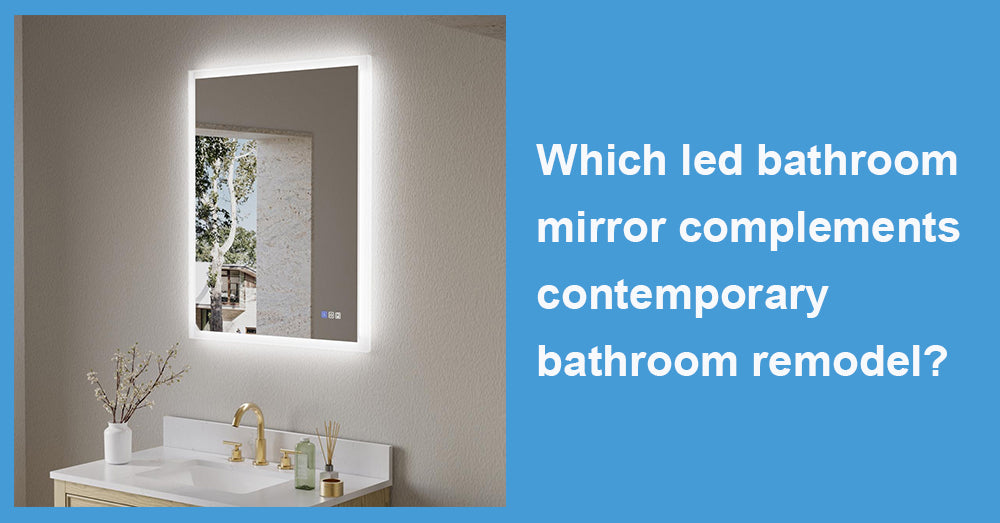
In recent years, with the trend of bathroom renovation, "modern style" is no longer a vague concept but has gradually taken shape with a clear design logic: simple lines, restrained materials, and highly integrated functions.
In this context, LED bathroom mirror are becoming a core element that cannot be ignored in modern bathrooms.
But the problem is that there are many types of LED mirror products on the market, not all of which are genuinely suitable for modern bathroom renovation. So, which features of LED bathroom mirrors can truly harmonize with modern bathroom styles, rather than being a visual or functional burden?
1. The Core of Modern Bathroom Style Lies Not in "Decoration", But in "Order."
Modern bathroom design emphasizes spatial order rather than element stacking.
Design studies have shown that successful modern bathrooms typically reduce the number of wall decorations and achieve visual expression through functional components themselves.
In this context, an LED bathroom mirror is not just a mirror; it often serves as a mirror, an illuminator, and a visual center.
2. Mirror Shape: Simple Contours Are More Important Than Complex Shapes
From a morphological perspective, LED bathroom mirrors that are most compatible with modern bathrooms typically adopt rectangular or minimalist circular contours.
Complex carved borders and obvious decorative lines are often more suitable for traditional or retro styles.
Design trend analysis shows that mirror surfaces with clean edges and restrained shapes are more likely to form a unified language with the linear structures in modern bathrooms.
3. The Size Selection Needs to Match the Spatial Proportion
In modern bathrooms, the size of mirrors often directly affects the overall completion.
In industry practice, a common choice logic is to establish a clear proportional relationship between the width of the mirror and the washbasin.
For example:
Single basin washbasins are often paired with LED mirrors that are 30-36 inches wide.
Medium or double basin structures are more commonly available in sizes of 40-48 inches.
Research has shown that when the mirror width is close to the tabletop width, the space appears more stable and orderly visually.
4. The Presentation Style of Lighting Determines the Success or Failure of "Modernity."
Not all 'bright mirrors' have a modern feel.
The LED bathroom mirror that is genuinely suitable for modern bathrooms usually uses hidden or uniformly diffused light sources rather than point-like, direct, or overly emphasized edge-light strips.
Lighting research has shown that linear, continuous, and light source forms without obvious light spots are more in line with modern spatial aesthetic expectations for restraint.
5. Color Temperature Control Is an Important Detail of Modern Style
Modern bathrooms often use neutral or cool tones, making the color temperature selection for LED mirrors particularly crucial.
Generally speaking, neutral cool light in the 4000K-5000K range is more likely to reflect a clear, rational, modern temperament.
Research shows that within this temperature range, space is perceived as "cleaner, more rational" and less prone to feelings of oppression.
6. Framework Design: Weakening Presence Is Key
In modern bathrooms, the role of mirror frames is being redefined.
Compared to heavy frames, ultra-narrow borders or frameless designs are more commonly seen in modern renovation cases.
Design research indicates that when the frame's presence is weakened, the mirror is more likely to become part of the spatial structure rather than an independent decoration.
7. Functional Integration Conforms to Modern Spatial Efficiency Logic
Modern bathrooms emphasize "few but precise" functional configurations.
LED bathroom mirrors that integrate anti-fog, dimming, touch, and other functions are more in line with this trend, but the premise is that these features are well-integrated rather than used as gimmicks.
Research on usage behavior has found that when the functional entry is clear and the interaction is simple, long-term product satisfaction is significantly improved.
8. The Installation Method Affects the Overall Style Completion
Even if the LED mirror's design is simple, improper installation can undermine its overall effect.
Modern bathrooms tend to be wall-mounted or embedded, maintaining a clean transition relationship between the mirror and the wall.
Construction research has shown that when the mirror is more closely attached to the wall, the sense of spatial boundaries becomes clearer, thereby strengthening modern style features.
9. Collaboration with Other Modern Elements
LED bathroom mirrors rarely exist alone in modern bathrooms.
It usually requires coordination with elements such as suspended washbasins, hidden storage, and linear lighting fixtures.
Material-matching research shows that neutral-colored mirror light sources are highly compatible with materials such as concrete, stone, and light wood grain.
10. Energy Efficiency and Sustainability Are Both Part of Modern Values
Modern design not only focuses on appearance, but also emphasizes efficiency and long-term value.
A bathroom mirror with an LED light source offers significant advantages in energy consumption and lifespan.
Data shows that energy-efficient lighting solutions are more easily accepted in long-term use and become a "stable part" of overall upgrades.
11. There Is No One "Best" LED Mirror
It should be recognized that no LED bathroom mirror is suitable for all spaces in modern bathroom renovations.
The spatial layout, usage habits, and lighting conditions all affect the choice.
But in most cases, LED mirrors with simple shapes, reasonable sizes, uniform light sources, and restraining functions are more easily integrated into modern bathroom design systems.

12. Conclusion: Modern Bathrooms Require a Design That Does Not Disturb
The LED bathroom mirror that truly complements the modern bathroom renovation style is not the most eye-catching, but the least distracting.
Its value lies in enhancing the experience without creating a burden, and in integrating into the space rather than dominating it.
When mirrors find a balance between functionality, proportion, and visual language, they naturally become the most stable and durable component of modern bathrooms.









































Leave a comment
This site is protected by hCaptcha and the hCaptcha Privacy Policy and Terms of Service apply.