














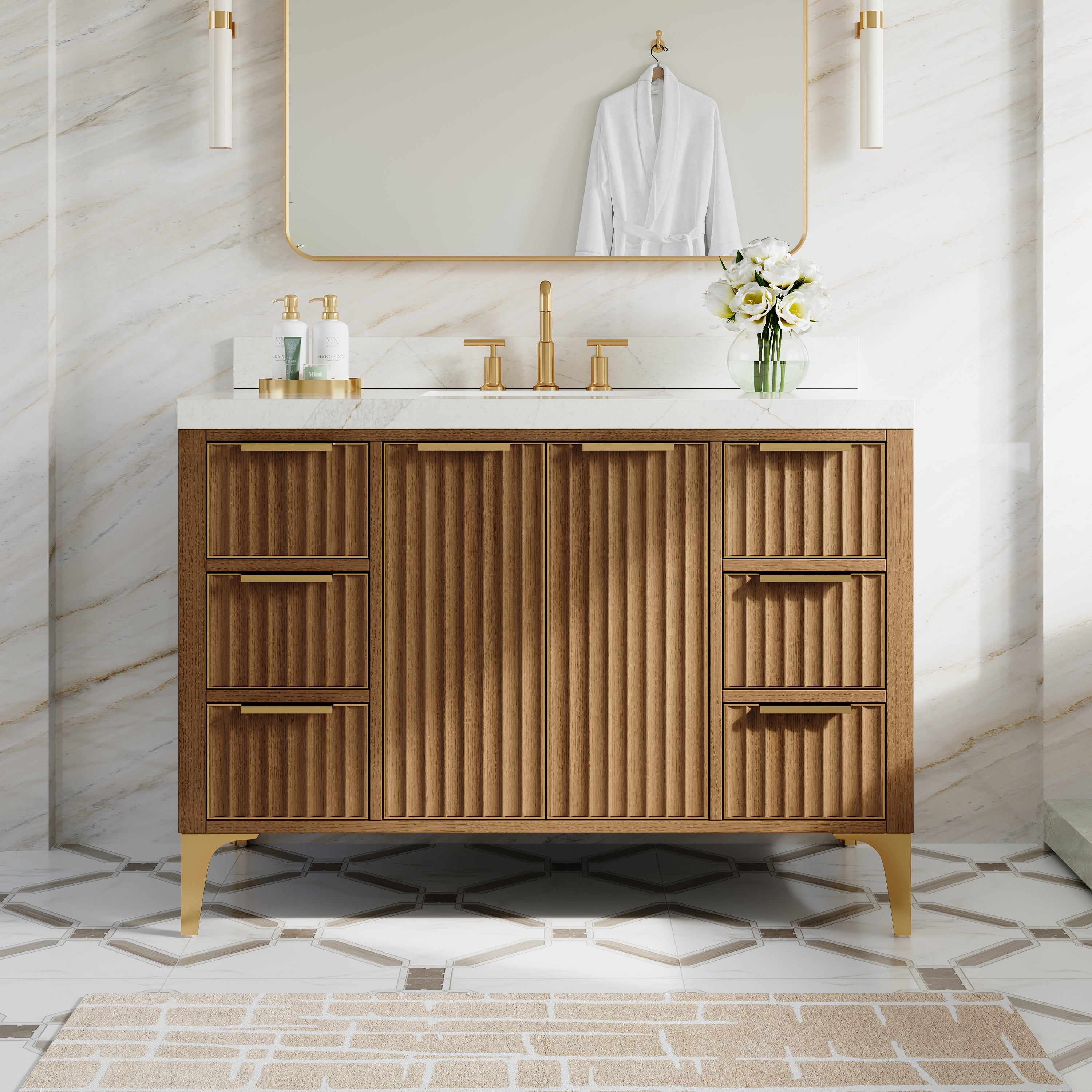
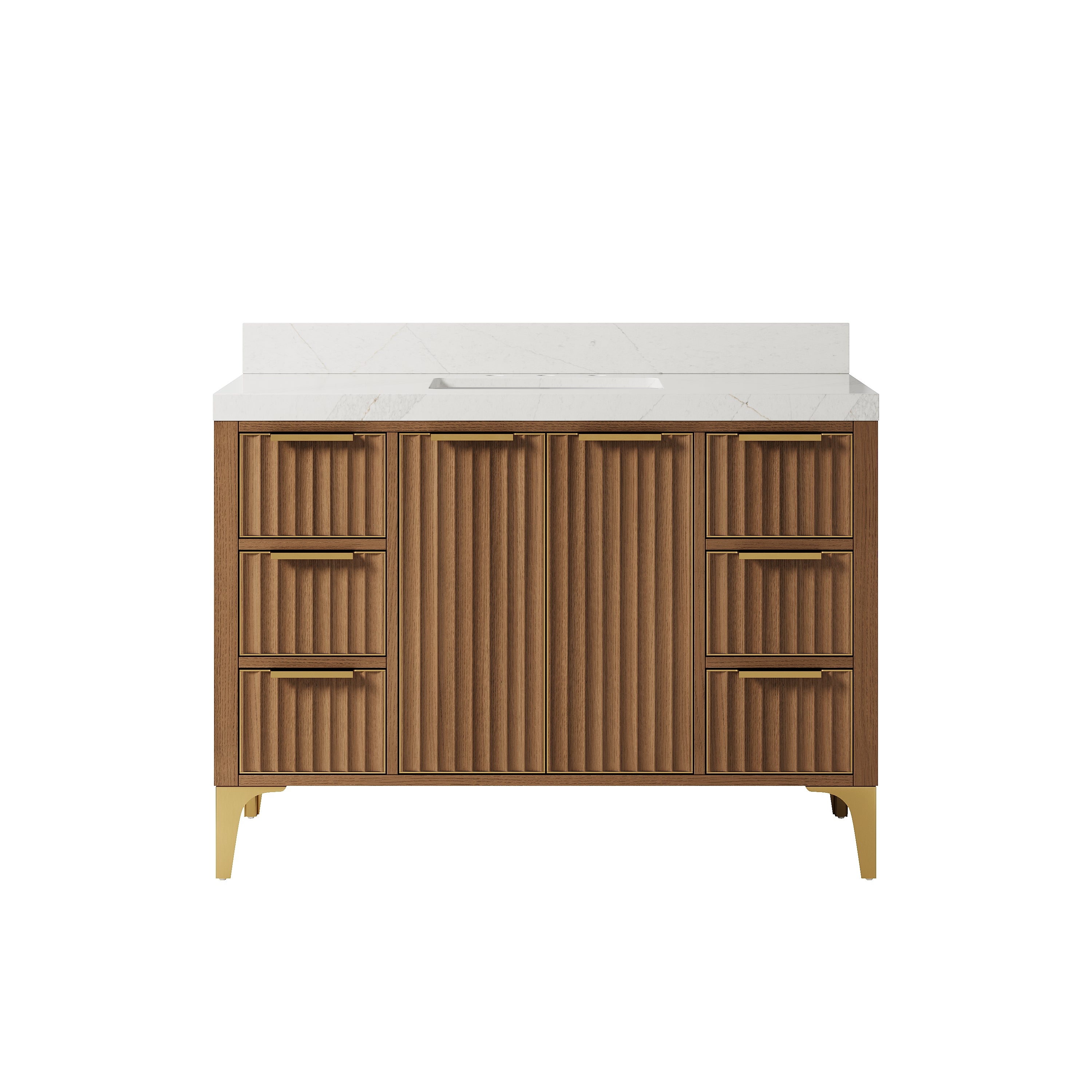


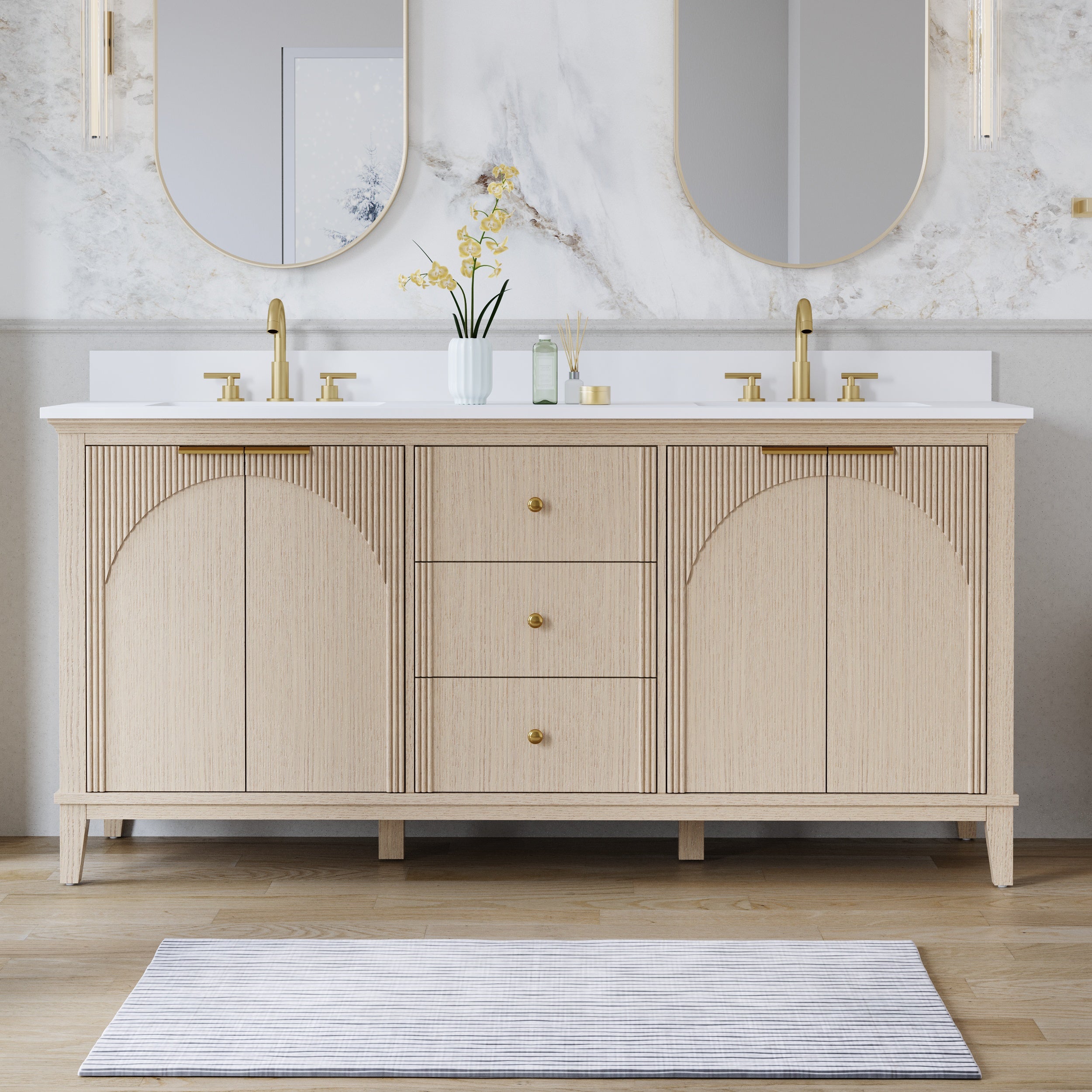
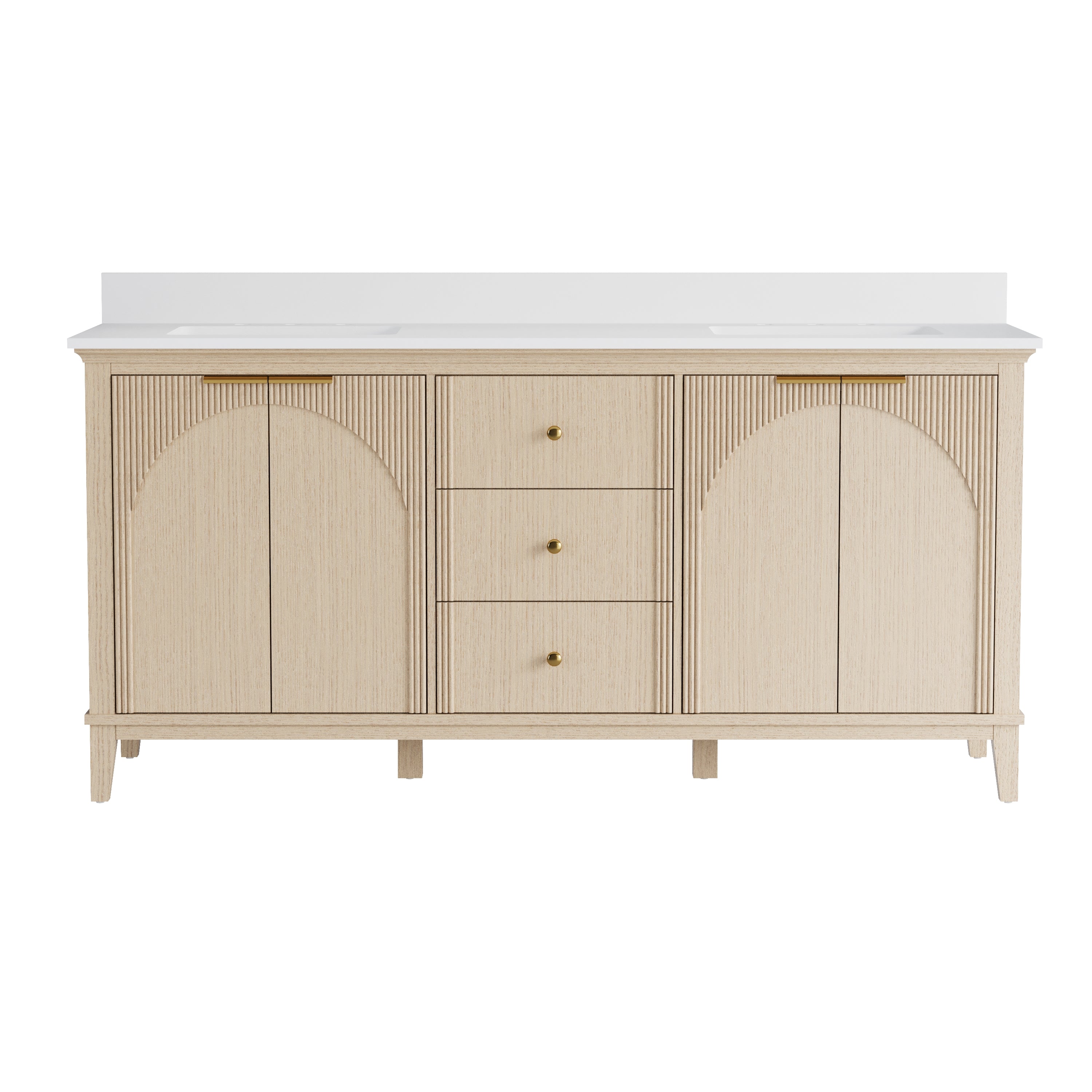
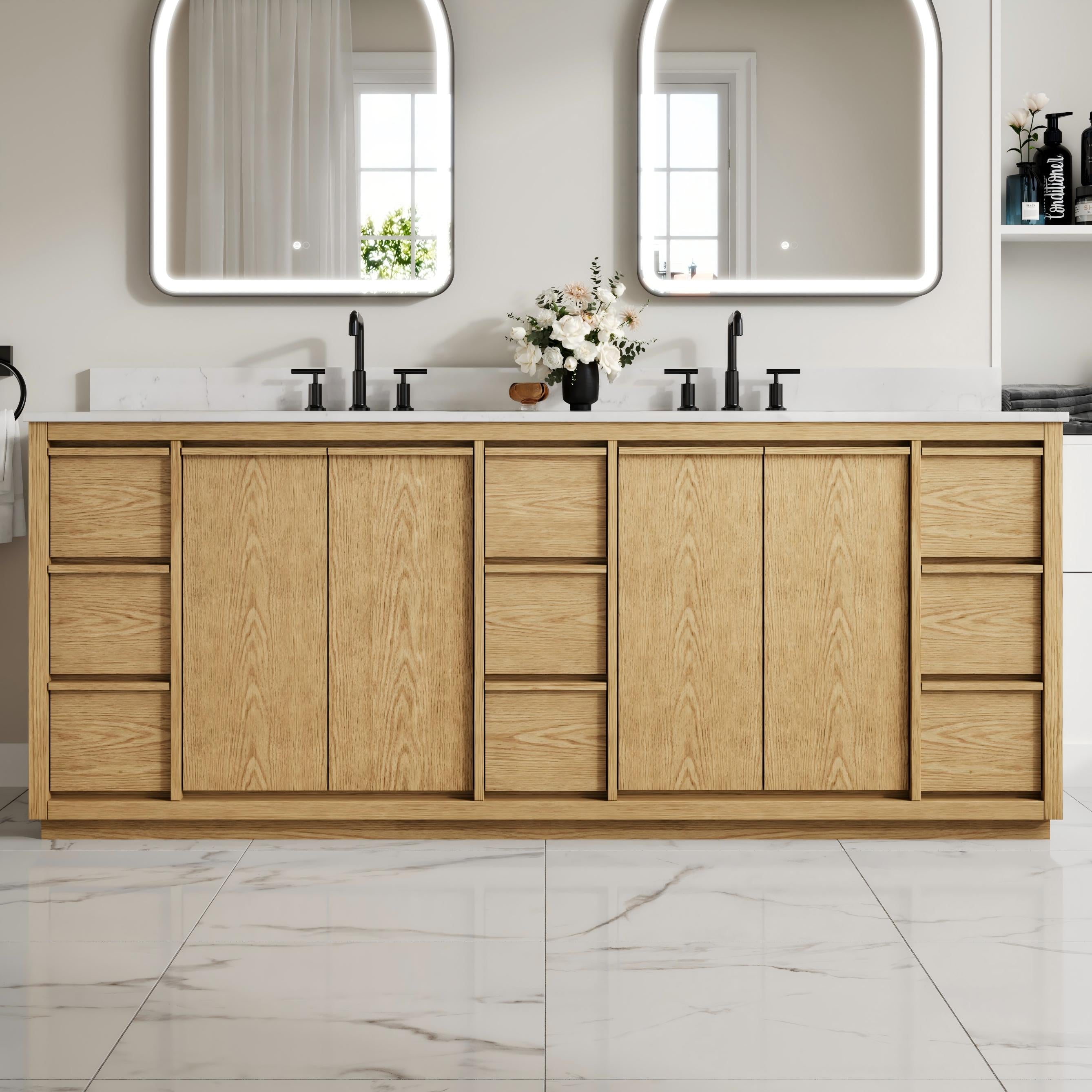
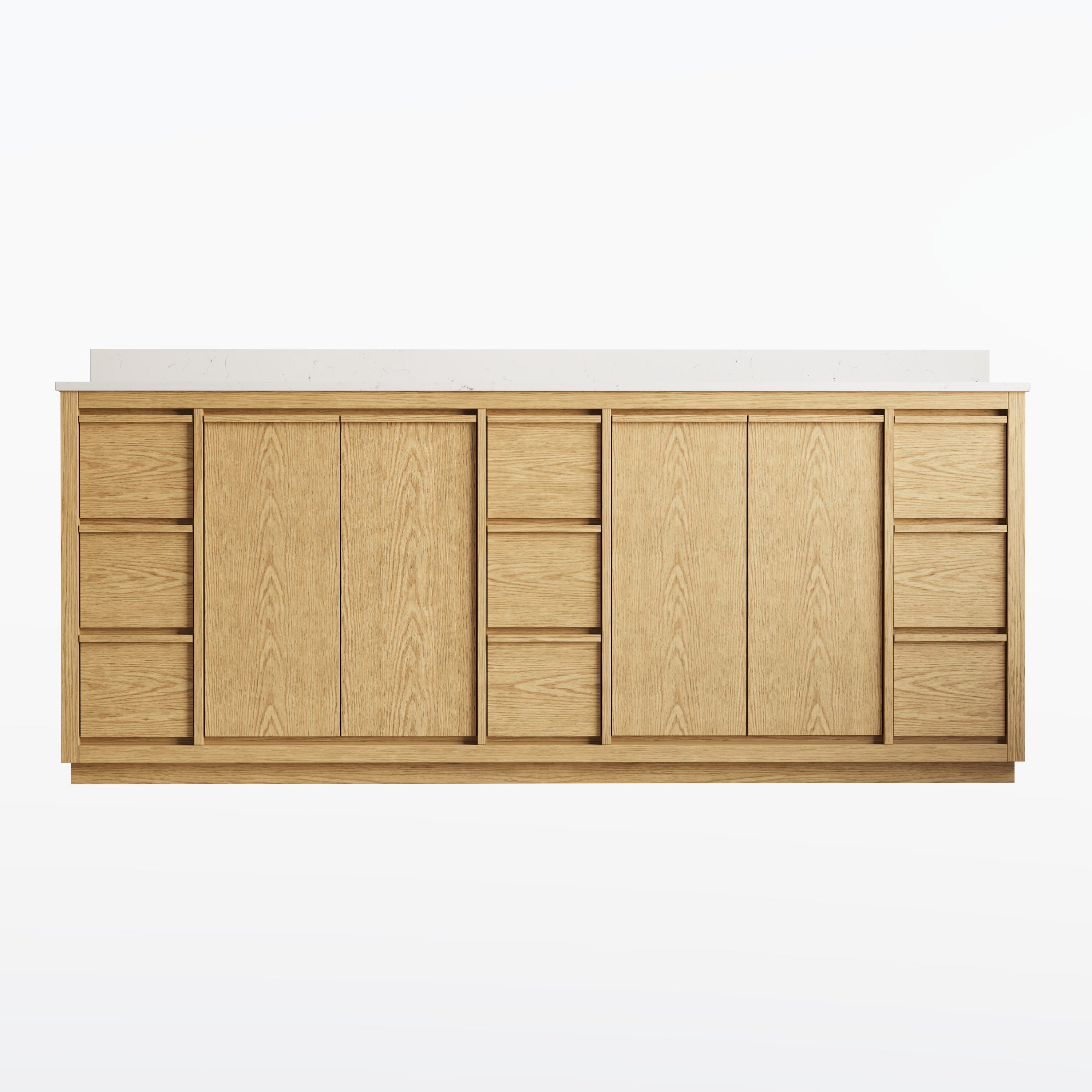

Choosing stone for wood bathroom vanities with tops is no longer a matter of placing a white surface over a brown cabinet. Wood species, stain color, stone undertone, veining, edge thickness, sink configuration, and hardware finish all affect whether the finished vanity feels balanced. Recent industry data also points to a stronger preference for natural-looking materials. In the 2025 Houzz Bathroom Trends Study, 74% of homeowners upgrading a vanity selected solid wood, while engineered quartz accounted for 45% of vanity countertop choices. Quartzite followed at 20%, granite at 14%, and marble at 13%.
1. White Oak and Warm White Quartz
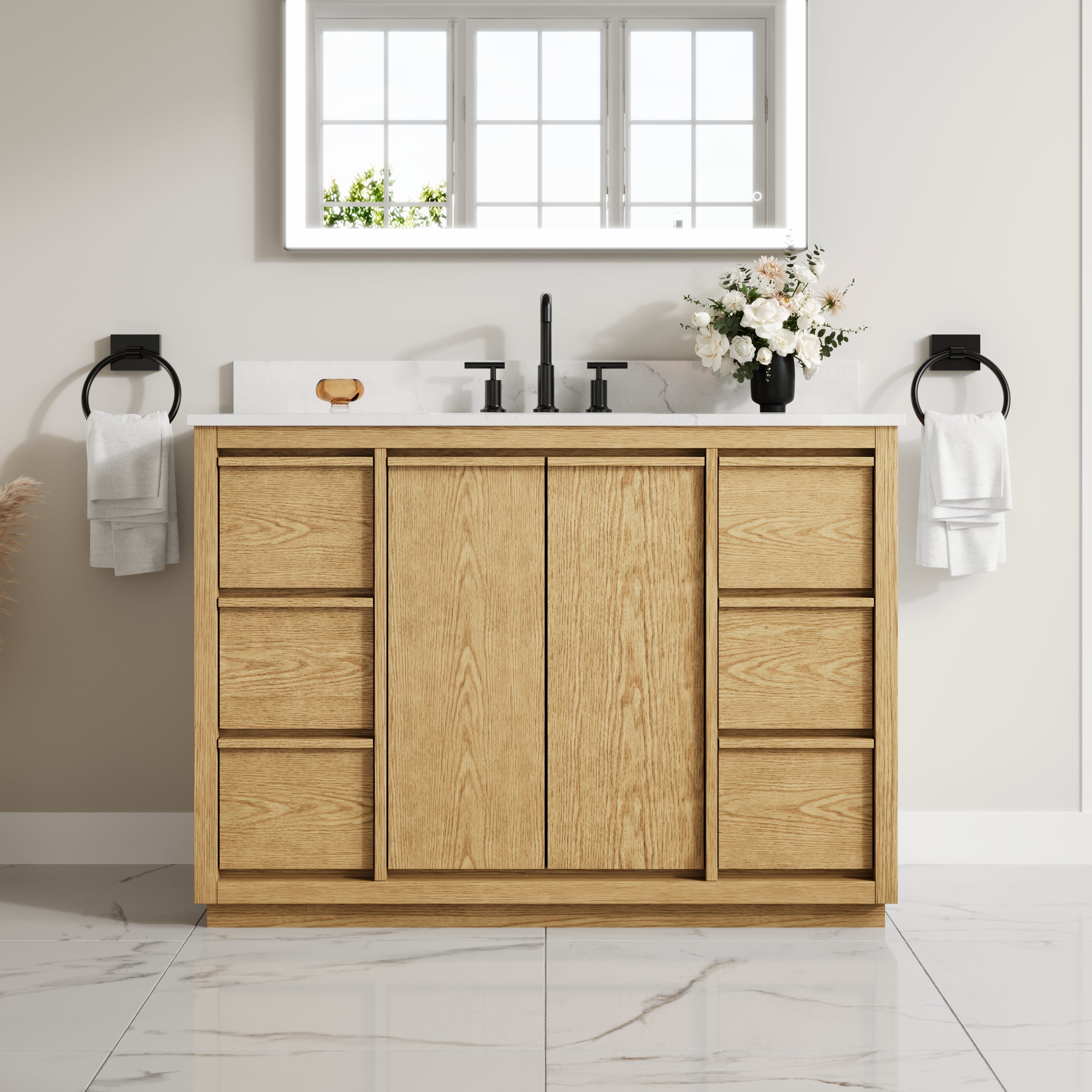
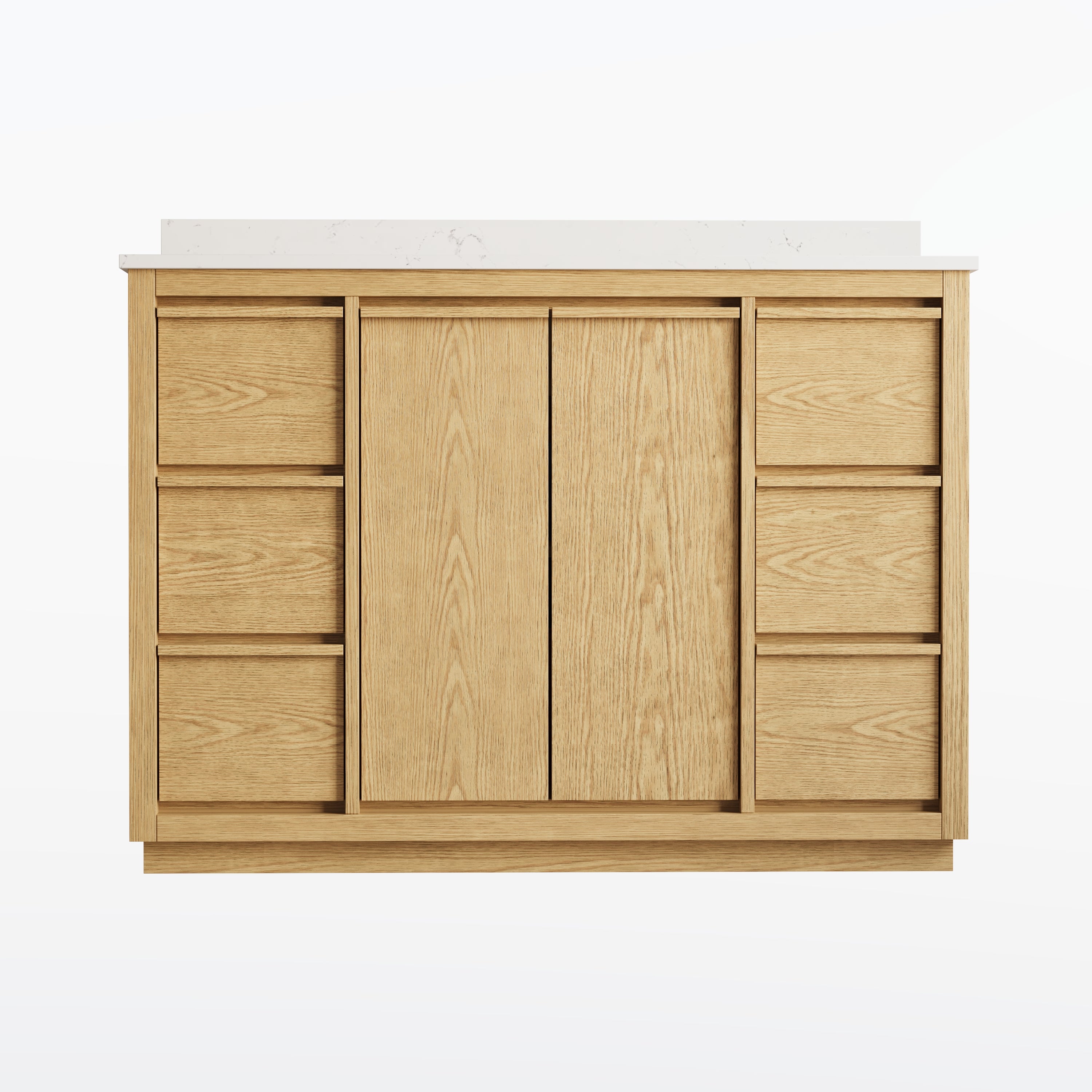
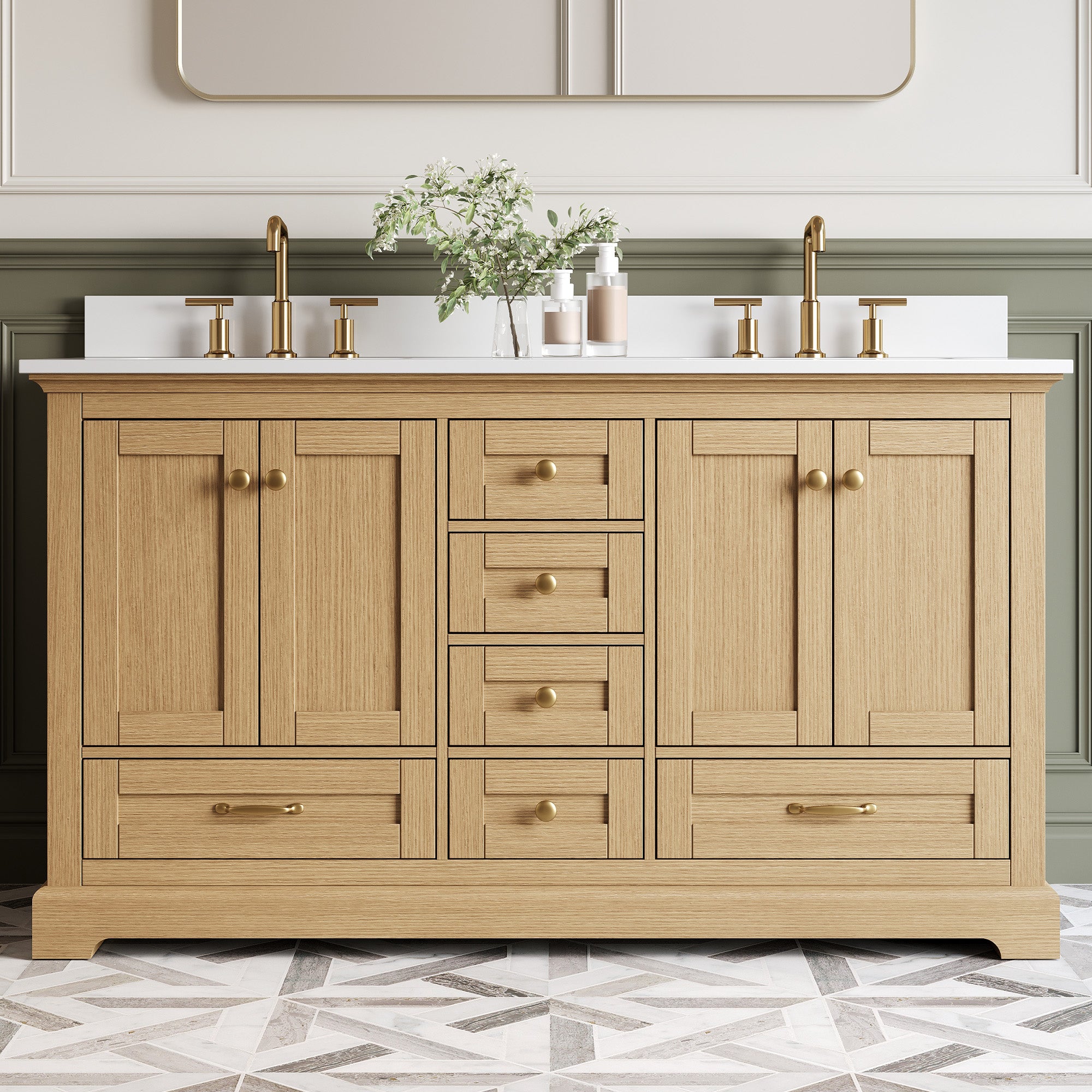
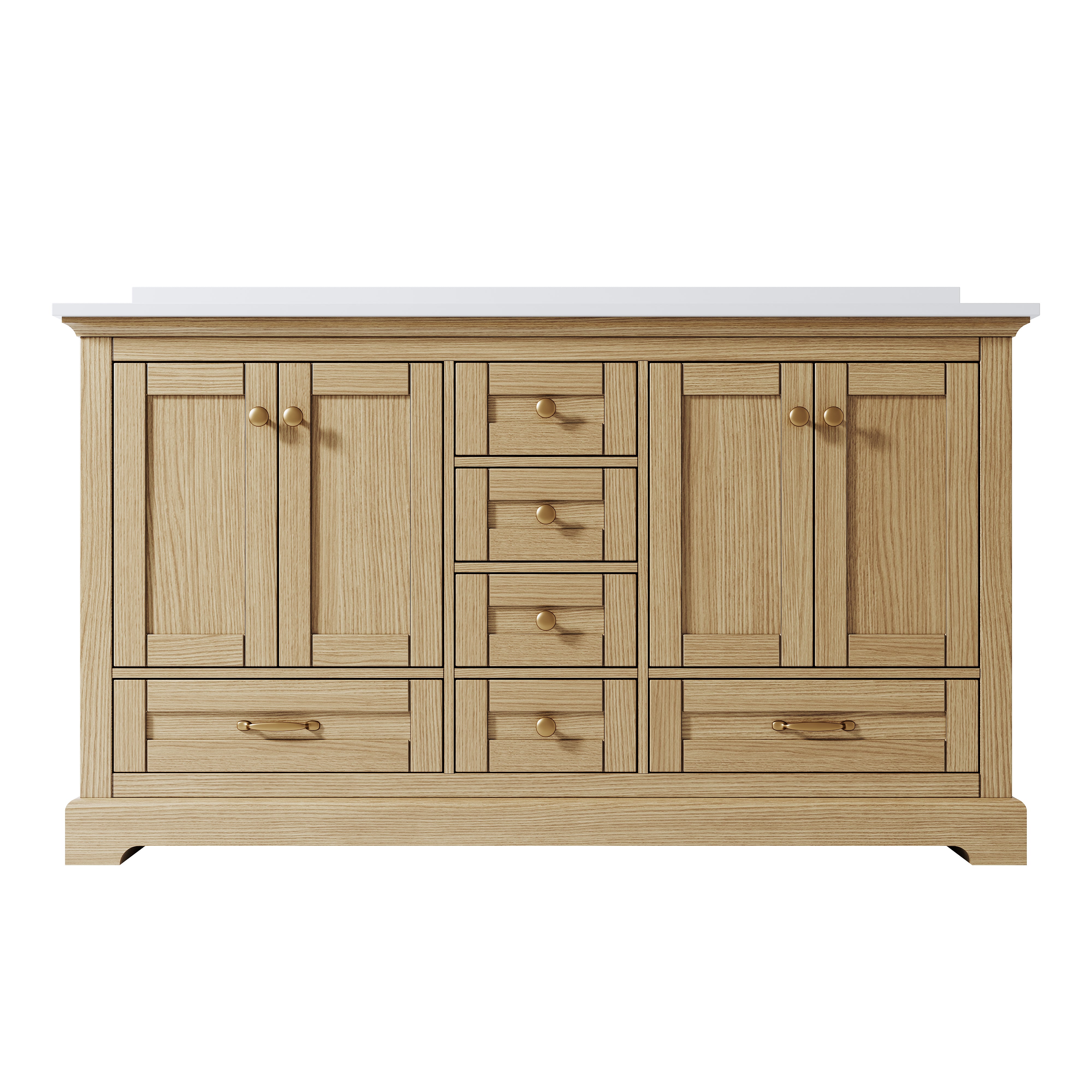
White oak remains one of the easiest cabinet materials to pair with stone. Its pale grain carries beige, honey, and muted gray notes, so a warm white quartz top usually looks more natural than a sharp blue-white surface.
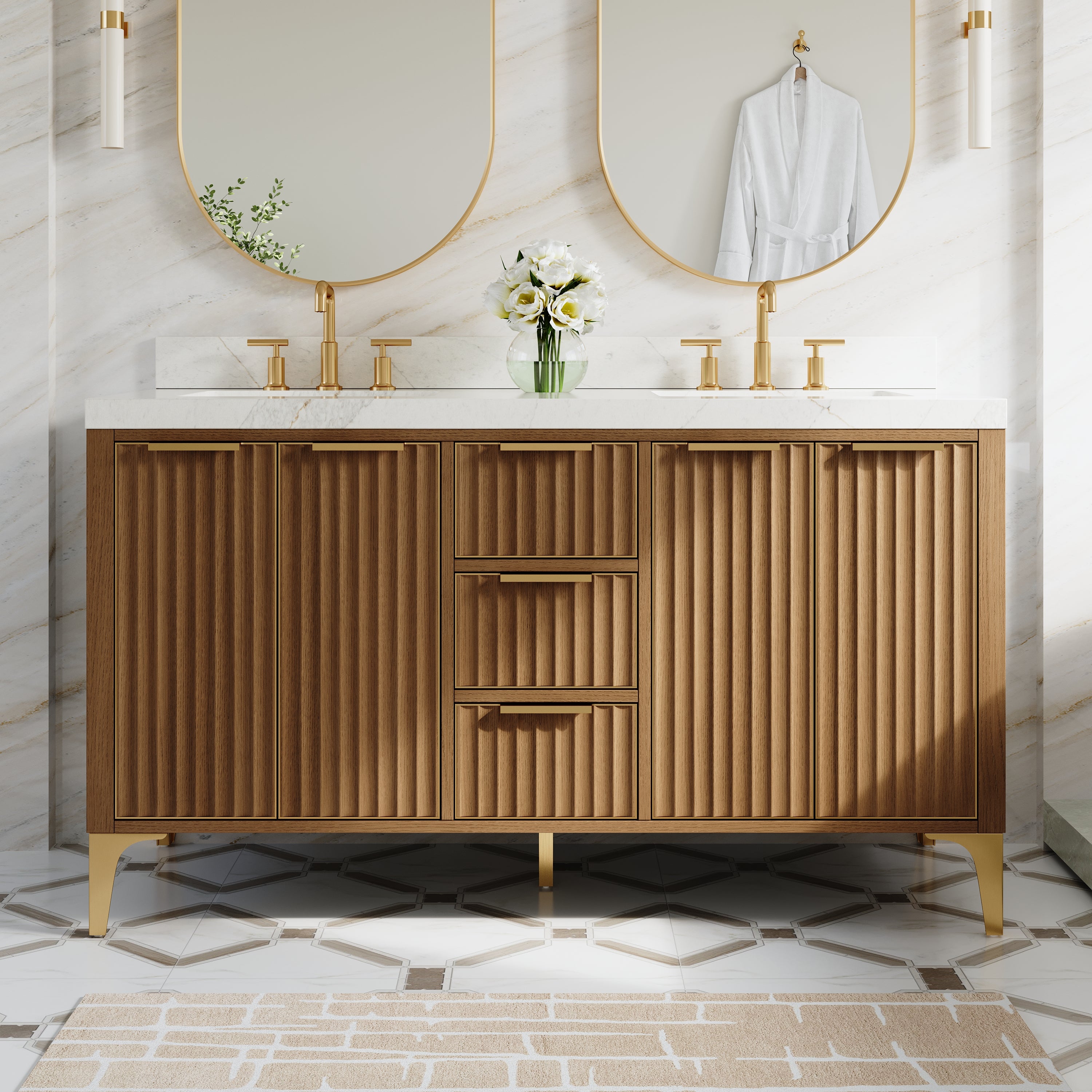
The most adaptable quartz patterns have a creamy background with light taupe, beige, or soft gray veining. They add movement without covering the oak with an overly decorative pattern. This combination works particularly well on 36-inch, 48-inch, and 60-inch vanities, where enough wood remains visible beneath the top to maintain a warm furniture-like appearance.
A countertop around 1 inch to 1 1/4 inches thick gives the vanity a finished profile without making the cabinet appear top-heavy. A 4-inch backsplash is still a practical specification for many freestanding models, especially when the product is intended for easier installation.
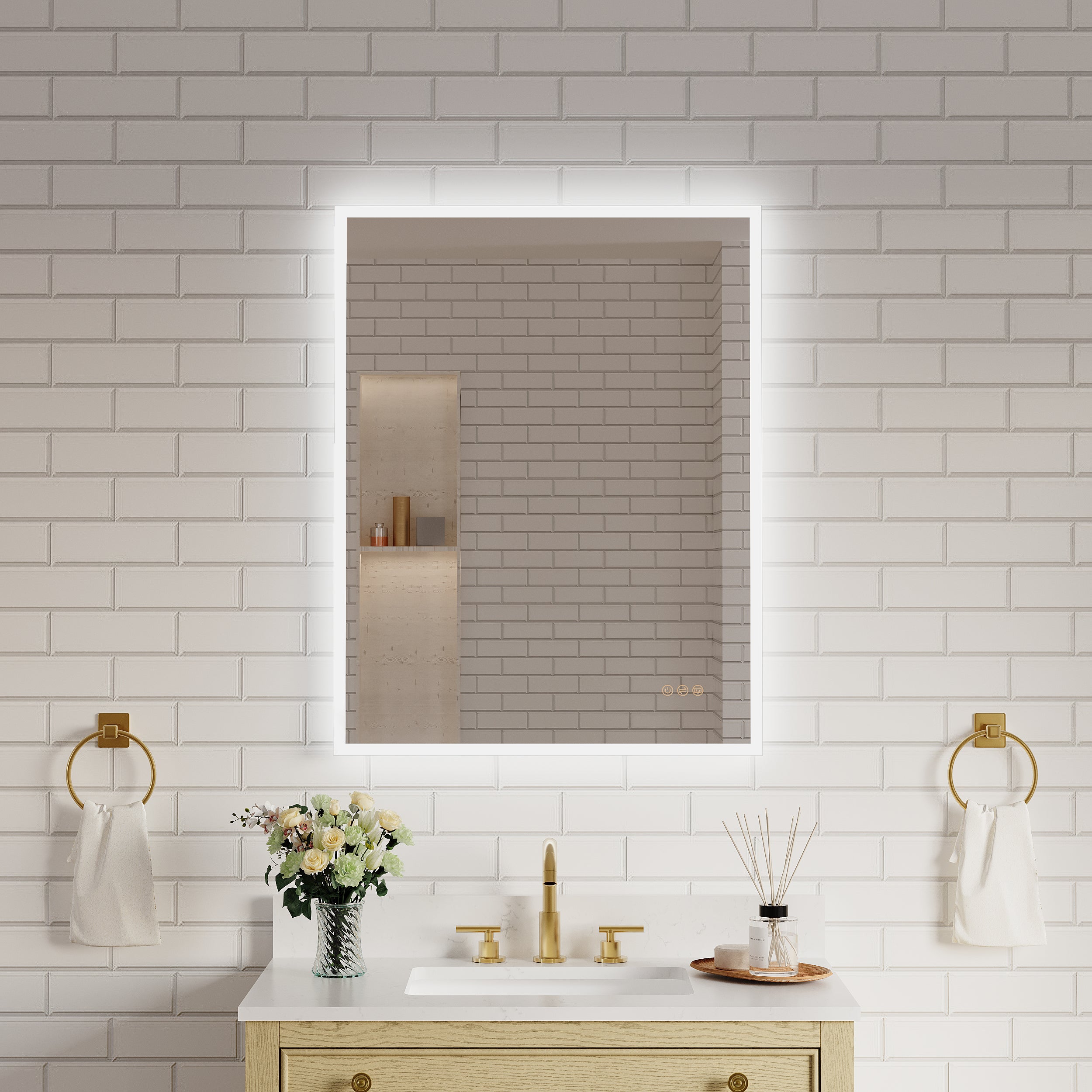
Brushed nickel creates a restrained look, while brushed gold brings out the warmer parts of the oak grain. Matte black can also work, although it produces a more graphic contrast.
2. Natural Oak and Beige Quartzite
Quartzite is becoming a more visible option in higher-end bathroom projects. NKBA’s review of 2025 design directions noted growing interest in quartzite alongside quartz, while its 2026 Bath Trends Report found that wood-faced vanities were identified as popular by 62% of respondents, ahead of painted finishes at 53%.
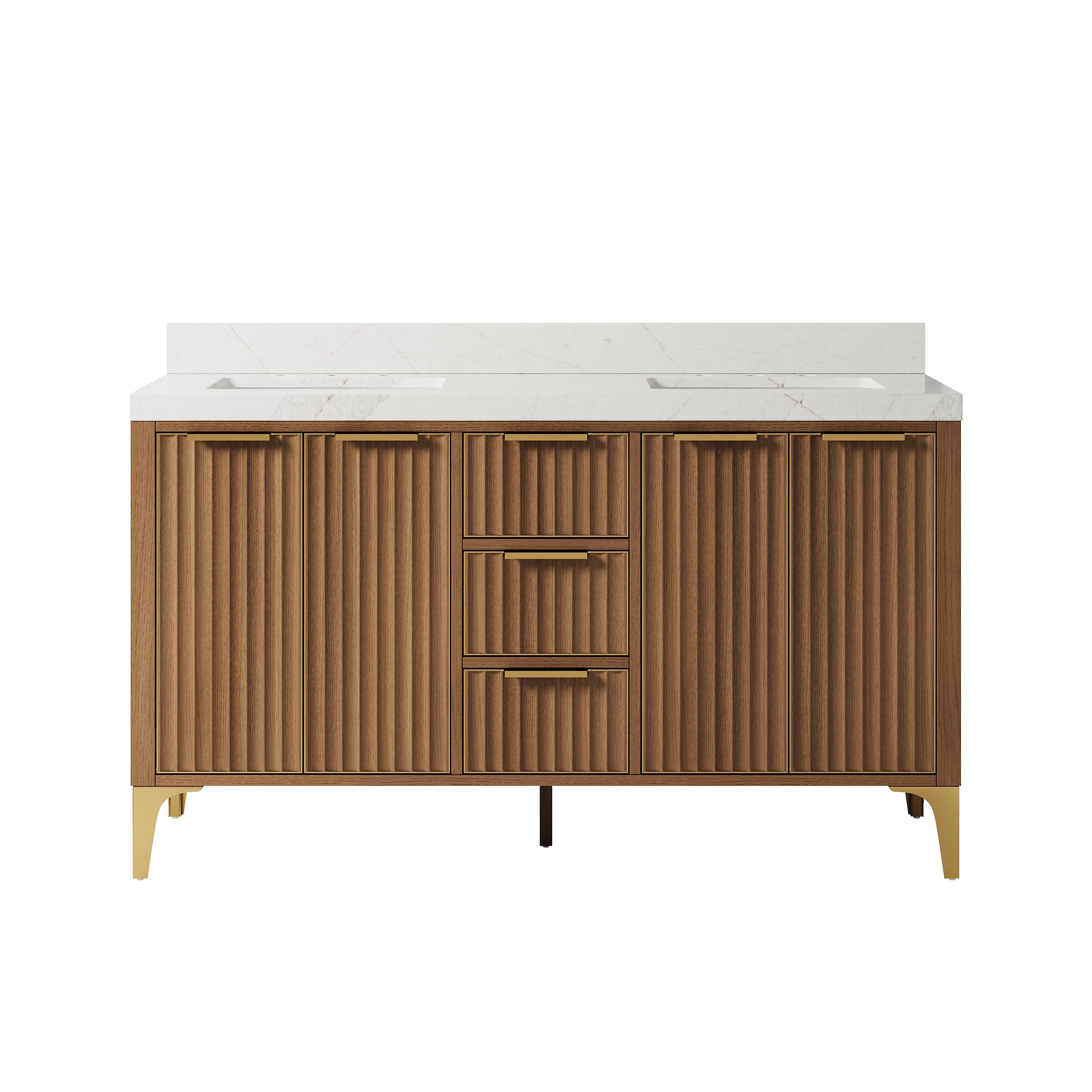
Natural oak pairs especially well with beige quartzite, including slabs with cream backgrounds and long, quiet veins. The stone has enough variation to look authentic, but the warmer palette keeps it connected to the wood.
This pairing is effective on larger 60-inch and 72-inch vanities because a wider countertop provides room for the quartzite pattern to develop. On a narrow 24-inch vanity, a strongly veined slab may look cropped or visually crowded.
Cabinet detailing should also influence the selection. A flat-panel oak vanity can support more visible stone movement. A vanity with fluted drawer fronts, reeded doors, or prominent grain usually benefits from a quieter slab. When both surfaces are highly active, neither material becomes the visual anchor.
3. Walnut and Honed Marble
Walnut has a deeper, more formal character than white oak. Its chocolate brown color and irregular grain can hold its own against marble, particularly when the stone has a honed rather than highly polished surface.
Carrara-inspired marble gives walnut a cooler, tailored appearance. Calacatta-style marble creates stronger contrast through wider gray or gold veining. For a less dramatic result, designers can use marble with a soft white base and fine linear movement.
The honed finish matters because it reduces glare and supports the softer appearance of natural wood. It also helps the vanity read more like a piece of furniture instead of a cabinet fitted with a reflective countertop.
Marble requires a more careful product story. It can develop etching, staining, and patina when exposed to cosmetics, acidic cleaners, or standing water. That does not rule it out, but it makes the pairing better suited to design-led primary bathrooms, guest baths, and powder rooms than applications where minimal maintenance is the main selling point.

4. Medium-Tone Wood and Greige Granite
Granite remains useful for vanity collections built around durability and natural variation. Houzz reported that granite represented 14% of upgraded vanity countertops in its 2025 study, placing it behind quartz and quartzite but slightly ahead of marble.
The more current granite pairings avoid heavily speckled patterns with extreme color variation. Medium-tone oak, maple, birch, and stained rubberwood tend to work better with greige, taupe, or warm gray granite containing smaller mineral markings.
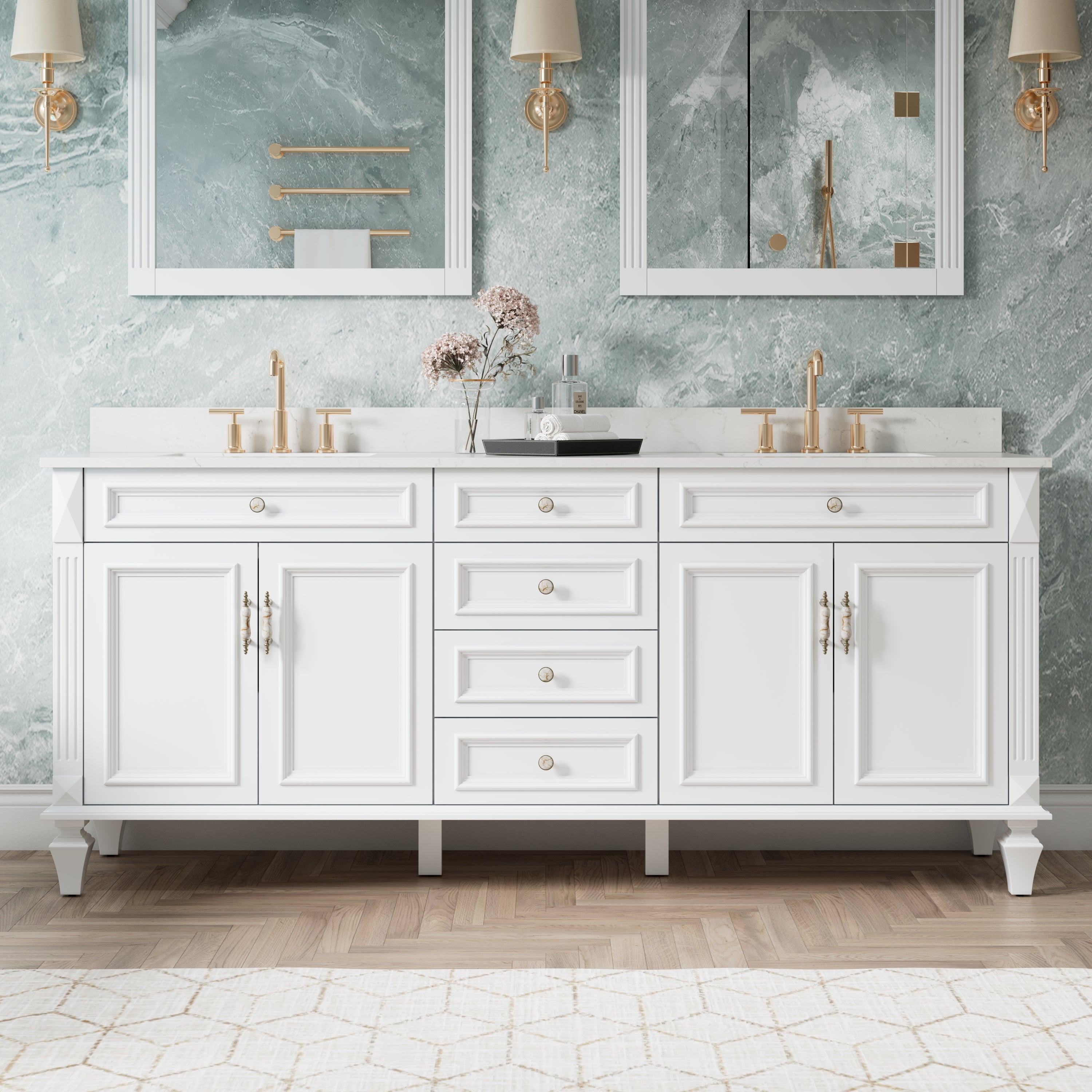
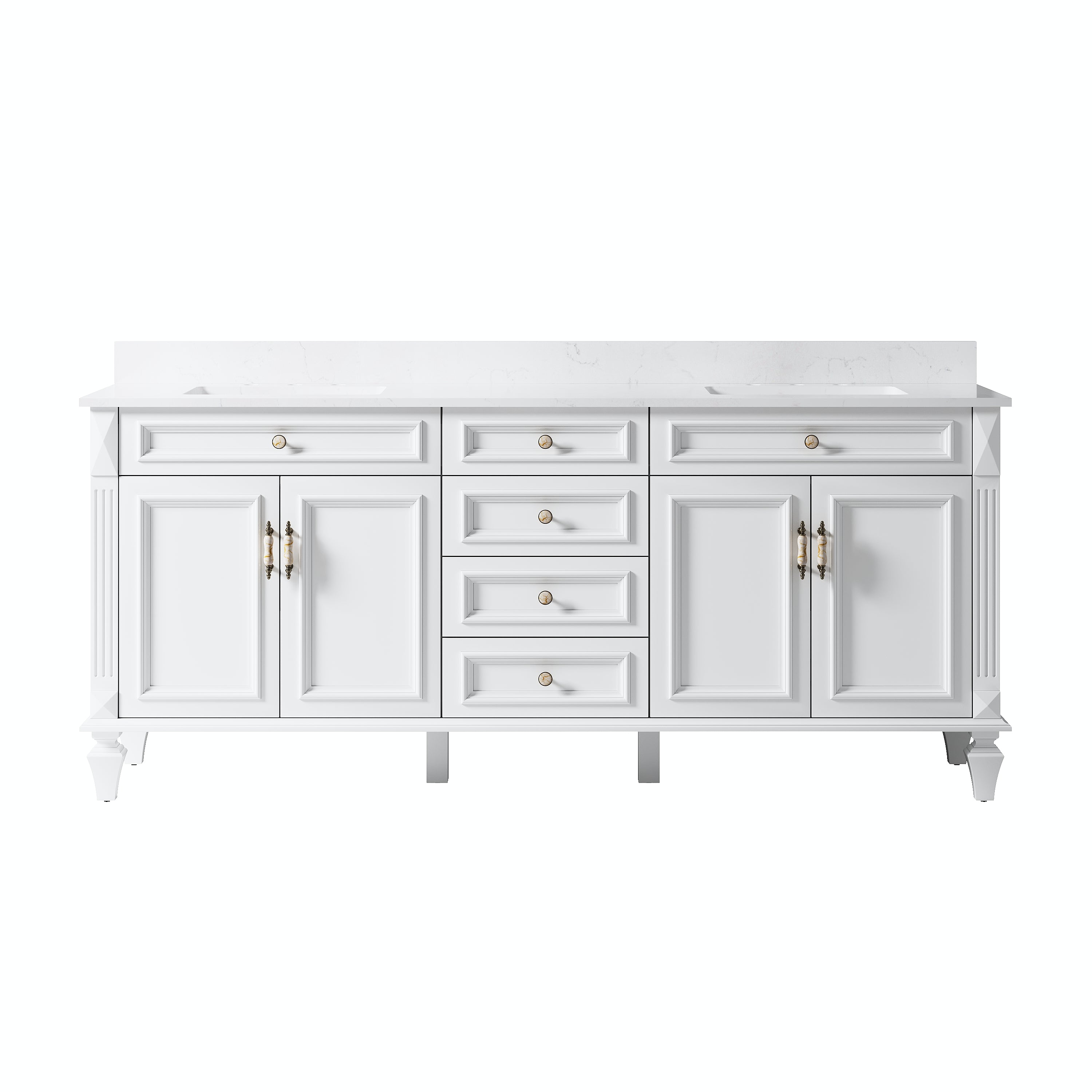
This approach suits 30-inch and 36-inch vanities because the controlled pattern keeps a compact top from looking busy. It is also practical for double-sink models from 60 inches to 72 inches, where repeated faucet holes and two sink cutouts already divide the countertop visually.
A simple eased edge generally looks cleaner than an ornate profile. The stone already has natural depth, so the edge does not need additional decoration.
5. Dark Wood and Soft White Quartz
Espresso, smoked oak, and dark walnut finishes need a lighter countertop to prevent the vanity from becoming visually dense. Soft white quartz is often the most reliable choice because it separates the cabinet from the sink and keeps the upper half of the vanity bright.
The white should not be too cold. A surface with faint warm gray or beige veining usually looks more comfortable beside dark brown wood than a blank, blue-toned white slab. The subtle movement also hides small water marks and everyday residue more effectively than a completely uniform surface.
On a 24-inch or 30-inch vanity, a slim countertop edge preserves a lighter proportion. Larger 48-inch and 60 inch vanities can support a thicker mitered edge, particularly when the cabinet has substantial legs, wide rails, or a furniture-style base.
Dark wood with soft white quartz also leaves room for several hardware directions. Matte black keeps the palette tonal, brushed nickel adds a cooler architectural note, and brushed gold creates a more decorative contrast.
6. Light Wood and Limestone-Look Surfaces
Real limestone offers a soft, chalky character that looks natural with pale oak, ash, and maple. Its beige and sand-colored surface can make a bathroom feel quieter than conventional white quartz. However, limestone is porous and usually requires sealing and more careful maintenance.
For broader product collections, limestone-look quartz or porcelain can provide a similar appearance with more predictable color and performance. The best versions avoid obvious printed patterns. A matte finish with slight tonal variation tends to look more convincing beside real wood grain.
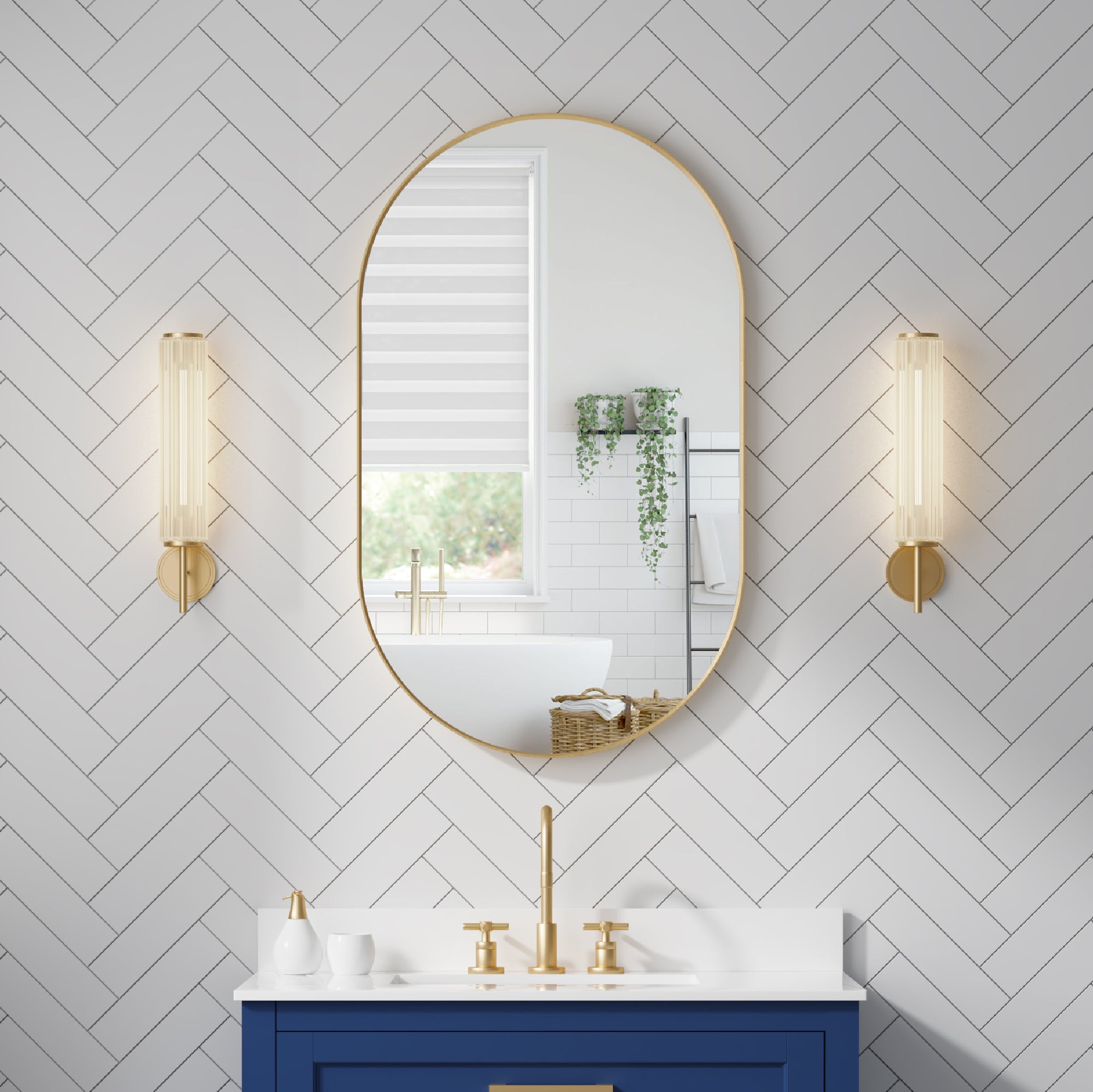
This pairing is especially suitable for organic modern bathrooms with plaster-look walls, warm neutral tile, rounded mirrors, and brushed metal fixtures. NKBA’s 2026 Bath Trends findings placed organic or natural design among the leading style directions and also showed strong preference for neutral bath colors.
8. Stone Choice Is Becoming Part of the Product Identity
Wood-faced vanities are increasingly treated as finished furniture rather than simple storage cabinets. The countertop therefore carries part of the collection’s identity. Warm white quartz supports accessible transitional designs. Beige quartzite signals natural luxury. Honed marble creates a more formal statement, while greige granite provides a practical natural-stone option.
For manufacturers and retailers, the pairing needs to work beyond a styled room image. It should remain attractive under showroom lighting, read clearly in online photography, coordinate with common faucet finishes, and translate across several vanity widths. A restrained stone pattern often gives a wood vanity more flexibility than the most dramatic slab in the warehouse.














Leave a comment
This site is protected by hCaptcha and the hCaptcha Privacy Policy and Terms of Service apply.