






















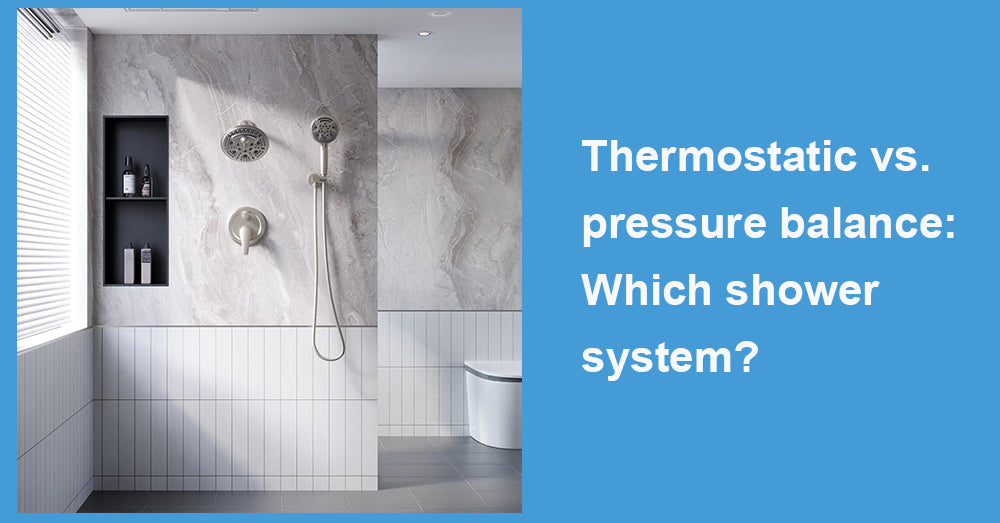
In contemporary bathroom renovations, the choice of shower system is no longer just a matter of whether the showerhead looks good, but a core decision directly related to water safety, comfort, and long-term stability. Among them, the Thermostatic valve and the Pressure Balance valve are the two most commonly compared technical routes. The two have little difference in appearance, but their internal control logic, response methods, and applicable scenarios are entirely different. Truly understanding their differences often determines the upper limit of future bathing experiences.
1. The essence of the problem: Stable water temperature is more important than the amount of water
During the shower, the human body is susceptible to changes in water temperature. Research shows that when water temperature suddenly fluctuates within the range of 3-5 °F, most people will feel noticeable discomfort; changes above 7 °F can easily trigger startle reflexes and even pose burn risks.
In real life, starting the washing machine, flushing the toilet, and using water in the kitchen can instantly change the pressure and flow rate in the hot and cold water pipes. The core task of a genuinely excellent shower system is not "producing a lot of water", but "maintaining a stable temperature".
This is the technical starting point for distinguishing between constant-temperature systems and pressure-balanced systems.
2. Pressure balancing system: the most common and fundamental solution
The working logic of a pressure balancing valve is relatively simple. When the pressure on one side of the cold or hot water changes, the valve core synchronously adjusts the flow ratio on the other side to maintain the "pressure ratio" of cold and hot water unchanged.
For example, when cold water suddenly decreases, the system automatically reduces hot water flow to maintain a stable ratio of hot and cold water, thereby avoiding sudden overheating.
The advantages of this system lie in its simple structure, low cost, and easy maintenance. In a large number of residential projects, pressure-balancing systems account for more than half of installations and have become a long-standing "basic standard configuration".
But its limitations are also pronounced: it can only maintain "proportional stability", but cannot lock in "temperature values". If the inflow temperature changes, the final outflow temperature will still fluctuate accordingly, but the magnitude of the shift is constrained within a small range.
3. Thermostatic system: a precise control method that directly locks the temperature
The core of the constant-temperature system is that the internal constant-temperature core senses water temperature in real time and automatically adjusts the ratio of hot and cold water to the set value.
Users only need to set the knob to a specific temperature range, such as 100-104 °F, and the system will continue to maintain that temperature output even if the inlet pressure or the temperature of the hot or cold water changes. The thermostatic valve will still prioritize adjusting the ratio rather than simply following pressure changes.
Test data show that when water is used at multiple points simultaneously, the fluctuation of the outlet temperature of the constant-temperature system is usually controlled within ±1-2 °F, while the fluctuation range of the pressure-balanced system is more likely to approach ±4-6 °F.
This stability difference is particularly evident in environments with significant changes in inlet water temperature during winter.
4. The gap in security performance: not just whether it will be hot or cold
In terms of security, the difference between the two is more crucial.
The pressure balance system mainly prevents "sudden overheating", but does not have absolute temperature limit protection capability. If the hot water inlet temperature itself is too high, the outlet temperature may still exceed the comfortable range.
And constant-temperature systems usually have built-in high-temperature limit devices. When the outlet temperature approaches around 120 °F, the system will automatically limit further heating and quickly close the hot water channel when the cold water is interrupted. This protective mechanism has significant advantages in scenarios where children and older people use it.
Industry accident statistics show that in shower systems with temperature control, the risk of discomfort and minor burns caused by abnormal water temperature can be reduced by more than 40%.
5. Differences in user experience: Stability comes from "continuity of details"
From daily experience, the pressure balance system is already qualified in terms of "basic comfort", and most users do not frequently experience significant thermal shocks.
But in multi-nozzle systems, top spray + handheld + side spray combination structures, the differences begin to amplify.
When multiple water outlets are opened, the system's internal flow distribution changes. Pressure-balancing valves often prioritize maintaining the proportion, but balancing temperature consistency across numerous outlets is difficult, which can easily lead to situations where the top spray is too hot, and the handheld is too cool.
The constant-temperature system continuously adjusts the ratio between multiple outlet water paths to maintain a uniform overall water temperature. That is also why thermostatic valves have almost become standard in high-end multifunctional shower systems.
6. Installation and maintenance: Complexity for long-term stability
Structurally, thermostatic valves are more complex than pressure-balancing valves and require higher installation accuracy and waterway conditions. Reverse water flow, excessive impurities, or abnormal water pressure can all affect the response speed of the constant-temperature core.
But once the installation standards and filtration system are in place, the system's stable life is often longer. Long-term project-tracking data show that after 8-10 years of use, the performance degradation of constant-temperature systems is generally about 20% lower than that of pressure-balanced systems.
This means that in high-frequency households or long-term self-occupied projects, constant-temperature systems have greater long-term value.

7. Price and positioning: not "the more expensive, the better", but "matching scenarios"
At the cost level, constant-temperature systems are usually 30%-60% higher than pressure-balancing systems, and the difference is more pronounced in multi-way control structures.
Therefore, a reasonable selection strategy should be based on usage scenarios:
For projects with a single outlet, limited space, and budget constraints, the pressure-balancing system can already meet basic safety and comfort requirements.
For spaces with a main bathroom, multiple nozzle systems, complex family members, or a pursuit of high-quality experiences, the stability and safety advantages of a constant-temperature system often far outweigh the increased costs.
8. Conclusion: Technology selection is essentially a trade-off between "experience stability"
From a technical perspective, the pressure balancing system represents "passive regulation", while the constant temperature system represents "active control".
The former solves fundamental security issues, while the latter pursues refined experience and long-term stability.
The former is suitable for standard configurations, while the latter is better suited for high-end and complex systems.
The truly ideal shower system is not unthinkingly pursuing the highest specifications, but finding the most reasonable balance between spatial structure, frequency of use, family members, and budget.
In shower scenarios that rely heavily on continuous experience, stability is often more important than dazzling appearance.









































Leave a comment
This site is protected by hCaptcha and the hCaptcha Privacy Policy and Terms of Service apply.