






















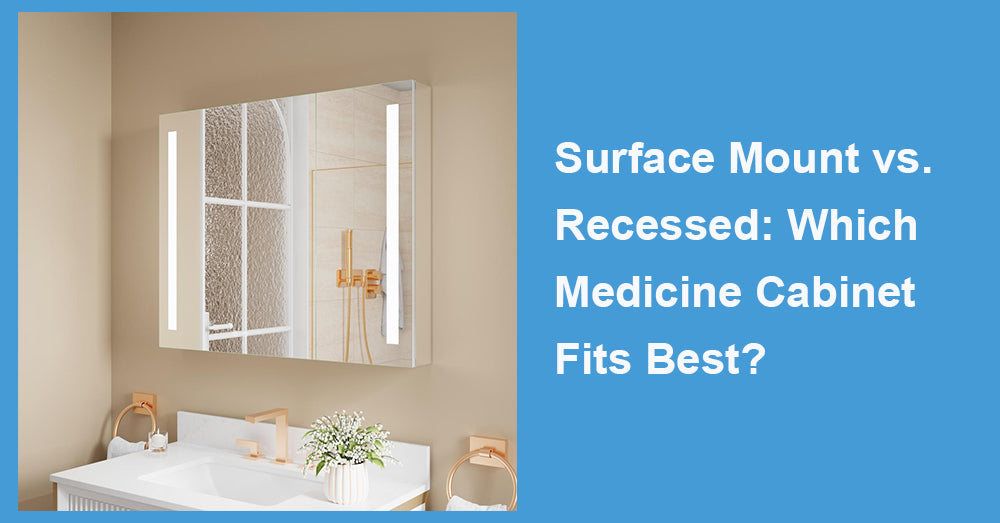
In bathroom renovation or new construction projects, the choice of a medicine cabinet for bathroom is not only about storage capacity but also directly affects the space ratio and installation complexity.
The current mainstream installation methods are divided into two structures: Surface Mount and Recessed.
There are differences between the two in terms of visual effects, space utilization, construction costs, and long-term maintenance.
For a 30-inch30-inch single-pot layout or a 60-inch60-inch double-pot structure, the choice of installation method often determines the overall design direction.
1. Structural differences and appearance proportions
The Surface Mount mirror cabinet is directly mounted on the exterior of the wall, and the overall depth is usually between 4 and 6 inches.
A surface-mounted mirror cabinet with a width of 24 inches and a height of 30 inches, with a protruding thickness of about 5 inches, and relatively sufficient internal storage space.
The Recessed structure is embedded inside the wall.
The effective cavity depth of a standard 2x4 wall is about 3.5 inches, so the internal depth of an embedded mirror cabinet is usually between 3 inches and 4 inches, with only about 1 inch of exposed parts.
Visually, the embedded structure is flush with the wall, making it more concise.
Design data shows that in compact bathrooms with an area of less than 100 square feet, the satisfaction with the spaciousness of embedded structures is about 20% higher than that of surface installations.
But in spaces where the floor height exceeds 9 feet, or the wall width exceeds 120 inches, the presence of exposed structures enhances the proportional hierarchy.
2. Difference between storage capacity and actual use
Under the same external dimensions, Surface Mount structures typically have a greater internal storage depth.
For example, a 24-inch-wide open-mount mirror cabinet with an internal depth of over 5 inches is sufficient to hold bottled skincare products with a diameter exceeding 3 inches.
In contrast, the Recessed structure is constrained by the wall depth, resulting in a slightly smaller internal space.
If there is a high demand for storage, such as storing electric shavers or larger bottled products, an exposed structure is more advantageous.
Data shows that in daily use, over 80% of common toiletries have a diameter less than 3 inches, so embedded structures are still sufficient for most households.
But for double-person households with high storage requirements, the capacity advantage of the exposed structure is more obvious.
3. Installation cost and construction complexity
Surface Mount installation is relatively simple.
Fix it on the wall and connect it to a power source (if it is a structure with lights).
Construction time is usually 1 to 2 hours.
Recessed installation requires opening the wall, reinforcing the frame, repairing the drywall, and repainting.
If there are water pipes or wires inside the wall, additional adjustments may be required.
Data shows that under standard conditions, the labor cost of embedded installation is usually 20% to 40% higher than that of surface installation.
During the new construction or large-scale renovation phase, if the walls are not yet enclosed, the additional cost of adding embedded structures is relatively low.
In spaces that have already been renovated, the difficulty of construction significantly increases.
4. The impact on spatial flow lines
In compact bathrooms with widths ranging from 36 to 42 inches, a 5-inch outward protrusion of the exposed structure may affect passage comfort.
If the aisle is only about 30 inches wide, reducing the protruding depth by 1 inch will improve the activity space.
The embedded structure is almost flush with the wall, making it more advantageous in narrow spaces.
In main bathrooms with over 120 square feet, the pressure on the flow line is relatively low, and the impact of exposed structures on traffic is limited.
5. Design Style and Visual Trends
The modern minimalist style leans more towards a Recessed structure to keep the walls clean.
Embedded mirror cabinets commonly have a width of 20 inches to 30 inches and a height of 26 inches to 34 inches on a 36-inch van, with a lighter proportion.
Traditional or transitional style spaces are often paired with framed, exposed-mirror cabinets, with metal frames that can complement the materials of faucets and showerheads.
Design surveys show that the adoption rate of embedded structures has been increasing year by year in mid to high-end renovation projects.
However, surface-mounted structures still dominate in retrofit projects.
6. Long-term maintenance and replacement flexibility
The Surface Mount structure will be more convenient for future replacement.
If you need to upgrade the size or change the style, disassemble the old cabinet.
If the Recessed structure is changed to a different size, it may require rerepairing the wall.
Especially when the new size is inconsistent with the old opening, the adjustment cost increases.
From a long-term flexibility perspective, the exposed structure is more suitable for households that may frequently change their designs.
7. Suggestions for adapting to different spaces
If the bathroom area is less than 100 square feet and you want to maximize the sense of space, the Recessed structure is more ideal.
If storage requirements are high or wall conditions are complex, Surface Mount is more practical.
In the 30-inch to 36-inch single-pot configuration, the embedded structure emphasizes proportional coordination.
In the 60-inch double-basin layout, the exposed double-mirror cabinet can provide greater storage capacity.

8. Conclusion
There is no absolute superiority or inferiority between Surface Mount and Recessed installation methods for a medicine cabinet for a bathroom.
The exposed structure emphasizes capacity and construction convenience, while the embedded structure highlights space optimization and visual cleanliness.
From the 3.5-inch wall depth limit to the selection of 24-inch or 30-inch mirror cabinet sizes, each decision should be based on spatial conditions and usage habits.
Understanding structural differences and construction logic is necessary to achieve the optimal balance between functionality, budget, and aesthetics.









































Leave a comment
This site is protected by hCaptcha and the hCaptcha Privacy Policy and Terms of Service apply.