






















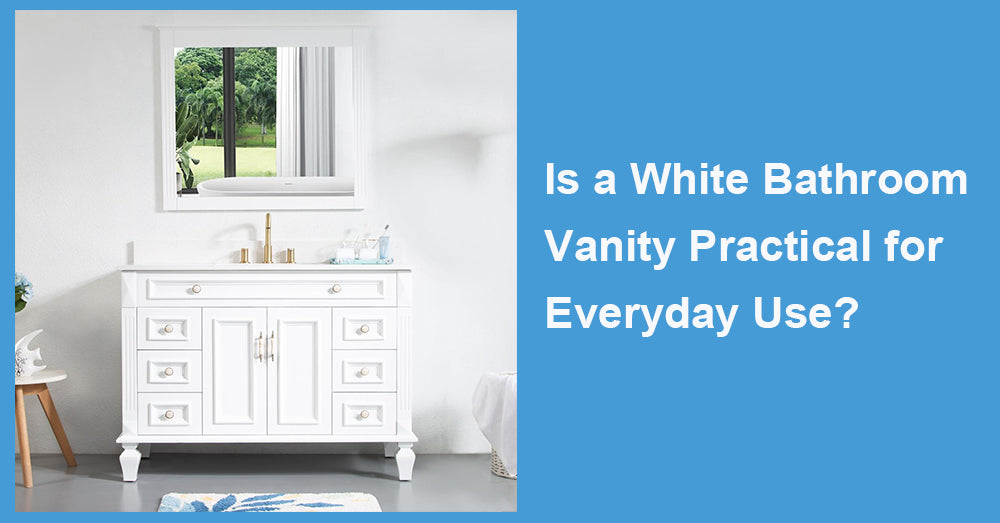
A white bathroom vanity has become a kind of “default luxury”: clean lines, brighter light bounce, and an easy match for nearly any tile or hardware. But practicality is the real question—especially now, when bathroom updates are being driven as much by maintenance and durability as by style. Remodeling activity is still supported by large-scale investment: Harvard’s Joint Center for Housing Studies projects total homeowner spending on improvements and repairs will hit $524 billion in early 2026, a record high.
That bigger spending context matters because bathrooms tend to be high-touch, high-humidity spaces where surfaces are tested every day. Houzz’s 2025 Bathroom Trends Study puts the median spend on all bathroom renovations at $13,000 in 2024, while major remodels (at least the shower is upgraded) reached a median of $22,000, with the top end climbing far higher. And the majority of bathrooms aren’t being completely reconfigured—Houzz reports 82% stay about the same size after renovation—so the vanity often becomes the “biggest functional change” without moving walls.
Why white is still everywhere (even as tastes diversify)
Design pros continue to favor light neutrals because they read as calm and adaptable. NKBA’s 2026 Bath Trends Report press release notes 96% of surveyed industry respondents identified neutrals as the most popular bath colors, and it lists off-white and white among the dominant responses. In earlier NKBA trend reporting for 2025, white also ranked as the most selected color in the top palette list (trade coverage of NKBA’s survey results puts white at 76%).
So yes—white is still highly “safe.” But safe doesn’t automatically mean practical. A white vanity is useful when you treat it like a performance surface, not just a color choice.
The real-world practicality test: what white shows
White finishes tend to show dark smudges (mascara, self-tanner, hair dye, muddy handprints) more clearly than mid-tone woods. On the flip side, white often hides light mineral spotting better than glossy black or very dark finishes, where every dried water droplet becomes visible under vanity lights.
The bigger issue is not the color—it’s the finish system and how the vanity is built at edges, seams, and around the sink where moisture lives.
What makes a white vanity hold up day after day?
1) Choose the right sheen
Ultra-matte painted cabinets look modern, but they can burnish or show rub marks in high-use zones. For everyday bathrooms, a satin or soft semi-gloss painted finish is usually the most forgiving: it wipes clean without telegraphing every touch.
2) Pay attention to the material at the door and panel core
White vanities are commonly painted, and paint performance depends on the substrate and edge sealing. Houzz data suggests buyers are paying attention to the base material: among those choosing wood vanities, 74% chose solid wood (with MDF, plywood, particleboard, and veneer taking smaller shares). Solid wood can be excellent, but it also moves with humidity; MDF can be stable and smooth for paint when it’s properly sealed—what fails most often is poor edge finishing and water exposure at joints.
3) Pick a countertop that forgives daily mess
If your goal is “looks white, stays easy,” the countertop does a lot of work. Non-porous surfaces (for example, many quartz tops) resist staining and don’t require sealing the way some natural stones do. Pair that with a sink shape that keeps water in the bowl (adequate rim height, controlled splash), and your cabinet stays cleaner longer.
4) Hardware finish can be your secret weapon
Every day, practicality isn’t just the cabinet—it’s the whole touch system. Houzz reports vanity handle finishes skew toward easy-living options, with brushed nickel leading at 32%. Brushed finishes generally hide fingerprints and micro-scratches better than polished ones.
And soft-close is no longer a “nice-to-have.” Houzz finds 78% choose soft-close drawers and 75% soft-close doors. On a painted white vanity, that matters: gentle closing reduces impact at corners and at hinge-side edges, where paint chipping usually starts.

Size and layout: practical dimensions in inches
A white vanity can look amazing and still be annoying if it’s the wrong size. Here’s the sizing logic that aligns with common planning expectations:
· Depth: A widely used “standard” depth is about 21 inches, with many vanities falling roughly in the 20–23-inch range; shallow options around 16–18 inches can work in tight baths but sacrifice counter landing space.
· Height: Many vanities land in the 30–36 inch band, depending on “standard” vs “comfort height.” If you’re planning around accessibility guidance, lavatory rim/counter heights are often referenced at 34 inches max in accessibility standards.
· Clearance in front: Planning guidance commonly calls for around 30 inches of clear floor space in front of fixtures, while minimum code clearances can be tighter (often cited at 21 inches).
Those numbers aren’t about style—they’re about whether you’ll hate the space during the morning rush.
What “practical” looks like in 2026: less upkeep, fewer fussy surfaces
The industry conversation is increasingly blunt: people want less maintenance. NKBA’s 2026 Bath Trends findings highlight that 91% of respondents prioritize durability and practicality to minimize upkeep when choosing flooring materials, and 89% reported a preference for more minor or no grout lines. That same low-maintenance mindset carries straight to the vanity: fewer grooves to trap grime, better edge sealing, and finishes that can take frequent wipe-downs.
At the same time, there’s a noteworthy shift: NKBA reports wood-faced vanities (62%) overtook painted (53%) in popularity in its 2026 trend findings. That doesn’t mean white is “out.” It means white is now being judged more on performance—buyers will still choose it, but they’ll punish cheap paint and weak construction faster than ever.
The bottom line: is white practical?
Yes—a white bathroom vanity is practical for everyday use if you spec it like a working surface:
· Favor wipeable sheen (often satin/soft semi-gloss over dead-flat in busy baths).
· Prioritize sealed edges and solid joinery over “pretty door profiles.”
· Pair it with a forgiving countertop and brushed hardware.
· Don’t undersize: a depth of around 21 inches and enough clearance in front will matter every single day.
· Treat soft-close as standard, not premium—today, most people already do.









































Leave a comment
This site is protected by hCaptcha and the hCaptcha Privacy Policy and Terms of Service apply.