




















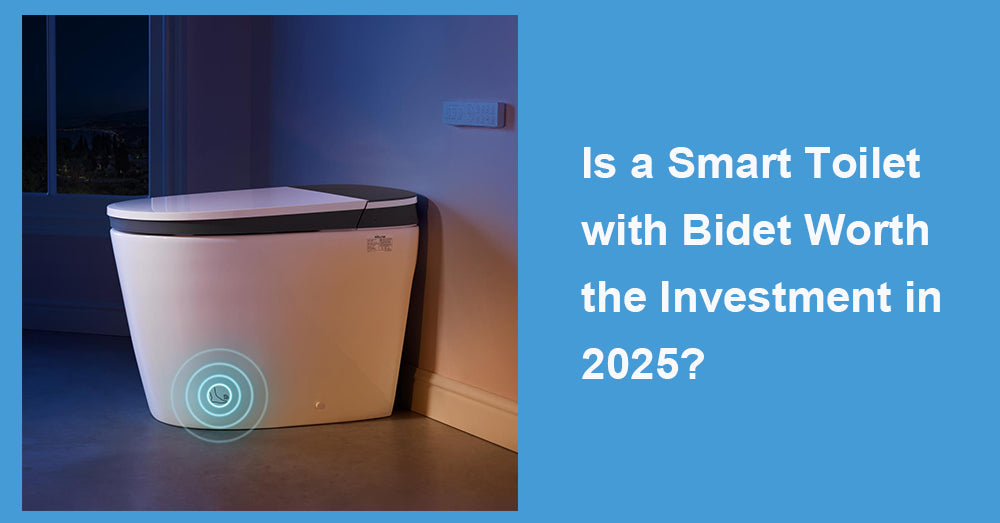
With the continuous penetration of smart homes into people's daily lives, smart toilet with bidet are becoming a new hotspot for the growth of the bathroom industry. Is the development of this niche market still worth investing in by 2025? From multiple dimensions such as market size, technological trends, water resource efficiency, and health value, the answer tends to be 'yes', but there are also challenges.
1. Market size and growth drivers
According to authoritative industry reports, the overall market size of smart toilets is expected to reach approximately 4.66 billion US dollars in 2024 and 5.11 billion US dollars by 2025, with a compound annual growth rate (CAGR) of approximately 7.15% in the coming years.
Meanwhile, another study proposes a more aggressive prediction: by 2034, the smart toilet market will grow from approximately $8.3 billion in 2024 to $28.4 billion, with a compound annual growth rate of 13.1%.
The driving factors behind this growth include increased awareness of hygiene, the penetration of smart homes, demand for water resource conservation, and demand for higher comfort sanitary equipment in an aging society.
In addition, both smart toilets and electric Bidet seats have experienced substantial growth in their respective markets. According to a report by GlobalGrowth Insights, the demand for electric bidet seats and smart toilets is expected to reach $1.95 billion in 2024 and grow to $2.07 billion by 2025, with a CAGR of 6.0% over the coming years. The standalone "smart bidet toilet seat" market is estimated at around $3.79 billion in 2024 and is expected to grow to $4.09 billion by 2025, with a CAGR of 7.89% over the coming years.
These data indicate that this niche market still has significant expansion potential.
According to another analysis, the connectivity capabilities of smart toilets (such as Wi-Fi and Bluetooth) are also a key driver of the market. Some high-end models support remote control and app management, meeting the needs of modern homes for connected devices.
2. Technological Trends and Product Evolution
At the technical level, the integration of smart toilets and bidets is becoming increasingly sophisticated. Modern models typically have the following functions:
Automatic flushing and sensor cover opening
Heating seat ring
Bidet nozzle for regulating water temperature and pressure
Night light, deodorizing, drying function
Self-cleaning nozzle
Connect to cloud/smart home platforms
In the future, new products will emphasize health-monitoring functions, such as sensors that detect health indicators (urine pH, blood sugar, etc.), which may further increase product premiums and added value.
The "integrated" intelligent all-in-one machine (i.e., the toilet body with functions such as Bidet, heating, and flushing) in the smart toilet market is growing rapidly. According to Fortuna Business Insights' forecast, the integrated sector will grow at a CAGR of up to 8.37% over the coming years. Meanwhile, premium products are increasing at a higher rate, with an estimated CAGR of approximately 10.05%.
3. Water conservation and sustainability
A key selling point of smart toilets with a Bidet function is their water-conserving and environmentally protective features. Traditional toilet flushing and cleaning mainly rely on impulse and require a large amount of water; the bidet function reduces dependence on tissues through washing, thereby reducing toilet paper consumption to some extent.
According to the Bidets market report, the global bidet market is expected to reach $6.54 billion in 2024, $6.82 billion in 2025, and grow at a CAGR of 4.14% between 2025 and 2034. The report points out that about 48% of users choose a bidet because it reduces toilet paper use. In addition, some high-tech, bright toilet designs can achieve water-saving effects through dual-flushing or optimized water-flow paths.
Under the investment logic of strong environmental awareness, promoting the popularization of smart toilets may meet the needs of commercial projects, such as residential decoration, green buildings, and even hotels, for water conservation and reduced paper consumption.
4. Health Value and Aging Demand
The Bidet function of the intelligent toilet not only enhances comfort but also has health benefits. For people with a history of hemorrhoids, inflammatory bowel disease, or urinary tract infections, washing with water is milder, more hygienic, and less irritating to the skin than wiping. The UPC (Unified Pipe Code) documents also state that this type of equipment provides a milder, more hygienic alternative.
In addition, in an aging society, smart toilets can enhance the independence of people with limited mobility by sensing lid opening, facilitating self-cleaning, and offering simple operation. The intelligent seat heating, night light, and other functions are also efficient during nighttime activities.
Therefore, for investors or manufacturers concerned about health, hygiene, or long-term comfort, the combination of smart toilets and bidets is beautiful.
5. Risks and Challenges
Despite the promising prospects, there are still some potential obstacles to investing in smart toilets with a bidet:
High installation cost
Smart toilets, especially integrated all-in-one machines, have stricter requirements for water and electricity installation. Many traditional toilets cannot be replaced directly and require plumbing or wiring renovations.
High price threshold
The price of high-end smart toilets may be too high for ordinary families to accept. Some users have also reported that some intelligent all-in-one machines cost thousands of dollars.
Maintenance and repair issues
Smart toilets with electronic components and sensors require more maintenance. If there is a shortage of professional installation personnel or local accessories, it is likely to hinder the user experience.
Water quality issues
If the water supply is poor (e.g., contains minerals or is hard), the nozzle and heating element may be more prone to scaling or malfunction.
Cultural and habitual barriers
The acceptance of the Bidet varies among users in different regions. Although more and more people are paying attention to hygiene, some users are still unfamiliar with washing and using the toilet.
6. Investment Logic Analysis
From a comprehensive perspective of risks and opportunities, the following types of investors may be the most suitable:
Innovative bathroom manufacturers: Continuous investment in technology-oriented, integrated smart toilets can capture high-end growth opportunities.
Real estate developers/high-end residential projects: Integrating smart toilets into newly built residences, villas, and luxury homes can enhance overall value and comfort.
Elderly care/health care institutions: If smart toilets and bidets are used in elderly residences, rehabilitation centers, and medical institutions, they can improve the accessibility of the toilet experience and overall health.
Smart Home Service Provider: Collaborate with the home automation ecosystem to integrate smart toilets into a complete smart home solution.

7. Summary: 2025 is worth investing in, but requires precise positioning
In summary, the market foundation for smart toilets with a bidet in 2025 remains solid, with strong growth drivers. The global smart toilet and smart bidet seat markets both have significant long-term growth potential; technological iteration (water temperature control, automatic flushing, health sensing), water conservation and environmental protection needs, and health value are driving this growth. Meanwhile, the aging trend also provides a stable potential user base for it.
But successful investment is not without challenges. Controlling installation costs, reducing prices, ensuring after-sales service, and adapting to cultural differences will be key. For investors, the focus should not be on broad coverage, but on accurately selecting niche areas such as high-end residential properties, elderly care institutions, and smart home ecosystems.
If the strategy is clear and the product differentiation is evident, then entering the field of smart toilets with a bidet in 2025 is undoubtedly a direction worth serious consideration.






























Leave a comment
This site is protected by hCaptcha and the hCaptcha Privacy Policy and Terms of Service apply.