






















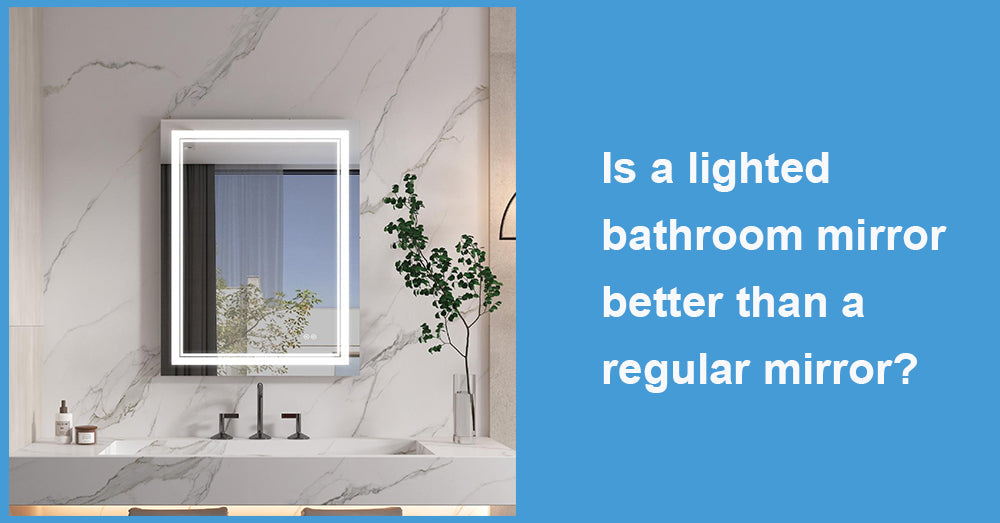
Walk into a new hotel, a show flat, or a freshly renovated apartment, and you’ll notice one detail again and again: the lighted bathroom mirror. Once a niche luxury, it’s quickly moving toward mainstream, pushing many homeowners and developers to ask the same question:
Is a lighted bathroom mirror actually better than a regular mirror, or is it just a trend?
From an industry point of view, the answer is becoming clearer: lighted mirrors aren’t replacing regular mirrors overnight, but they’re shifting the market and changing what people expect from a bathroom.
A fast-growing category, not just a gimmick
Global data shows that mirrors with integrated LEDs are no longer a small side product.
Research firms estimate the LED mirrors market at around USD 2.8 billion in 2024, with expectations to almost double to about USD 5.2 billion by 2033.
Other reports that focus specifically on illuminated or decorative mirrors point to steady growth in North America and Europe, driven by home renovations, hospitality projects, and a desire for functional yet stylish fixtures.
Why the rush? In simple terms: better light, better selfies, and better bathrooms.
What makes a lighted mirror “better”?
A lighted bathroom mirror usually has built-in LED strips around or behind the glass. Compared with a plain mirror that depends on ceiling lights or wall sconces, it changes the user experience in several ways.
1. More even, face-friendly lighting
Designers and lighting brands agree on one thing: lighted mirrors give more even illumination on the face than a regular mirror with only overhead lights. LEDs placed around the mirror reduce shadows under the eyes, nose, and chin, which makes tasks like shaving, tweezing, or applying makeup easier and more accurate.
Backlit mirrors can also create a soft halo of light, making small bathrooms feel larger and more high-end.
2. Adjustable brightness and color
Many newer lighted mirrors offer dimming and color temperature adjustment. Users can switch from warm, relaxing light at night to bright, neutral light in the morning with a simple touch button.
This flexibility is something a regular mirror can’t provide unless you redesign the entire lighting scheme around it.
3. Energy efficiency and long life
Because they use LEDs, lighted mirrors typically consume less power and last longer than traditional bulbs or halogen fittings. Market analysts cite energy efficiency as a key driver of the rapid growth of the LED and illuminated mirror segment worldwide.
For developers and hotels, this means lower running costs over time. For homeowners, it’s a small but visible step toward a “greener” bathroom.
4. Extra features built into the glass
To stand out, brands are packing more functions into the mirror itself:
· Anti-fog heating pads to keep the glass clear after a hot shower
· Touch controls on the surface for power and dimming
These features turn the mirror into a mini control center, rather than just a reflective surface.

The downside: cost, complexity, and “too cold” light
If lighted mirrors were perfect, regular mirrors would already be disappearing. They aren’t — and the reasons are convenient.
1. Higher purchase and installation cost
A good-quality lighted bathroom mirror usually costs more than a simple glass mirror and may require an electrician for hard-wiring. Industry guides and consumer articles note that installation can be a barrier, especially in older bathrooms with limited power points or tight renovation budgets.
By contrast, a regular mirror with two wall sconces gives more flexibility: you can change lights or the mirror separately, and sometimes even do it yourself.
2. Repair and replacement are less flexible
Because the LEDs, drivers, and wiring are built into the mirror, repairing a failed component can be tricky. For cheaper models, it’s often easier (but more wasteful) to replace the whole unit. Designers point out that this “all-in-one” structure is elegant, but less forgiving in the long run than a regular mirror paired with separate, replaceable light fixtures.
3. Light quality matters — and cheap models cut corners
Another complaint comes from lighting specialists: not all LED mirrors produce flattering light. Many low-end products use very cool, harsh white LEDs that can make skin look washed out and the room feel clinical. Higher-end mirrors with adjustable color and a higher color rendering index (CRI) look much nicer, but usually cost more.
In other words, a poor-quality lighted mirror looks worse than a simple mirror plus two warm, well-placed wall lights.
How the market is positioning lighted mirrors
From an industry perspective, the question “Is a lighted bathroom mirror better than a regular mirror?” is really about segmenting users and projects.
· Homeowners upgrading bathrooms
· For urban, style-driven consumers, a lighted mirror is now seen as an affordable “luxury touch” that instantly modernizes a space. This group often values aesthetics, Instagram-ready lighting, and convenience, and is willing to pay more for them.
· Developers and hospitality
· In hotels, rental apartments, and show units, lighted mirrors help create a consistent, high-end look while offering good task lighting and reasonable energy use. Illuminated mirrors are increasingly specified in project packages, becoming part of the standard “modern bathroom” checklist.
· Cost-sensitive or traditional buyers
· For buyers whose main priority is keeping costs low, a regular mirror still wins. A simple mirror with basic lighting remains the most economical and easiest-to-maintain option, especially in secondary bathrooms or guest toilets.
Market reports suggest that as prices continue to fall and LED tech improves, illuminated mirrors will take a larger share of the total bathroom mirror market. Still, regular mirrors will remain important in budget and ultra-traditional segments.
So is a lighted mirror “better”?
From a user experience and market trend standpoint, the answer is:
· For lighting quality and functionality:
· Yes, a lighted bathroom mirror is usually better. It gives more even light on the face, better visibility for grooming, and extra features that a plain mirror does not offer.
· For cost, simplicity, and long-term flexibility:
· A regular mirror plus separate lights can still be the more intelligent choice, especially when budgets are tight, styles change often, or easy maintenance is a top priority.
For the bathroom industry, the key takeaway is not that one completely replaces the other, but that customer expectations are rising. People now know they can have a mirror that lights up, adjusts to their mood, clears its own fog, and saves energy at the same time.
In that sense, whether a lighted bathroom mirror is “better” than a regular mirror, it is already reshaping the standard for what a modern bathroom mirror should be.







































Leave a comment
This site is protected by hCaptcha and the hCaptcha Privacy Policy and Terms of Service apply.