






















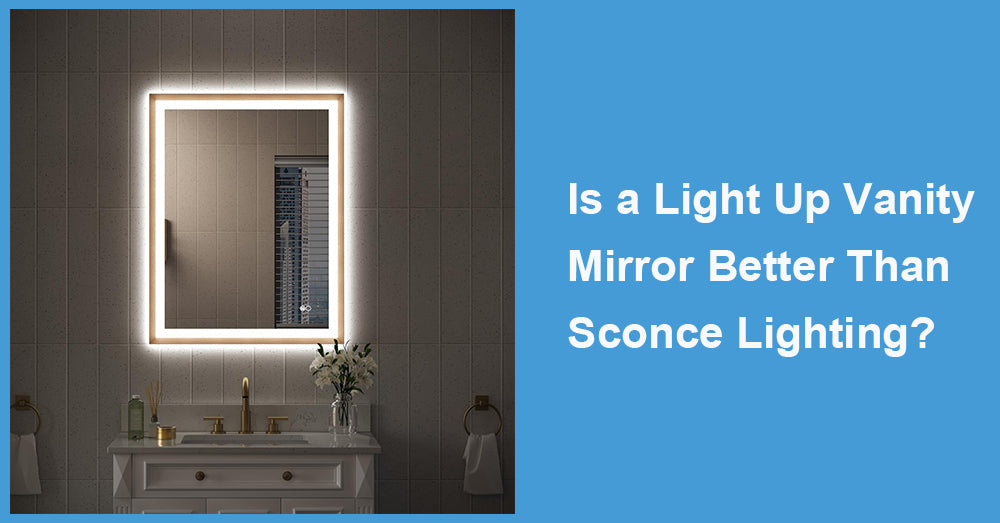
A light up vanity mirror can feel like the smarter choice the first time you use one. The light is closer to your face, the bathroom looks cleaner, and daily tasks like shaving or skincare usually become easier. After working around bathroom remodels and product selection for years, I would say a light up mirror is often better for task lighting, but not always better for the room as a whole. That difference matters more than most homeowners expect.
1. Why this comparison matters in real bathrooms
People rarely ask this question in a vacuum. They are usually updating a bathroom and trying to avoid making an expensive lighting mistake. Maybe they want a cleaner wall above the vanity. Maybe they are tired of old sconces that cast strange shadows. Maybe they saw a sleek LED mirror online and assumed it could do everything.
Sometimes it can.
In smaller bathrooms, a light up mirror can change the whole experience. It gives the vanity area a sharper, more modern look and often makes the room feel less cluttered. In guest bathrooms and powder rooms, that can be enough to justify the choice.
But bathrooms are not judged only when someone is standing still at the sink. They are lived in at 6 a.m., late at night, in steam, during rushed mornings, and while cleaning around the toilet or tub. That is why I do not like absolute answers here. A product can look better and still perform worse in certain layouts.
2. A light up vanity mirror usually wins for face-level lighting
If the question is strictly about grooming, a light up vanity mirror is often the stronger option. The light is built into the mirror plane, so it hits the face more evenly and reduces the shadows that overhead fixtures and poorly placed sconces can create.
That makes a real difference for makeup, shaving, eyebrow grooming, and contact lenses. It is one of those upgrades people do not always appreciate until they have used it for a week. Once they do, it is hard to go back to dim or uneven side lighting.
There is also a design advantage. A mirror with integrated lighting can simplify the wall and make a bathroom look calmer. In contemporary bathrooms, especially those with floating vanities or frameless glass, that cleaner look often works better than decorative sconces.
Still, not all LED mirrors perform equally. Some are beautiful but weak. Some create a halo effect that looks sophisticated in photos but does not give enough useful light for real tasks. That is a common homeowner mistake: buying by appearance without checking whether the mirror is meant for actual illumination or just visual mood.
Where a light up mirror works best
I like them most in smaller bathrooms, modern spaces, and bathrooms where the vanity is the clear focal point. They also work well for homeowners who prefer a simpler wall layout and do not want separate fixtures flanking the mirror.
A good model from a brand like Wellfor can be especially appealing when you want lighting, mirror, and visual polish in one piece rather than three separate decisions.
Where they fall short
A light up mirror is not always enough by itself, especially in larger bathrooms or darker spaces. Charcoal tile, deep wood finishes, black hardware, and low natural light all make the room more demanding. In those conditions, the mirror may make your face look well lit while the rest of the bathroom still feels dim.
That is where people get disappointed. They expected full-room lighting and bought task lighting.
3. Sconce lighting still has real advantages
Sconces are not outdated. Poorly chosen sconces are.
A good pair of vanity sconces can create flattering light, bring warmth to the room, and add an architectural layer that a mirror alone cannot. In traditional bathrooms, transitional designs, or vanities with more decorative cabinetry, sconces often look more natural than a fully illuminated mirror.
They also give you flexibility. You can choose fixture size, bulb type, finish, and placement based on the room rather than committing everything to one mirror product. If the mirror ever needs to change later, the lighting can stay.
That said, sconces need careful placement. Too high, and they create downward shadows. Too far apart, and the face lighting becomes patchy. Too small, and they look decorative but do not do much work.
The most common sconce mistake
Homeowners often treat sconces like jewelry and forget they are functional fixtures. They choose something tiny and stylish, then wonder why the vanity still feels dark. I see this often in remodels where the wall looks beautiful but the daily experience is less convincing.
If you go with sconces, the bulbs, scale, and position matter just as much as the fixture style.

4. Which option is better depends on how the bathroom is used
In a powder room, I would often lean toward the light up mirror. The room is smaller, storage is limited, and the mirror has a chance to do more of the visual work without asking too much from the lighting plan.
In a busy primary bathroom, the answer gets more nuanced. If two people use the sink every morning, if the room has a shower zone and separate corners, or if the finishes are dark and light-absorbing, sconces or layered lighting still have an edge. Sometimes the best solution is not mirror versus sconces. It is mirror plus supplemental ambient light.
This is where industry reality is a little less dramatic than showroom marketing. The best bathrooms usually use layered light. Task light at the mirror. Ambient light for the room. Sometimes accent light if the design calls for it.
Installation and maintenance advice
Before buying, check the wiring plan. A hardwired mirror can look cleaner, but it needs proper placement and a wall prepared for it. Sconces give you more flexibility, though they create more visible components and more finishing work around the vanity wall.
For maintenance, mirrors are usually easier. You clean one surface, keep the edges dry, and occasionally check the controls if the model includes dimming or anti-fog. Sconces require bulb changes, dusting around fixture arms, and a little more patience when cleaning.
If you want the cleanest look and the best face-level illumination, choose a light up vanity mirror with strong output and let the rest of the bathroom lighting support it. If you care more about decorative character and room-wide balance, well-placed sconces still deserve respect. The right choice is the one that matches how you actually use the bathroom, and for many homeowners, that means choosing a light up vanity mirror for the vanity itself without expecting it to solve every lighting need in the room.









































Leave a comment
This site is protected by hCaptcha and the hCaptcha Privacy Policy and Terms of Service apply.