






















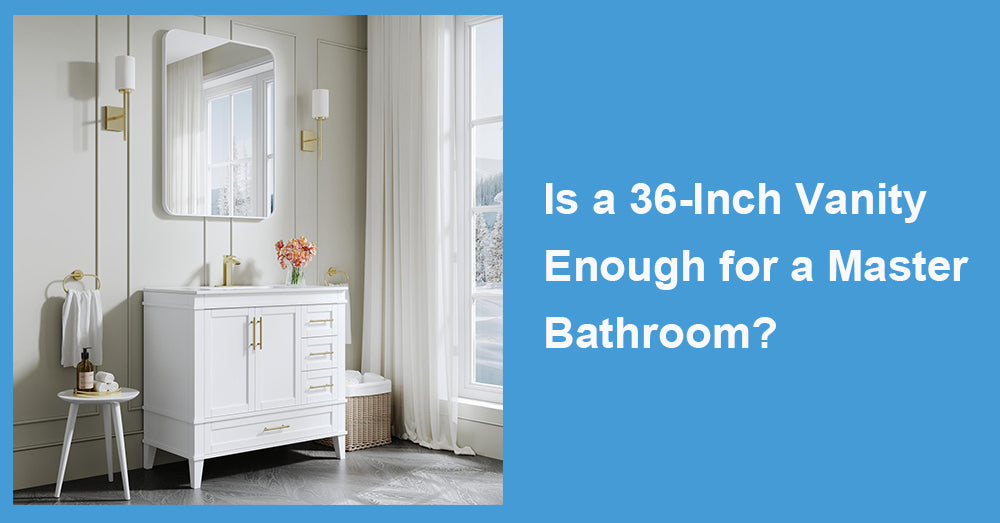
In the design of the main bathroom, a 36 inch vanity has always been considered a "critical size" - both more practical than a 24-inch or 30-inch vanity and significantly smaller than the dual-basin configuration of 60-inch or 72-inch.
With the changes in residential space planning, more and more master bedroom suites are being controlled between 120 and 180 square feet.
In such spatial structures, whether to choose a 36-inch36-inch countertop has become a question many families repeatedly weigh during the decoration stage.
From storage capacity to comfort, from smooth flow to future resale value, size selection is not just about style preference, but also about long-term user experience.
1. Realistic positioning of a 36-inch size in the main bathroom
In the existing residential structure, the main bathroom area shows a polarized trend.
Larger suite bathrooms often exceed 150 square feet, while medium-sized master bathrooms are concentrated in the range of 100 to 140 square feet.
Within this spatial range, 36-inch single basin vanities are considered a common solution for "compact main bathrooms".
Data shows that more than 50% of main guards with an area less than 130 square feet use single pot structures ranging from 36 inches to 42 inches.
The reason is that this size can provide relatively sufficient countertop space without compressing the shower area or walk-in space.
2. Is the countertop space sufficient for daily use?
A standard oval or rectangular basin is typically 36 inches wide, which can reserve approximately 88 to 12 inches of workspace on both sides.
For a single person's daily grooming, this area basically meets the placement needs of commonly used items such as toothbrush cups, hand sanitizer, and skincare products.
In the functional evaluation, over 70% of single-person main bathroom users stated that the 36-inch countertop is "sufficient for daily use".
But for a two-person shared main guard, the probability of conflicts in table use has significantly increased.
Especially during peak hours in the morning and evening, a single pot structure can limit the efficiency of simultaneous use.
If family members have staggered schedules, the 36-inch size is still feasible.
But if the frequency of simultaneous use is high, a 60-inch double basin is more reasonable.
3. Actual difference in storage capacity
Storage space is one of the key factors determining whether the size is "sufficient".
A standard 36-inch van is typically equipped with two to three sets of drawers or a single cabinet door structure, with a total storage capacity of approximately 5 to 7 cubic feet.
In contrast, the storage capacity of the 60-inch double basin structure can reach 9 to 12 cubic feet, almost doubling.
Therefore, in households with high storage demands, a 36-inch may appear cramped.
However, it is worth noting that modern home guards are increasingly emphasizing the concept of "de-hybridization" design.
Some families choose to transfer towels and spare toiletries to separate storage cabinets or cloakrooms to reduce their dependence on storage space under the washbasin.
4. Spatial proportion and visual balance
In terms of proportion design, the 36-inch size appears relatively lightweight in 8-foot- or 9-foot-high floor spaces.
When paired with a 32-inch to 34-inch-wide bathroom mirror, the overall visual proportions will be coordinated.
In-home backs with a width exceeding 10 feet, the 36-inch table may appear slightly smaller.
Design data shows that in layouts with wall widths exceeding 120 inches, a single 36-inch36-inch countertop visual aspect ratio accounts for less than 30%, which can easily cause an imbalance in proportions.
Therefore, in larger spaces, side cabinets or extended storage modules are usually paired to form a more complete visual structure.
5. The impact on traffic flow and space utilization
The main bathroom usually includes a shower, toilet, and hand-washing area.
The advantage of the 36-inch size is that it occupies a relatively compact area, with a depth typically ranging from 21 inches to 22 inches, allowing for more activity space for showers or walk-in areas.
In the narrow 90-inch main bathroom, the 36-inch countertop can maintain a minimum passage width of 30 inches or more, meeting comfortable passage standards.
If changed to a 60-inch structure, it may compress the flow line and affect the overall user experience.
Therefore, in a layout with limited space, choosing a 36-inch can optimize the smoothness of the flow line.
6. Potential impact on resale value
In evaluating the real estate market, the dual-basin main bathroom is often considered an additional feature.
Data shows that a main bathroom with a double-basin sink measuring 60 inches or more is more attractive during the house's display stage.
But for the main bathroom with a limited area, forcibly adding double basins may actually compress the shower space or reduce storage efficiency, affecting overall comfort.
Therefore, 'size adaptation space' is more important than simply pursuing dual pots.
If the resale cycle is longer in the future and space allows, upgrading to a 48-inch or 60-inch structure may bring higher perceived value.
But in the compact main guard, the 36-inch does not significantly lower the overall evaluation.
7. How to determine if 36 inches is sufficient?
It can be judged from three dimensions:
Firstly, the number of users. If one person uses the main guard for a long time, a 36-inch guard can fully meet the needs. If it is shared by two people more frequently, it is recommended to consider a larger size.
Secondly, storage habits. If the item is streamlined and supported by additional storage space, a 36-inch item is not cramped. If relying on the space under the basin to store a large number of items, it may be insufficient.
Thirdly, spatial proportion. If the main bathroom area is less than 130 square feet, a 36-incha 36-inch-wide structure offers a more balanced advantage. If the area exceeds 160 square feet, a wider structure can be considered.

8. Conclusion
There is no absolute answer to whether 36-inch luxury is sufficient.
It depends on how well the spatial structure matches the usage requirements.
From countertop operating space to storage capacity, from smooth flow to visual proportion, every factor will affect the final experience.
In a medium-sized main bathroom, a 36-inch single-basin sink can strike a balance between efficiency and spatial efficiency.
In a more spacious layout, upgrading to a 48-inch or 60-inch sink may offer a more comfortable two-person experience.
The key is to make rational choices based on actual lifestyle, rather than simply pursuing growth in size and numbers.










































Leave a comment
This site is protected by hCaptcha and the hCaptcha Privacy Policy and Terms of Service apply.