






















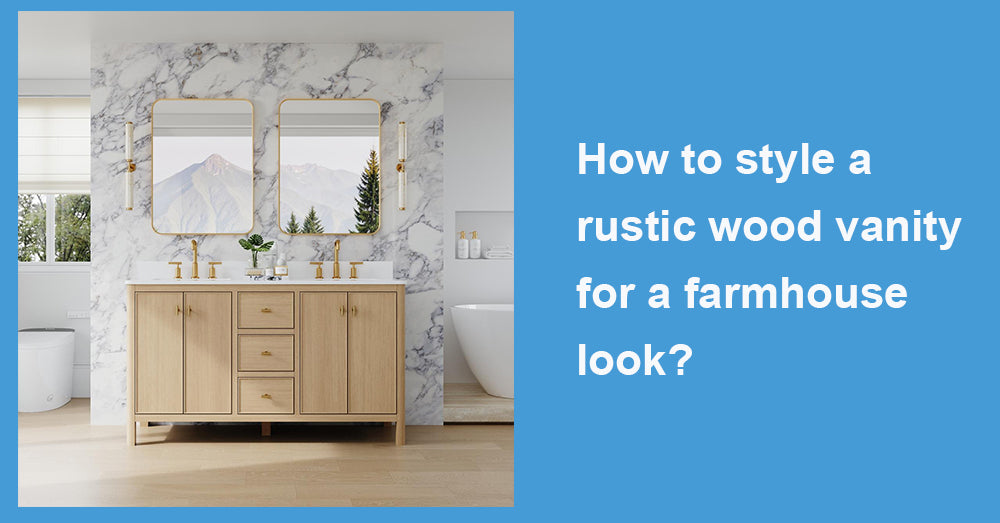
A wood vanity gives a farmhouse bathroom its visual center, but the room should not look as though every rustic detail came from the same catalog. The strongest designs mix natural grain with cleaner surfaces, practical storage, simple metalwork, and one or two aged accents. That balance is becoming more relevant as natural materials move deeper into bathroom design. Houzz reports that solid wood is used for 74% of upgraded vanities, with maple accounting for 29%, white oak 23%, birch 12%, and walnut 9%.
1. Start With a Wood Tone That Shows Real Character
Farmhouse style works best when the cabinet grain remains visible. Medium oak, weathered white oak, pine, alder, and lightly stained maple can provide warmth without making the bathroom too dark. Knots, tonal variation, and subtle saw marks are useful, but an aggressively distressed finish can feel artificial.
Light wood suits smaller 30-inch and 36-inch vanities because it keeps the cabinet from appearing heavy. A 48-inch or 60-inch vanity can handle a deeper stain, especially when the walls and countertop are pale. Walnut creates a richer version of the look, though it leans closer to refined country style than casual farmhouse.
Wood-faced vanities were identified as popular by 62% of respondents in the NKBA 2026 Bath Trends Report, moving ahead of painted vanity finishes at 53%. The same research links the shift to stronger interest in biophilic and natural design.
2. Choose a Countertop That Calms the Grain
A rustic cabinet already brings color and movement, so the countertop does not need to compete with it. Warm white quartz, creamy quartzite, honed marble, and limestone-look surfaces are dependable choices.
For a practical family bathroom, quartz with faint beige or gray veining is easier to coordinate than a dramatic marble pattern. A lightly veined top also works across several vanity widths without looking awkward after the sink opening is cut.
Natural stone can make the vanity feel more collected and less manufactured. Quartzite is particularly effective with oak because its warm mineral tones echo the grain. A simple eased edge or a restrained 1-inch to 1 1/4 inch profile usually feels more appropriate than an ornate decorative edge.
Engineered quartz currently leads upgraded vanity countertops at 45%, while quartzite accounts for 20%, granite 14%, and marble 13%.
3. Use Farmhouse Hardware Without Overdoing It
Matte black pulls are an easy match for rustic wood, but they are not the only option. Aged brass, brushed nickel, dark bronze, and pewter can all produce a farmhouse effect with less contrast.
Cup pulls look natural on wide drawers, while simple bar pulls are more comfortable for everyday use. Small round knobs can be reserved for cabinet doors. Mixing two shapes in the same finish often makes a stock vanity appear more considered.
Avoid adding decorative hinges, oversized corner straps, and heavy black handles at the same time. One strong hardware detail is enough. Current finish preferences support quieter surfaces: NKBA found matte faucet finishes popular among 54% of respondents, brushed finishes among 51%, and satin finishes among 46%, compared with 39% for polished finishes.
4. Pair the Vanity With a Simple Mirror
The mirror can move the room toward traditional farmhouse or toward a cleaner modern farmhouse look. A rectangular wood-framed mirror reinforces the cabinet finish, but the two woods should not match too perfectly. Slight variation makes the room feel assembled over time.
A thin black metal frame gives the vanity more definition. For a softer appearance, an arched mirror in aged brass or brushed nickel works well above a warm oak cabinet.
Mirror width should remain slightly narrower than the vanity. A mirror around 30 to 34 inches wide generally fits a 36-inch cabinet, while a 42- to 46-inch mirror can balance a 48-inch vanity. Leaving several inches of visible wall on each side prevents the arrangement from feeling crowded.

5. Keep the Walls Quiet
Shiplap can support farmhouse style, but covering every wall may make the theme feel forced. One paneled wall behind the vanity is usually enough. The remaining walls can be painted warm white, light greige, muted sage, or pale clay.
Large-format stone-look tile offers another useful background. Fewer grout lines keep attention on the wood cabinet and make the bathroom easier to clean. NKBA’s 2025 trend review noted that large-format surfaces and minimal grout lines are being used to meet demand for easier maintenance and greater visual calm.
Pure white walls can look sharp beside weathered wood. Cream, linen, and softly grayed whites tend to produce a more natural transition.
6. Select Lighting That Feels Warm but Not Dim
Farmhouse lighting often relies on glass shades, lantern forms, or metal sconces. The shape can be traditional, but the fixture should still provide useful task light around the mirror.
Clear glass exposes the bulb and can create glare. Opal or seeded glass produces a softer effect. Two vertical sconces placed beside the mirror generally light the face more evenly than a single overhead fixture.
LED lighting around 2700K to 3000K emphasizes honey, oak, and walnut tones. A setting near 3500K offers a cleaner appearance for makeup and grooming while preserving warmth. Very cool light can make weathered wood look gray and disconnect it from beige stone or bronze hardware.
7. Add Texture Through Small, Useful Pieces
Farmhouse styling becomes convincing through ordinary objects rather than themed signs. A woven basket can hold towels. A ceramic tray can collect soap and grooming items. Linen hand towels, an earthenware vase, or a small wooden stool can add texture without filling the counter.
Open shelves should be used with restraint. They look attractive when holding folded towels or two matching baskets, but quickly become cluttered when used for every bathroom product. Closed vanity storage keeps the rustic materials visible instead of covering them with bottles and cords.
A vintage-style rug can introduce muted red, blue, or brown, while a simple striped runner creates a lighter country look. These pieces are easy to replace when the room needs a change.
8. Let the Vanity Carry Most of the Farmhouse Character
A farmhouse bathroom does not need a barn door, galvanized containers, mason jar lights, and distressed lettering all at once. When the vanity already has visible grain, furniture-style legs, inset doors, or a weathered finish, the surrounding elements can remain straightforward.
That restraint also makes the room easier to update. Remodeling activity remains substantial, with Harvard’s Joint Center for Housing Studies projecting annual homeowner improvement spending of approximately $518 billion by the end of 2026. Materials that can move between farmhouse, transitional, and organic modern interiors may stay useful longer than highly themed details.
The finished room should feel warm and familiar rather than staged. A well-proportioned wood cabinet, a quiet stone top, practical hardware, soft lighting, and a few textured objects can establish the farmhouse character without turning the bathroom into a collection of rustic symbols.








































Leave a comment
This site is protected by hCaptcha and the hCaptcha Privacy Policy and Terms of Service apply.