






















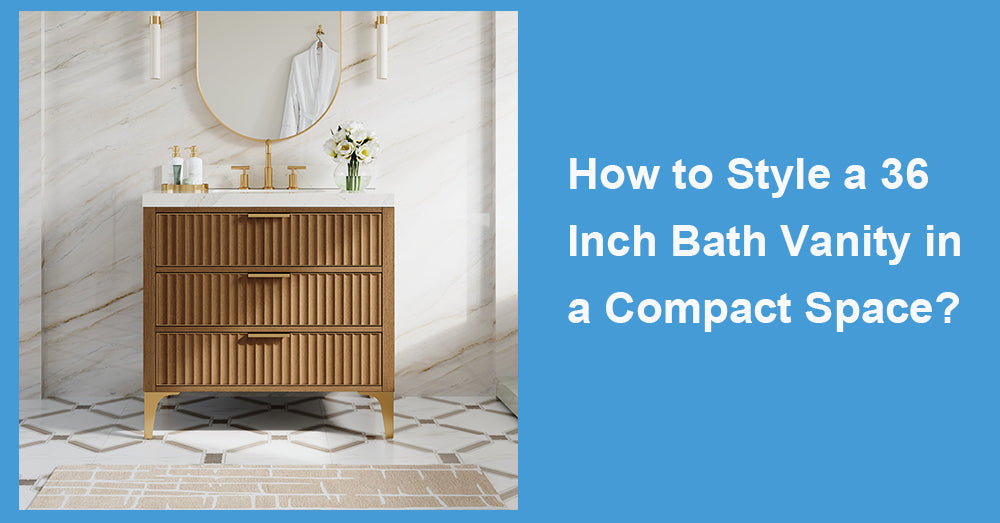
A 36 inch bath vanity is often large enough to give a compact bathroom real storage and countertop function without making the room feel crowded. The challenge is styling it so that the cabinet feels proportional to the available floor space. That matters because smaller bathrooms remain common in remodeling. The 2025 Houzz Bathroom Trends Study, based on 1,737 recent or planned renovation projects, found that 51% of renovated bathrooms were under 100 square feet. The same research showed that 47% of upgraded vanities measured 48 inches or less.
Start With the Visual Weight of the Cabinet
A 36-inch vanity can look surprisingly substantial in a narrow bathroom. Color and construction determine how heavy it appears.
White, off-white, and pale wood finishes generally keep the cabinet visually quieter. A dark navy or black vanity can still work, but it needs lighter walls and enough illumination to prevent the lower half of the room from feeling closed in.
Current design trends favor this softer approach. NKBA's 2026 Bath Trends Report found that 96% of design professionals identified neutrals as a leading bathroom color direction. Off-white reached 58%, light brown or tan 54%, and white 40%.
For a compact bathroom, a light oak vanity with a white quartz top can provide warmth without creating the visual density of a much darker cabinet.
Consider a Floating Vanity When Floor Space Feels Tight
A floating 36-inch vanity can make a small bathroom appear more open because the flooring remains visible beneath the cabinet.
Houzz found that floating vanities accounted for 11% of upgraded installations, compared with 30% for freestanding models and 58% for built-in designs.
The percentage is smaller, but the format has a clear advantage in tight interiors. Exposed flooring allows the eye to travel farther across the room, especially when the same tile continues into a walk-in shower.
A freestanding vanity remains the better choice when maximum storage is required. In that case, choose simple legs or a restrained toe-kick rather than a heavy furniture base.
Industry judgment: In a compact room, the best vanity is not always the physically smallest model. It is the one that creates the least unnecessary visual interruption.
Keep the Countertop Light and Relatively Quiet
A dramatic countertop can be attractive in a showroom but overwhelming across a 36-inch cabinet surrounded by other small-scale elements.
For compact bathrooms, quieter surfaces usually make styling easier. White quartz, off-white stone, or lightly veined tops coordinate with a broad range of tile and cabinet finishes.
Avoid combining a strongly patterned countertop with equally dramatic wall tile unless one material clearly plays a supporting role.
The countertop should also remain reasonably clear after installation. Soap, skin-care products, electric toothbrushes, tissue boxes, and decorative containers can quickly make a 36-inch surface feel much smaller than it really is.
Treat the counter as working space first and display space second.

Use Drawers to Control Visual Clutter
Storage has a direct effect on how spacious a bathroom feels. A clean vanity top creates longer uninterrupted lines, while scattered bottles divide the surface into many small visual elements.
Look for a 36-inch cabinet with usable drawers rather than several decorative drawer fronts. An offset sink can be particularly useful because it may allow a complete vertical drawer bank on one side.
Houzz's vanity research shows how important functional storage has become. Soft-close drawers appear in 78% of upgraded vanities, soft-close doors in 75%, built-in electrical outlets in 29%, and drawer organizers in 22%.
In a compact room, one shallow drawer can hold daily grooming products while a deeper lower drawer handles larger bottles and towels. This keeps frequently used items accessible without leaving them on display.
Choose a Mirror That Makes the Vanity Wall Feel Wider
A small mirror can make a 36-inch vanity look disproportionately large.
For many layouts, a mirror approaching the width of the vanity creates a stronger relationship between the cabinet and upper wall. A 30-inch to 36-inch mirror can work well, depending on sconces, wall width, and sink location.
A frameless mirror gives the lightest effect. Thin metal frames provide slightly more definition without creating much bulk.
The mirror also reflects light and other parts of the room, which can help the vanity wall feel deeper. This becomes particularly useful in bathrooms without a window.
Avoid filling every inch above the sink with decorative framing. In a small space, restraint tends to work better than adding another visual border.
Give Lighting a Bigger Role Than Decoration
Lighting is one of the easiest ways to make a compact vanity area feel more finished.
Houzz reports that 82% of bathroom renovation projects upgrade lighting. Recessed lighting remains common, while lighted mirrors have also gained attention.
NKBA's 2026 report goes further: 91% of surveyed professionals said lighting quality is a top bathroom consideration, 92% supported task lighting in the primary bath, and 88% identified natural lighting as a priority.
For a 36-inch vanity, balanced facial lighting around the mirror is generally more useful than one strong ceiling fixture directly overhead. A lighted mirror can also eliminate the need for bulky sconces when side-wall space is limited.
Under-vanity lighting works particularly well with floating cabinets, but keep it subtle. The goal is to add depth, not turn the floor into a feature wall.
Coordinate Hardware Instead of Matching Everything
Small bathrooms already contain many visible details: faucet, cabinet pulls, mirror frame, shower hardware, towel hooks, and lighting fixtures.
Using exactly the same finish everywhere can work, but it is not required.
Matte black hardware gives a pale vanity sharper definition. Brushed nickel feels quieter, while brushed gold can warm white or light oak cabinetry. NKBA found matte faucet finishes preferred by 54% of respondents, brushed finishes by 51%, and satin finishes by 46%, all ahead of polished finishes at 39%.
Limit the palette to one dominant metal and, at most, one supporting finish. Too many finishes in a small bathroom can make the room feel visually fragmented.









































Leave a comment
This site is protected by hCaptcha and the hCaptcha Privacy Policy and Terms of Service apply.