






















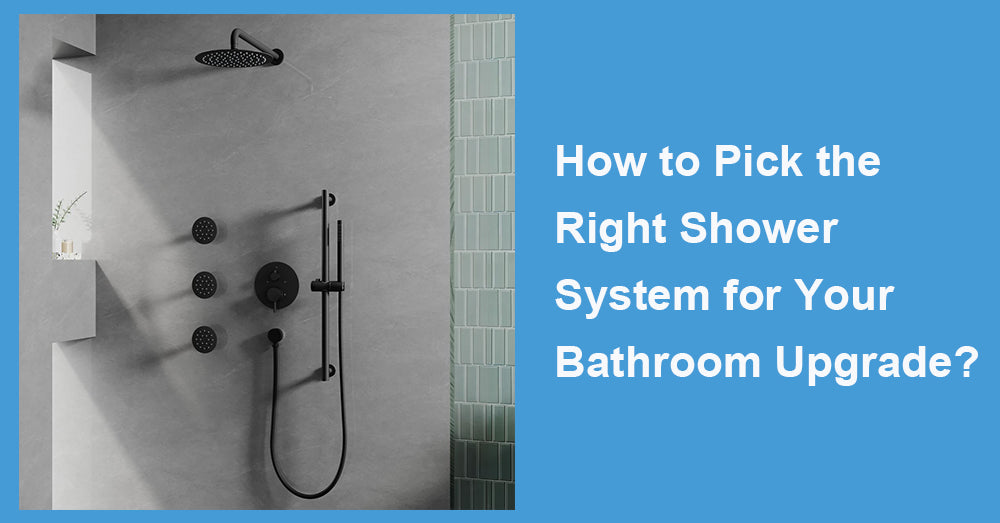
In the process of bathroom renovation or upgrade, the shower system is often one of the core configurations that is most easily underestimated, but can directly affect the user experience. It not only determines the comfort of taking a shower every day, but also relates to the spatial layout, long-term maintenance, and overall design style coordination. From an industry perspective, choosing the appropriate shower system is not simply about "looking at appearance or price", but rather a comprehensive judgment process involving spatial conditions, household structure, and technical parameters.
1. First, look at the bathroom conditions, not the product
The most crucial step before selecting a shower system is to evaluate the existing bathroom conditions, including the shower area's width, height, wall structure, and plumbing location.
Taking the common shower area as an example, the width is usually 36-48 inches, while the ceiling height is typically 96 inches. If the space itself is relatively compact, excessive top spraying or complex exposed pipelines can actually make the area appear compressed. Industry data shows that in bathrooms with limited space, shower systems that simplify structure and reduce the number of external components have significantly higher overall satisfaction.
2. Identify the target audience: single person, partner, or family
The demand for shower systems varies significantly among different user groups. Single-use tends to prioritize stable water flow and simple operation, while home use emphasizes flexibility and adaptability.
If the bathroom needs to be shared by multiple members, a system with a handheld showerhead is often more practical. The handheld showerhead can be adjusted within a height range of 24-36 inches, making it easier to adapt to different heights and usage habits. Based on long-term feedback, systems with dual water outlets (top spray + handheld) have a significantly higher usage frequency in household settings than single water outlet systems.
3. The larger the top spray size, the better
Top spray flowers are often seen as a symbol of "sophistication", but size selection also requires rational judgment. The mainstream top spray diameter is usually between 8 and 12 inches, and different sizes bring significant differences in experience.
In a shower room with a width of 36-40 inches, a top spray of 8-10 inches is more likely to form a uniform water curtain, preventing overflow or concentration in a single area. Industry tests have shown that when the ratio of top spray size to shower area is imbalanced, it can actually affect overall comfort and water efficiency.
4. Whether a constant temperature function is needed is a watershed experience
The role of a thermostatic valve in a shower system is far more important than its appearance. It can automatically adjust the ratio of hot and cold water to maintain a stable outlet temperature when water pressure or temperature fluctuates.
From a safety perspective, a constant-temperature system is particularly suitable for multiple people sharing a bathroom. Industry data shows that after introducing constant-temperature control, discomfort feedback from sudden water-temperature changes has significantly decreased. For bathroom upgrades that prioritize a stable experience, the continuous temperature function has gradually shifted from "optional" to "basic configuration".
5. Control mode: knob, button, or hidden panel
The control method of the shower system directly affects the system's intuitive operation. The traditional knob structure is durable and straightforward, while the buttons or hidden panels are visually simpler.
In upgrade projects, more and more designs are concentrating control units in easily accessible areas, typically 40-48 inches above the ground, which is more in line with the natural height for standing operations. Industry research shows that the clearer the control logic, the higher the user's evaluation of the product's "intelligence".
6. Water efficiency and comfort are not in conflict
Many people worry about the trade-off between water volume and comfort when choosing a shower system. But with advances in nozzle design and waterway design, this contradiction has been greatly alleviated.
The design features multiple water-outlet modes and air-injection technology, allowing the water flow to maintain a full tactile sensation while controlling overall water usage. Industry testing has found that, for the same shower duration, the optimized design system can achieve more stable water-use performance without reducing comfort.
7. Long-term cost considerations for installation and maintenance
An easily overlooked issue is the installation and post-maintenance of shower systems. Although installing exposed pipelines is relatively straightforward, cleaning frequency is higher. Hidden systems require higher standards during construction, but they can deliver a cleaner visual effect.
From long-term feedback, systems with clear structures and highly standardized components have greater advantages in maintenance and replacement. Especially in renovation projects, choosing a system with strong compatibility can significantly reduce the additional costs of future adjustments.
8. Style matching is the final step in enhancing the sense of upgrade
The final key point is the degree of coordination between the shower system and the overall bathroom style. Whether it's modern minimalism, transitional style, or industrial design, the shower system is a visual focal point.
Industry observations have found that in successful bathroom upgrade cases, shower systems are often not deliberately flashy, but are unified with space through lines, proportions, and materials. This kind of design, which does not exist excessively but is indispensable, is more likely to withstand long-term aesthetic changes.

9. Conclusion: Choosing the right system is the key to truly completing the upgrade
The goal of a bathroom upgrade is not simply to replace equipment, but to make daily use smoother, more comfortable, and more stable through a reasonable selection. A suitable shower system is often the result of balancing spatial conditions, usage requirements, and technical configuration.
When these factors are systematically considered, the shower system is no longer just a hardware product but becomes the core foundation that supports the entire bathroom experience. This is a truly successful bathroom upgrade.









































Leave a comment
This site is protected by hCaptcha and the hCaptcha Privacy Policy and Terms of Service apply.