




















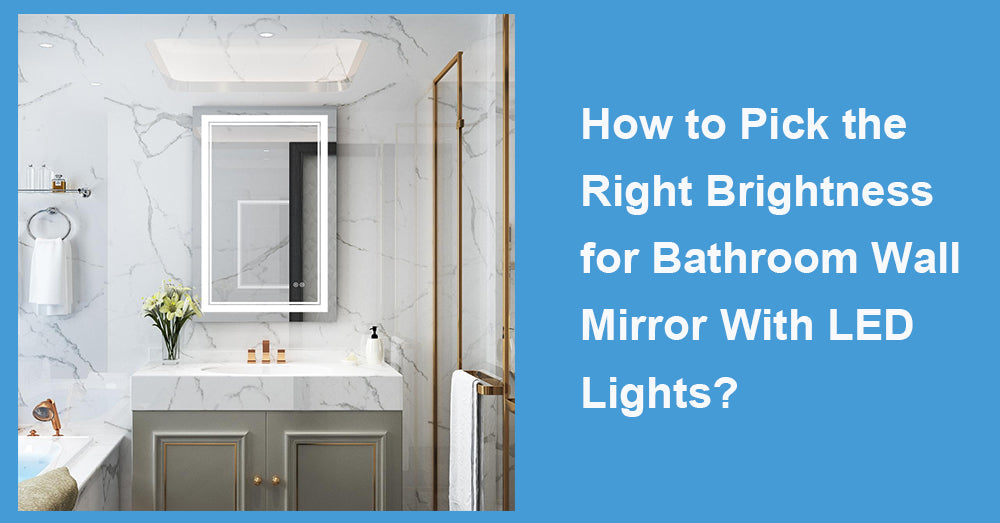
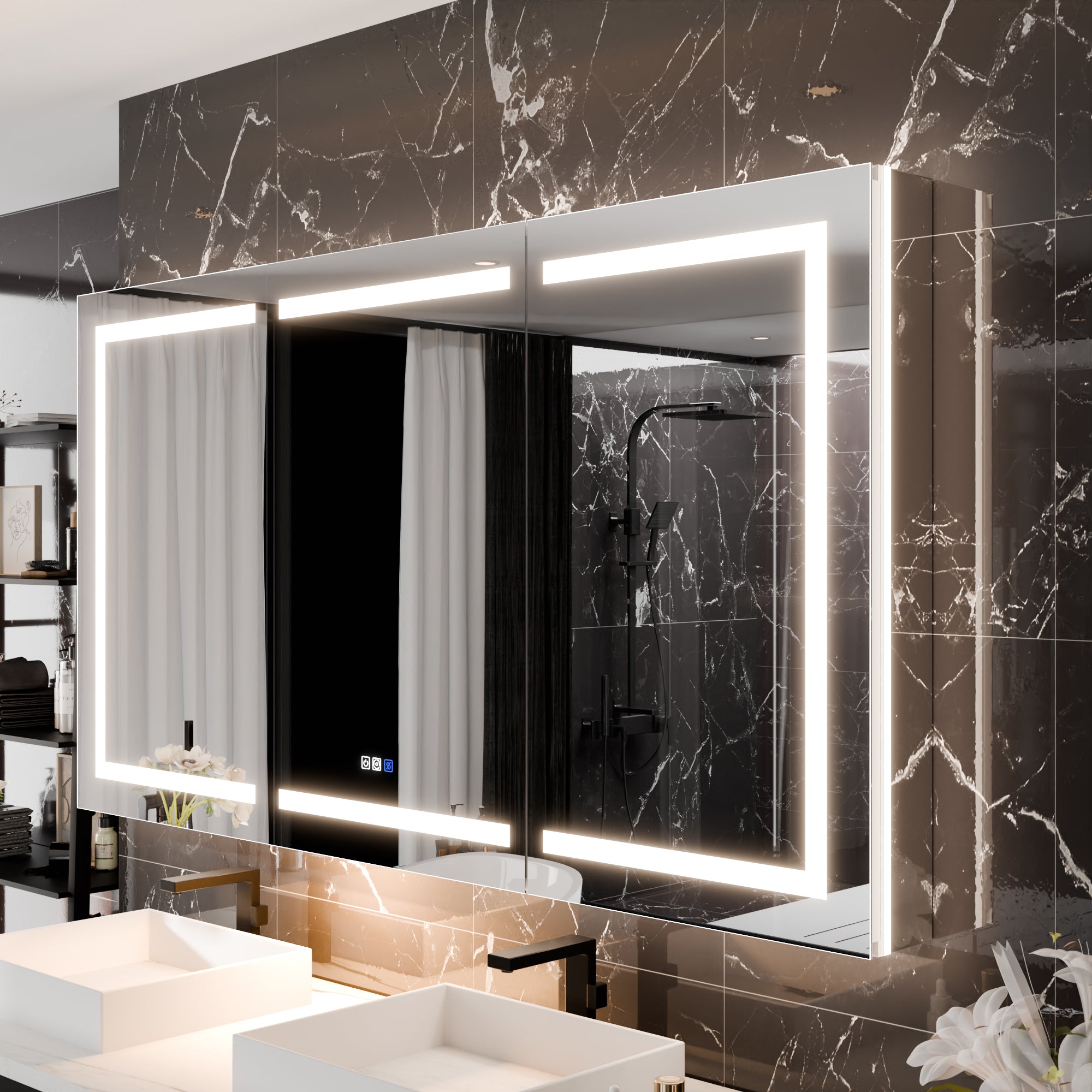
In modern bathroom design, bathroom wall mirror with led lights have evolved from a single lighting accessory to an essential component that integrates functionality, experience, and visual expression. Compared to traditional ceiling or wall lights, wall mirrors with LED lights are closer to the user's face, directly affecting the clarity and comfort of high-frequency behaviors such as washing, makeup, and shaving.
However, in practical selection and application, the question of "how much brightness to choose" has become the most easily overlooked and error-prone issue. Insufficient brightness can lead to blurry facial details, while excessive brightness can cause glare, visual fatigue, and even affect the overall spatial atmosphere. Industry research and project experience have shown that selecting a reasonable brightness requires a balance among functional requirements, spatial dimensions, and light distribution.
1. Understanding brightness: it's not just a matter of whether it's bright or not
Before discussing the brightness of LED mirrors, it is necessary to clarify a basic fact:
Brightness is not equal to the number or power of light beads, but is determined by the light output intensity, irradiation distance, and light distribution.
Bathroom wall mirrors with LED lights typically have their light source at the edge, back, or embedded in the mirror, with the light only 20-30 inches from the user's face. Because of the close distance, even if the overall power is low, the actual intensity of light on the face will be significantly higher than that of overhead light.
This is also why the brightness selection for mirror lighting needs to be more cautious than for ordinary ambient lighting.
2. The widely recognized brightness range in the industry
From a large number of project applications and lighting suggestions, the ideal brightness range for bathroom wall mirrors with LED lights is typically 700-1200 lumens. This range can meet the vast majority of daily grooming, skincare, makeup, and shaving needs while avoiding excessive visual stimulation.
700–900 lumen:
Suitable for small bathrooms, auxiliary lighting scenes, or spaces with a relaxed atmosphere. At this brightness, the light is soft and ideal for use in the morning and evening, without causing glare.
900–1200 lumen:
More suitable for the main bathroom or a high-frequency-use bathroom, able to clearly present facial details, ideal for makeup, fine care, and other applications.
In practical selection, it is also necessary to consider the mirror's size and lighting method. The larger the mirror surface and the more dispersed the luminous area, the lower the light stimulation per unit area, and the higher the tolerance for high brightness.
3. The relationship between mirror size and brightness
The appropriate brightness is often closely related to the mirror's physical size.
Taking common wall mounted mirrors as an example, when the width of the mirror is in the range of 24-30 inches, 700-900 lumens are often sufficient; when the mirror width is expanded to 36-48 inches, if lower brightness is still used, the light is prone to appear scattered and the illumination in the center area of the face is insufficient.
Therefore, industry experience typically suggests:
The larger the mirror size, the greater the total light output should be, but this increase should not be achieved through single-point highlighting; instead, it should rely on a uniform lighting design.
In other words, instead of choosing a small-area light strip with extremely high brightness, it is better to choose an LED light-emitting structure with moderate brightness but broader coverage.
4. The synergistic relationship between brightness and installation position
The brightness of bathroom LED wall mirrors is determined not only by product parameters, but also by the installation position.
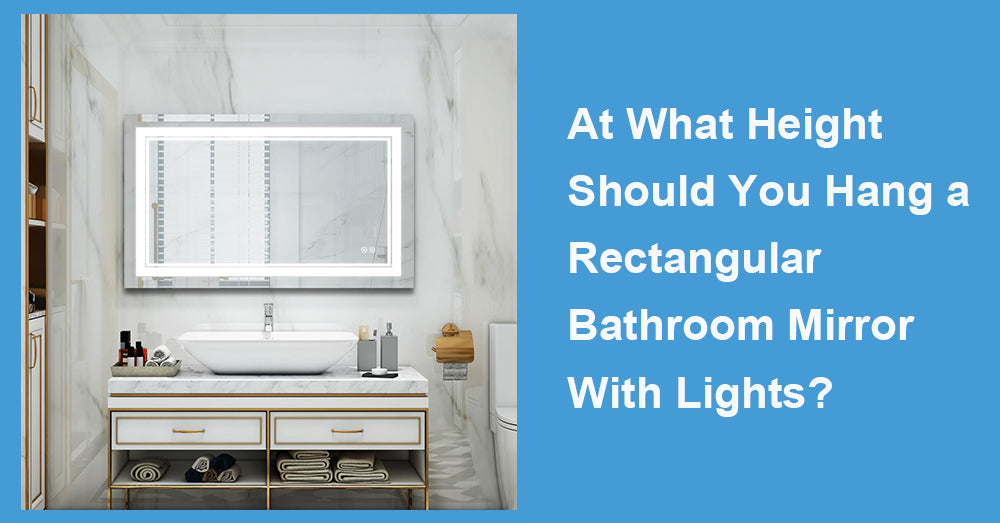
When the mirror is installed at a reasonable height (the center of the mirror is roughly within the natural line of sight of adults, usually about 60-65 inches from the ground), the light can illuminate the core of the face more directly. In this case, even with moderate brightness, ideal usage effects can still be achieved.
If the mirror is installed too high, the light will shine more on the forehead and top of the head, and the lower part of the face will appear darker. Users often mistake the brightness for insufficient brightness and choose products with high brightness, ultimately leading to glare problems.
Therefore, brightness selection should be considered synchronously with installation height, rather than making isolated decisions.
5. The linkage effect of color temperature and brightness
In practical use, brightness experience is often inseparable from color temperature density.
LEDs with lower color temperature (approximately 3000K-3500K) provide a softer visual experience at the same brightness, making them suitable for bathroom environments that emphasize comfort and relaxation.
The neutral-to-cool color temperature (about 4000K) is closer to natural light. It provides a higher degree of facial detail restoration, making it suitable for spaces with high functional requirements.
It is worth noting that at lower color temperatures, even with the same brightness values, the human eye is more likely to perceive a "brighter" appearance. Therefore, when choosing LED mirrors with a color temperature around 4000K, there is usually no need to deliberately push the brightness to its upper limit.
6. Dimmable design is becoming an industry trend
With the popularization of intelligent lighting technology, the industry's acceptance of dimmable LED wall mirrors continues to rise. This type of product allows users to adjust brightness freely at different times and in various usage scenarios, thereby balancing functionality and atmosphere.
For example:
Use in the morning or at night; lower the brightness to reduce interference with visual and physiological rhythms.
When applying makeup or caring for your face during the day, increase brightness to achieve more precise facial illumination.
From a long-term use perspective, dimmable design offers significant advantages by reducing the risk of misselection and improving adaptability.
7. Common Misconceptions and Industry Reminders
In actual projects, the industry has observed the following common misconceptions:
Only focus on power or the number of light beads, ignoring actual light output and lighting structure.
Excessive brightness on small mirrors causes glare at close range.
Using LED mirrors as the sole light source in the bathroom, while ignoring the overall lighting hierarchy.
A reasonable approach is to consider LED wall mirrors as the core component of facial functional lighting and complement them with ceiling lights or auxiliary light sources, rather than completely replacing them.

8. Conclusion
Choosing the appropriate brightness for bathroom wall mirrors with LED lights is essentially a question about how light serves people. Industry practice has proven that truly excellent brightness design does not pursue parameter limits. Instead, it allows users to obtain comfortable, transparent, and controllable lighting experiences at different times and in other states.
In the future development of bathroom lighting, brightness will no longer be the sole indicator; it will be combined with mirror size, installation height, color temperature, and dimming capability to form a complete usage system. This is also an important reason why LED wall mirrors are constantly evolving towards higher specialization.





































Leave a comment
This site is protected by hCaptcha and the hCaptcha Privacy Policy and Terms of Service apply.