






















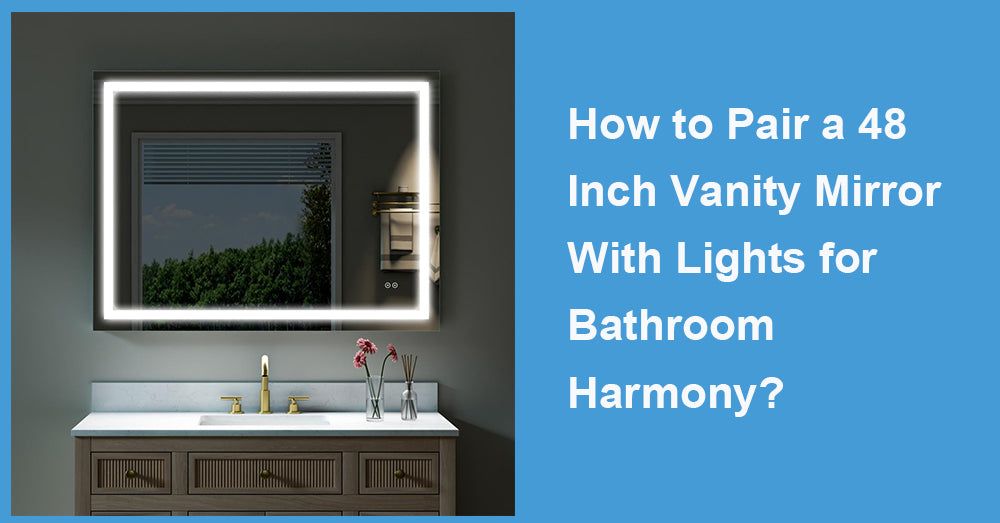
In the current trend of bathroom design and renovation, 48 inch vanity mirror with lights are gradually becoming a core configuration in medium- to large-sized bathrooms. It not only serves as a daily mirror but also plays a key role in lighting levels, spatial proportions, and overall aesthetics. How to create a true "harmony" between a 48-inch illuminated bathroom mirror, bathroom cabinet, lighting, and spatial structure has become an essential topic of ongoing discussion in the industry.
1. Why is 48 inches the "golden width" for bathroom mirrors?
From the perspective of residential bathroom size evolution, 48-inch bathroom cabinets are widely used in master bathrooms and double-occupancy scenarios, and the matching mirror width often determines whether the space appears coordinated. Industry data shows that when the mirror width is controlled within 90%- 100% of the bathroom cabinet width, overall visual stability is highest, and the combination of a 48-inch mirror and a 48-inch bathroom cabinet is considered the safest match.
Compared to smaller mirrors, the 48-inch mirror provides a more complete horizontal field of view, reducing the need for frequent user position changes. Compared to mirrors that are 60 inches or wider, it does not appear oppressive in ordinary residential bathrooms.
2. Mirror height. a key variable determining "good-looking" and "useful."
After the 48-inch width is determined, height becomes the core factor affecting the harmony of the bathroom. The industry generally recommends that the center height of rectangular illuminated bathroom mirrors be kept within 60-65 inches, which covers the natural line-of-sight height of most adults.
The distance between the lower edge of the mirror and the ground is usually recommended to be between 38 and 42 inches. When the height of the bathroom cabinet is between 34 and 36 inches, this installation method can leave a buffer space of 6-8 inches between the cabinet and the mirror, ensuring that water vapor, lighting, and visual balance are relatively ideal.
If the mirror is installed too low, the space will appear compressed. If installed too high, it will weaken the light's direct illumination on the opposite side.
3. How does the design with lights affect the overall coordination logic?
Compared to ordinary unlit mirrors, the 48-inch vanity mirror with lights has a more complex matching logic. Lighting is not only a functional configuration but also an essential component of the spatial atmosphere.
In the current mainstream design, common lighting forms include front light strips, backlight light strips, and bidirectional luminous structures at the front and rear. The front light strip is more sensitive to height, and if the center of the mirror deviates from the line of sight, it can easily create shadows on the face. The backlight design emphasizes the wall-reflection effect, which has a greater impact on the overall spatial hierarchy.
Industry research shows that when the center of the mirror aligns with the user's eye level, the uniformity of facial illumination is significantly improved, and the comfort of fine operations such as makeup and shaving is enhanced accordingly.
4. Proportional relationship with bathroom cabinet. width is only the first step
Although 48-inch mirrors are usually paired with bathroom cabinets of the same width, "equal width" does not mean "random installation." At the visual level, the vertical ratio between the mirror and the cabinet is equally essential.
In practice, the overall proportion is most balanced when the mirror's height occupies 55%- 65% of the wall's visible height. If the mirror is too high, it will weaken the presence of the bathroom cabinet. If it is too short, it will make the wall appear empty.
In addition, whether the mirror's edge is vertically aligned with the cabinet's edge directly affects the sense of order in the space. The industry generally believes that the larger the rectangular mirror, the higher the importance of alignment accuracy.
5. The difference between single-use and double-use scenarios
48-inch bathroom mirrors are commonly used in shared master bathroom environments for two people. In this scenario, the mirror's height and lighting distribution need to account for users of different heights.
Compared to a single bathroom that allows for personalized height adjustment, a multi-person environment emphasizes the "median principle" more. Setting the mirror to 62-64 inches can accommodate a broader range of users and reduce the need for frequent bending or tiptoeing.
Some projects will further enhance comfort when multiple people use it simultaneously through left- and right-sided dual light zones or partitioned lighting.
6. Coordination strategy when coexisting with side cabinets and wall cabinets
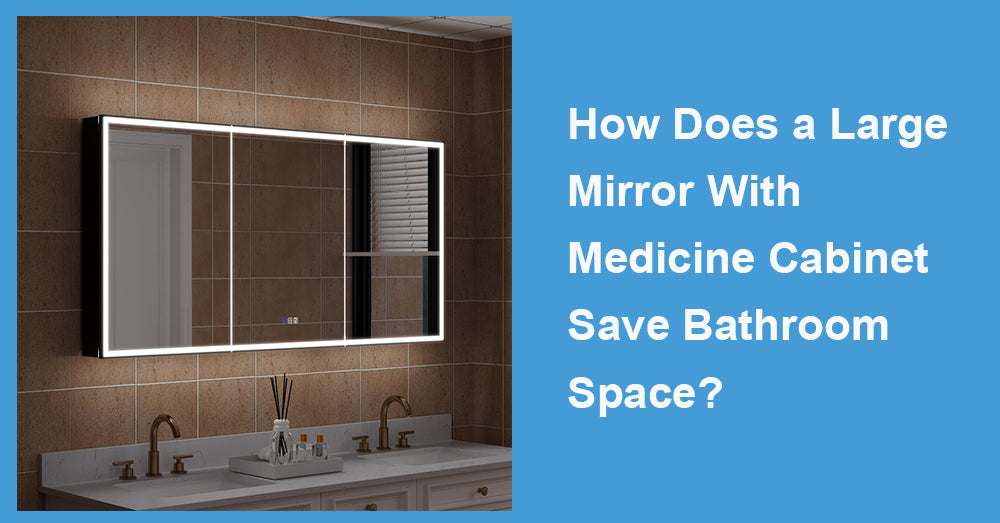
In modern bathrooms, 48-inch mirrors are no longer isolated. They form a wall structure with side cabinets, hanging cabinets, or open storage systems.
When a hanging cabinet is above the mirror, it is usually recommended to leave a gap of 2-4 inches between the mirror edge and the bottom of the cabinet to avoid visual pressure and ensure the lights are not obstructed. If the mirror is at the same height as the side cabinet, it emphasizes the consistency of the longitudinal lines, and the height is often adjusted based on the cabinet size.
In these combination designs, mirror height is no longer a separate decision, but a part of the overall system.
7. Common Matching Misconceptions and Industry Reflections
According to industry feedback, the standard issue with 48-inch bathroom mirrors with lights is not the product itself, but rather a misjudgment during the matching stage. The most common situations include: the mirror size is appropriate, but the height is unbalanced. The lighting configuration is advanced, but the lighting experience is poor. The mirror-to-bathroom cabinet ratio is out of balance, making the space appear cheap.
These problems often stem from the combination strategy of "only looking at size, not relationships, while ignoring the interaction logic between mirrors, lighting, and people."

8. Conclusion. True harmony comes from systematic thinking
From an industry perspective, how to match a 48-inch vanity mirror with lights is not simply choosing the "right size", but a systematic decision involving height, proportion, lighting, and usage behavior.
When the mirror's width naturally aligns with the bathroom cabinet, the center of the mirror falls within a comfortable line of sight, and the lighting structure and spatial layout complement each other, the bathroom can truly achieve the unity of function and aesthetics. It is precisely in such a systematic combination that the 48-inch illuminated bathroom mirror can fully realize its value and become an indispensable part of the space.









































Leave a comment
This site is protected by hCaptcha and the hCaptcha Privacy Policy and Terms of Service apply.