




















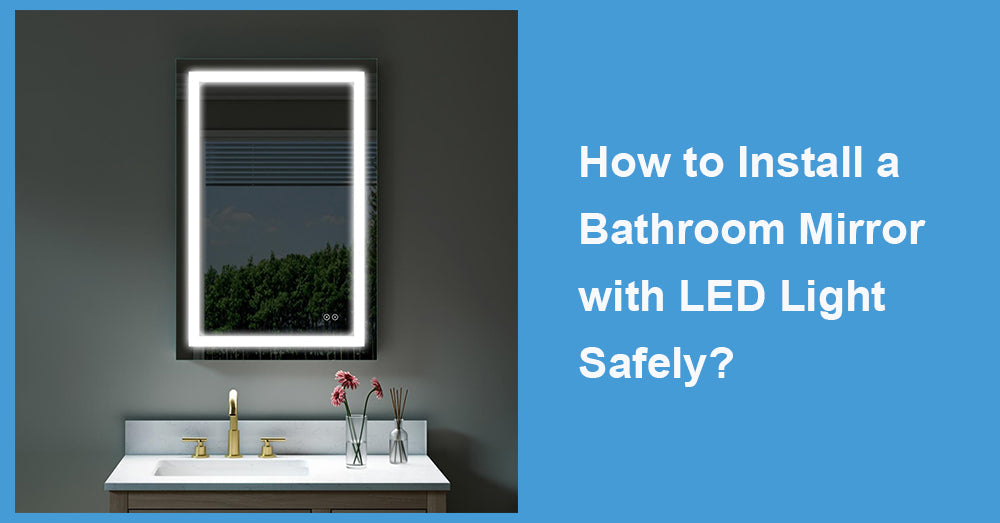
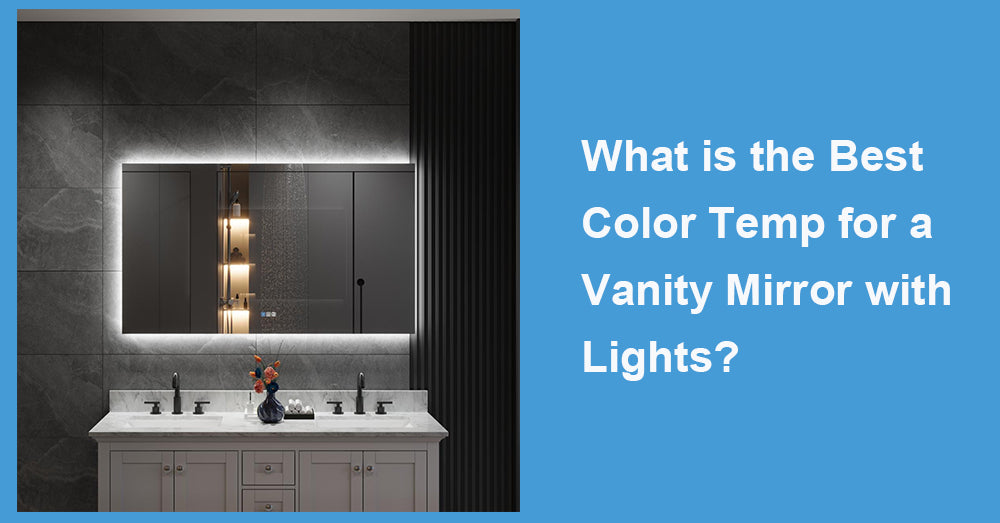
In modern bathroom upgrades, a bathroom mirror with LED light has become a standard choice that balances functionality and aesthetics.
But unlike ordinary mirrors, LED-mirror installations require structural fixation, electrical connections, and wet-area safety.
If the installation method is improper, it not only affects the user experience but may also bring long-term hidden dangers.
Industry data shows that a significant portion of small-scale electrical issues in bathrooms stem from overlooked installation details during the early stages, rather than from product quality issues.
1. Before installation, determine whether your bathroom is suitable or not
The most crucial step before starting is not drilling holes, but evaluating environmental conditions.
Wall type
Common installation walls for bathroom mirrors include gypsum board, tile-covered walls, and solid walls.
Industry experience shows that gypsum board walls must be coordinated with keel positioning or specialized expansion components; the risk of mirror sagging significantly increases under long-term load-bearing and vibration.
For ceramic tile walls, whether the drilling position avoids the brick joints will directly affect stability.
power condition
LED mirrors usually require an independent power supply.
At standard installation heights, the reserved position for the power supply should be kept at a reasonable distance from the mirror's back interface to avoid exposing the wiring.
The data show that exposed wires persist after installation, and the rework rate is significantly higher in later stages.
2. Size and position: Safety and comfort start from proportion
The position of the mirror is not just about being installed in the center.
The size and height directly affect the safety of use.
In most bathrooms, the bottom of the mirror is about 40-44 inches above the ground, and the center of the mirror is close to the user's line of sight, allowing it to be used without looking up or down.
The height of the mirror is usually 28-36 inches, which covers the face without appearing oppressive.
For mirrors with LED lights, leaving at least 1-2 inches of heat dissipation and operation space on the left, right, and top can help extend the lifespan of the light strip and power module.
3. Fixed method: More important than you imagine
In industry feedback, the most common problem with LED mirrors is not "the light is not on", but "the mirror is loose".
Hanging rail vs fixed point position
Hanging rail installation distributes weight horizontally, resulting in higher fault tolerance.
Fixed-point positions require higher measurement accuracy but have a simpler appearance.
The data shows that in mirrors over 36 inches, the hanging rail structure has better long-term stability.
Load-bearing accounting
Mirrors with LED lights are usually heavier than regular mirrors, with the weight concentrated in the power and light strip areas.
Even styles that appear "thin" should not be underestimated in terms of their load-bearing requirements.
Reasonable use of metal expansion fittings or specialized fasteners is the key to avoiding later loosening.
4. Electrical connection: the core link of safety
The electrical aspect is the most important to handle with caution during LED mirror installation.
Power off operation
Before making any wiring, confirm that the relevant circuit is completely powered off.
In industry accident statistics, the majority of minor electric shock incidents in bathrooms occur in scenarios where the voltage is considered low and the risk is not significant.
Waterproof grade and connection method
The LED mirror wiring points should be located on the back of the mirror body or in a waterproof area to avoid direct exposure to moisture.
A stable connection method should ensure that the junction box is sealed and kept at a safe distance from the water source.
Even low-power LEDs may experience circuit aging due to long-term moisture infiltration.
5. Lighting test: Don't wait until the installation is complete to discover the problem
Conducting a power-on test before fully fixing the mirror is a recommended industry standard.
The test content is not just about whether it is on or off, but also includes:
Whether the brightness is uniform
Whether there is flickering
Whether the switch response is normal
Data shows that early testing can significantly reduce rework rates, especially in embedded or cabinet-integrated installation scenarios.
6. Hidden details of the anti-fog and control module
Many bathroom mirrors with LED also integrate anti-fog and touch functions.
The installation location and ventilation conditions of these modules will directly affect their service life.
The anti-fog module is usually located in the middle and lower area of the back of the mirror.
If it is tightly attached to the wall with no heat dissipation space, performance degradation will accelerate significantly over the long term.
Therefore, an appropriate distance between the backs is not a "slacking off", but a necessary design margin.
7. Common mistakes, more common than imagined
From industry cases, the following errors occur very frequently:
Only fix the upper hanging point and ignore the lower limit
The wires are pulled too tightly, making maintenance difficult in the later stages
The mirror is not aligned with the basin, which affects long-term comfort during use
The light's color temperature was not confirmed in advance, and it was found to be unsuitable after installation
These issues are not complicated, but once they occur, they often require disassembly and reassembly.
8. When should I hand it over to a professional
If it involves wiring inside the wall, switch modification, or a high-power mirror body, the industry generally recommends that professionals complete it.
Data shows that in complex installation scenarios, projects completed by professionals have significantly lower post-installation issue rates.

9. Conclusion: Safety is not about taking an extra step, but about avoiding detours
Installing a bathroom mirror with LED lighting is a systems engineering effort that integrates structure, safety, and experience.
The truly safe installation does not rely on "tightening a few more screws", but on confirming the size, position, fixing method, and electrical connection layer by layer.
When every inch is rationally planned, and every detail is considered in advance, this mirror can serve daily usage scenarios stably and with peace of mind for many years to come.
Safety is never an additional item, but the starting point of design and installation.



































Leave a comment
This site is protected by hCaptcha and the hCaptcha Privacy Policy and Terms of Service apply.