























Keeping mirrors spotless becomes noticeably harder as surface size increases, which is why large bathroom mirrors often show streaks, haze, and edge residue even after routine cleaning. In modern bathroom design, oversized mirrors are widely used to improve lighting reflection and visual spaciousness, but they also amplify cleaning challenges. With renovation activity remaining strong and total improvement spending projected to reach around $518 billion by 2026, more attention is being placed on low-maintenance finishes and easy-care surfaces that reduce daily upkeep time.
Why do large mirrors streak more easily than small ones
The physics of cleaning changes with scale. A larger mirror surface means more cleaning passes, more opportunities for uneven drying, and more visible light reflections that expose streak patterns.
Common reasons streaking happens:
l The cleaning solution dries before full wiping is complete
l Uneven pressure leaves micro-film residue
l Hard water minerals leave a visible haze
l Paper towels or low-quality cloths shed fibers
Industry cleaning guidance consistently emphasizes that residue buildup is usually caused not by dirt, but by leftover cleaning agents that were not fully removed during the final wipe.
The right tools make the biggest difference
The most important step in achieving a streak-free finish is not the cleaner—it is the wiping material. Large mirrors amplify small mistakes in technique and tool choice.
Recommended tools:
l High-quality microfiber cloth (lint-free, tightly woven)
l Spray bottle with diluted cleaning solution
l Squeegee with a soft rubber edge for large surfaces
l Dry polishing cloth for final buffing
Microfiber is especially effective because it traps particles rather than spreading them across the glass surface. For large mirrors, switching to a squeegee for the main wipe significantly reduces streak risk by removing liquid in one controlled motion.
Best cleaning solution approach for glass stability
A key mistake in mirror maintenance is overusing chemical cleaners. Strong solutions can leave behind a film that becomes more visible on large reflective surfaces.
A balanced approach includes:
l Light dilution of mild dish soap in water for general cleaning
l Vinegar-and-water mixtures for mineral residue (when needed)
l Minimal use of ammonia-heavy sprays unless necessary
In practice, fewer products often produce a cleaner finish. The goal is not to “coat and scrub,” but to lightly lift and remove residue without leaving trace compounds behind.
Step-by-step method for streak-free results on large mirrors
For oversized mirrors, consistency matters more than speed.
A reliable process:
l Start from the top corner and work horizontally in overlapping passes
l Use a squeegee or a folded microfiber cloth with steady pressure
l Immediately dry each section after wiping to prevent evaporation marks
l Finish with a clean, dry microfiber cloth using circular buffing motions along the edges
Edge areas require extra attention because residue tends to accumulate where glass meets framing or wall seams.

Lighting plays a role in visible streaking
One often overlooked factor is the lighting angle. Large mirrors reflect not only objects but also imperfections in cleaning patterns.
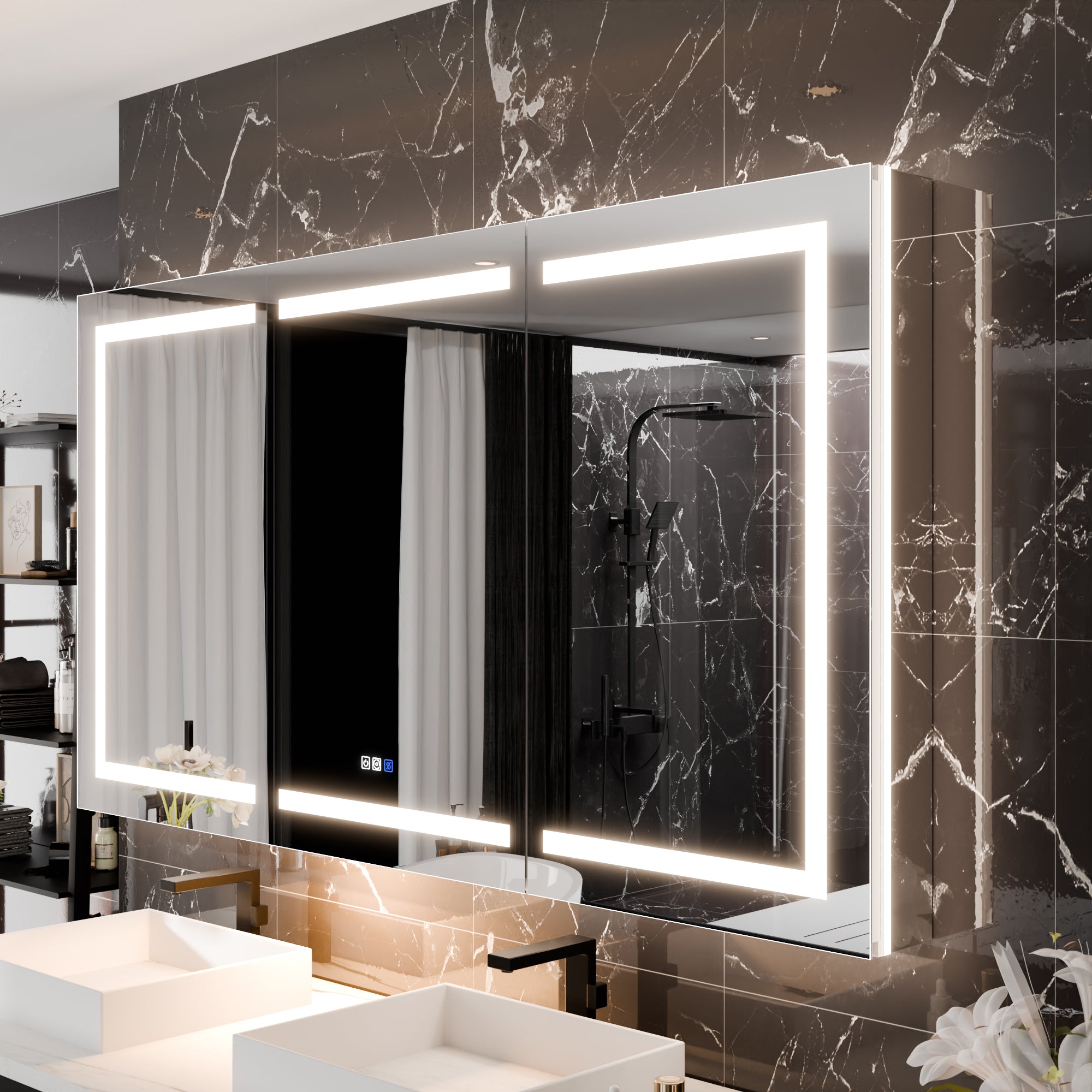
High-contrast LED lighting, commonly used in modern bathrooms, can make streaks appear more pronounced. Surveys of bathroom upgrades show widespread adoption of lighting-enhanced mirror systems, including dimmable LED setups, where surface clarity becomes more noticeable due to stronger directional illumination. In such setups, even minor streaking becomes visible under angled light reflection.
Water quality and mineral buildup issues
Hard water is one of the most common causes of persistent haze on bathroom mirrors. Mineral deposits form thin layers that standard cleaning may not fully remove.
Typical signs include:
l Cloudy patches near sink level
l White residue along the lower mirror edges
l Reappearing haze shortly after cleaning
In these cases, alternating between vinegar-based cleaning (for mineral breakdown) and microfiber polishing (for removal) is more effective than repeated general cleaning sprays.
Why do large mirrors require different maintenance routines
Large mirrors are not just scaled-up versions of small mirrors—they behave differently because:
l They reflect more environmental dust and humidity patterns
l They accumulate condensation across a wider surface area
l They require longer wiping cycles, increasing evaporation risk
l They show inconsistency in technique more clearly
As a result, professional maintenance approaches often treat large mirrors as “sectioned cleaning zones” rather than a single surface.
Preventing streaks before they happen
The most effective cleaning strategy is prevention rather than correction.
Best practices include:
l Wiping condensation after showers before it dries
l Using ventilation to reduce humidity buildup
l Avoiding aerosol sprays directly on the mirror surface
l Keeping clothes clean to prevent re-depositing residue
Humidity control is especially important because bathrooms with frequent steam exposure accelerate both water spotting and the visibility of cleaner residue.
Professional-grade trick: the two-pass finish
One of the simplest ways to eliminate streaks on large mirrors is a two-pass method:
l First pass: remove all visible moisture or cleaner using a squeegee or a damp microfiber
l Second pass: dry buff with a clean, completely dry microfiber cloth
This ensures that no liquid residue remains to evaporate unevenly. The second pass is what transforms a “clean” mirror into a truly streak-free one.
The bottom line: technique matters more than product
Large mirrors magnify everything—good technique and bad technique alike. The difference between a cloudy surface and a crystal-clear finish usually comes down to controlled wiping, minimal product use, and proper drying method.
As bathroom design continues to favor oversized reflective surfaces for brightness and spatial enhancement, maintaining clarity becomes part of everyday upkeep rather than occasional cleaning. With the right method, even the largest mirror can stay completely streak-free without heavy chemical use or repeated scrubbing.










































Leave a comment
This site is protected by hCaptcha and the hCaptcha Privacy Policy and Terms of Service apply.