




















In modern bathroom design, frameless bathroom mirrors are widely used for their clean aesthetic, minimal edges, and ability to expand smaller spaces visually. But when children are part of the household, safety becomes just as important as style. With bathroom upgrades continuing to rise in priority and overall renovation spending projected to reach around $518 billion by 2026, more attention is being placed on how design choices affect everyday safety and durability in high-use environments.
What makes frameless mirrors different from framed designs
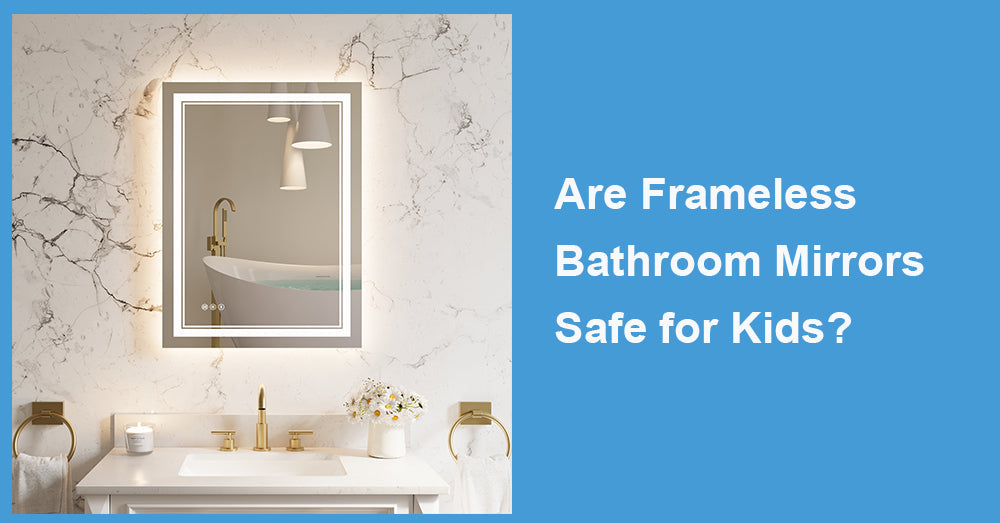
Frameless mirrors are typically made from tempered or safety glass with polished edges, mounted directly to the wall using adhesive, clips, or hidden brackets. Unlike framed mirrors, they have no external protective border, which creates a seamless look but also exposes edges more directly.
This structural difference is important when evaluating safety in homes with children, because the edges and mounting system become the key safety factors rather than the outer frame.
The real safety factor: tempered glass and edge finishing
Most modern bathroom mirrors are made from tempered safety glass, which is designed to break into small, less sharp fragments rather than large, dangerous shards. In general construction safety standards, tempered glass is significantly stronger than standard annealed glass and is widely used in residential interiors for this reason.
However, safety depends on more than glass type. The edge finishing and mounting quality are equally critical:
l Polished edges reduce cut risk during accidental contact
l Proper adhesive or bracket installation prevents shifting or detachment
l Wall anchoring distributes weight evenly across the surface
When these factors are properly executed, frameless mirrors can be safely used in family bathrooms, including those used by children.
Why mounting quality matters more than mirror style
For children, the biggest risk is usually not the glass surface itself but instability. A poorly installed mirror—framed or frameless—can become dangerous if it loosens over time.
Modern installation systems typically include:
l Mechanical clips at the top or bottom edges
l Industrial-grade adhesives rated for bathroom humidity
l Anti-slip backing films in some designs
These systems are designed to prevent movement even under vibration or changes in humidity. In bathrooms, where steam and temperature fluctuations are common, stable mounting is the key safety requirement.
Height placement: the most overlooked safety detail
Mirror height significantly affects child safety. In many bathroom layouts, mirrors are installed at adult eye level, but in homes with children, placement must account for reach range and interaction.
Accessibility guidelines used in building design often reference usable reach ranges and ergonomic access zones to prevent unsafe stretching or climbing behavior. While frameless mirrors are not inherently unsafe, poorly placed mirrors can encourage children to climb onto sinks or countertops to interact with them.
Best practice includes:
l Keeping the bottom edge high enough to reduce accidental impact
l Avoiding installation directly above climbing-prone surfaces
l Ensuring sinks and counters do not encourage stepping or leaning

Risk comparison: frameless vs framed mirrors
Framed mirrors add a physical buffer around the edges, which can reduce direct contact with the edges. However, they also introduce frame materials that can loosen, chip, or create additional joints over time.
Frameless mirrors remove this outer structure, which reduces potential failure points but places greater importance on:
l Edge polishing quality
l Glass thickness
l Secure wall mounting system
In well-installed systems, frameless mirrors are not inherently more dangerous than framed ones. The difference lies in installation precision and product quality rather than design category alone.
Bathroom environment risks that matter more than mirror type
When evaluating safety, environmental factors often matter more than mirror structure:
l Wet floors increase slip risk near sinks
l Hard surfaces (countertops, faucets) are causing impact injuries
l Steam is reducing visibility and increasing accidental contact
l High activity zones during morning routines
In this context, mirror safety is part of a larger system of bathroom safety rather than an isolated issue.
Material strength and break resistance expectations
Most bathroom mirrors today are manufactured with safety-backed glass and a protective film on the rear surface. This backing layer helps hold fragments together if breakage occurs, reducing scattering.
Industry-grade bathroom mirrors are typically designed to withstand:
l Daily humidity cycles
l Minor accidental contact
l Vibration from door closure or cabinet use
While no glass surface is completely “impact-proof,” modern frameless mirrors are engineered to meet standard residential safety expectations when properly installed.
When frameless mirrors are a good choice for family bathrooms
Frameless mirrors are generally a strong option when:
l They are made of tempered safety glass
l Edges are fully polished
l Installation uses certified mounting hardware
l They are securely anchored into studs or reinforced wall backing
l They are placed at an appropriate height for the room layout
In these conditions, frameless mirrors offer both aesthetic and functional advantages without introducing unusual safety risks.
When extra caution is needed
Additional caution is recommended when:
l Mirrors are oversized and heavily used by multiple children
l Installation is done on weak drywall without reinforcement
l The bathroom has frequent vibration or humidity issues
l Lower edges sit close to active sink or climbing surfaces
In such cases, reinforcing mounting points or choosing thicker glass can improve safety margins.
Bottom line: safety depends more on installation than design
Frameless bathroom mirrors are generally safe for children when they are properly specified and installed. The key factors are not the absence of a frame, but the quality of glass, edge finishing, mounting strength, and placement height.
In well-designed bathrooms, frameless mirrors can actually reduce risk by eliminating loose frame components and providing a flush, stable surface. The real safety outcome comes from installation quality and spatial planning—not the mirror style itself.



































Leave a comment
This site is protected by hCaptcha and the hCaptcha Privacy Policy and Terms of Service apply.