






















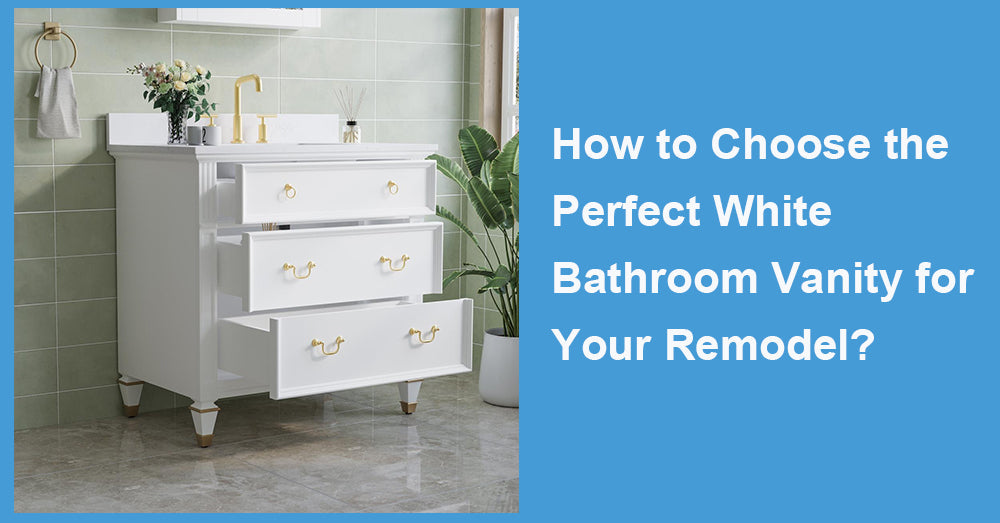
In contemporary bathroom renovations, the white bathroom vanity has almost become a 'no mistake' choice. From a visual perspective, white has a natural magnifying effect that can make small and medium-sized bathrooms appear brighter and cleaner. From a design perspective, white has strong compatibility and can naturally blend into any style, from modern minimalism to transitional to traditional. Therefore, white bathroom cabinets are not only an aesthetic choice but also a rational decision that balances functionality and long-term value.
But precisely because the "white bathroom cabinet" seems simple, choosing one suitable for one's own renovation actually requires a more systematic judgment. The size, proportion, material, countertop, and storage method will directly affect the user experience for more than ten years in the future.
1. Starting from spatial scale: size is always the top priority
In bathroom design, the width of the bathroom cabinet often determines the layout logic of the entire space. Industry data shows that the most common single bathroom cabinet widths in residential bathrooms are concentrated in four ranges: 24 inches, 30 inches, 36 inches, and 48 inches.
24-30 inches: More suitable for compact bathrooms or guest restrooms, emphasizing basic functionality and access space
36 inches: Considered as a 'balance point', achieving good coordination between countertop area, storage capacity, and visual proportion
48 inches and above: mainly used for the main bathroom, suitable for double use or families with high storage needs
It should be noted that, in addition to the cabinet's width, its depth should also be considered. The depth of most white bathroom cabinets is between 18 and 21 inches; anything deeper will compress the channels, and anything shallower will compromise the countertop's practicality.
2. There is not only one type of white: the material determines the long-term appearance
Many renovation projects may appear similar in initial renderings, but the differences will gradually become apparent over a few years, and the key often lies in the materials.
Common materials for mainstream white bathroom cabinets include:
Solid wood or solid wood composite: structurally stable, surface coated with white paint, high-quality texture, and relatively higher price
Plywood: with better moisture resistance than ordinary-density board, it is a common choice in mid to high-end projects
MDF density board: with a flat surface, suitable for complex shapes, but with higher requirements for a humid environment
Industry tests have shown that in long-term, high-humidity environments, the deformation rate of multi-layer plywood structures is significantly lower than that of ordinary-density boards, which is why many designers recommend them for white bathroom cabinets.
From a long-term renovation perspective, choosing a white bathroom vanity is also closely related to maintenance and aging. Unlike darker finishes, white surfaces are more sensitive to changes caused by moisture, cleaning frequency, and lighting conditions. Over time, factors such as yellowing, gloss loss, or uneven color aging may occur if surface treatments are inadequate. This is why professional projects often prioritize cabinets with multi-layer protective coatings, UV-resistant finishes, and moisture-sealed edges. These details may not be visually apparent at first. Still, they play a decisive role in maintaining the cabinet’s appearance and integrity over the course of a decade of use.
3. Table selection: The "second protagonist" of the white cabinet
The white bathroom cabinet is not an independent product; the countertop material directly determines the overall temperament.
Artificial stone (Quartz): With strong stain resistance and low maintenance costs, it is currently the most widely used choice
Natural marble: natural texture, but requires higher daily care.
Ceramic integrated basin: visually simple, suitable for modern or minimalist styles
In practical use, over 60% of renovation projects choose artificial stone countertops with light gray or white textures to maintain overall cleanliness and avoid monotony caused by pure white.
4. Storage Structure: Drawers are More Important than You Think
Many people focus only on appearance when choosing bathroom cabinets, while ignoring the internal structure. In fact, storage design is often a key factor in user satisfaction.
Compared to the traditional double-door structure, the full-drawer white bathroom cabinet offers more available space, and items are clear at a glance. Industry research shows that bathroom cabinets with at least two deep drawers have significantly higher daily efficiency than single-door cabinets.
If space permits, priority should be given to:
A combination of shallow top and deep bottom drawers
Internal structure with anti-slip or partition module
Silent buffer rail reduces long-term wear and tear.
5. Floor standing vs suspended: balance between visual and maintenance
White bathroom cabinets are mainly divided into two types in terms of installation form:
Freestanding: easy installation, low wall requirements, and larger storage capacity
Floating: visually lighter, convenient for cleaning the floor, and more suitable for modern spaces
In small and medium-sized bathrooms, hanging white bathroom cabinets often significantly enhance spatial transparency, while in large-sized main bathrooms, floor-standing cabinets emphasize stability and storage capacity.

6. Hardware and Details: The Key to Determining 'Ten Years of Durability.'
White itself magnifies details, so hardware configuration is critical. The texture of handles, hinges, and guide rails will be continuously amplified over the long term.
The current mainstream pairing trends include:
Matte black or brushed nickel handle, creating low contrast accents
Hidden handle, enhancing overall minimalism
Anti-fingerprint, corrosion-resistant coating on hardware improves long-term durability.
7. Conclusion: White bathroom cabinets are the intersection of rationality and aesthetics
Choosing a suitable white bathroom luxury is not simply about "choosing white", but a systematic decision from space size, material structure, countertop combination, storage logic, to installation method. A genuinely excellent white bathroom cabinet may not be flashy at first glance, but it can continue to provide a comfortable, orderly, and stable experience in daily use.
In high-investment, low-fault-tolerance projects, such as bathroom renovations, white bathroom cabinets have endured precisely because they maintain restraint in change and strike a long-term balance between functionality and aesthetics.








































Leave a comment
This site is protected by hCaptcha and the hCaptcha Privacy Policy and Terms of Service apply.