






















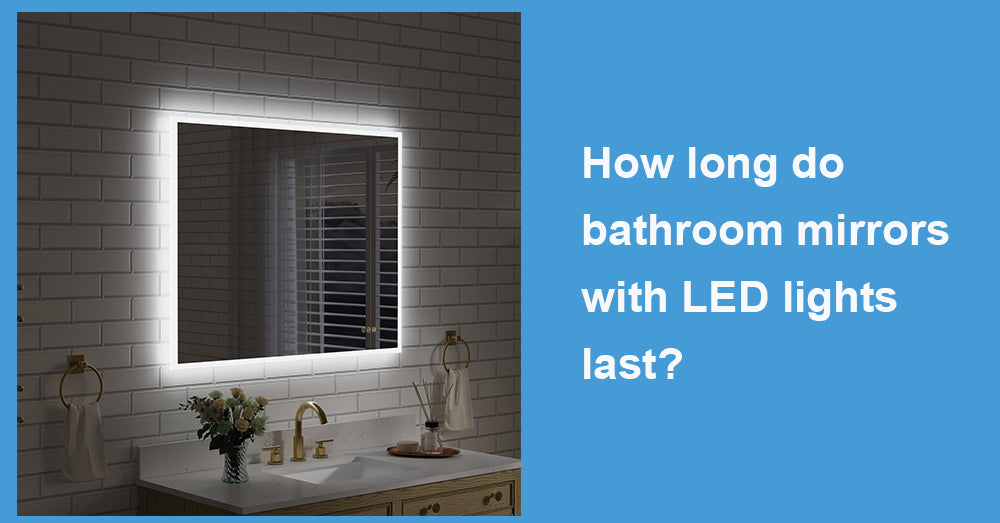
In recent years, the bathroom mirror with LED light has gradually evolved from a functional accessory to a core lighting device in the trend of bathroom upgrades. Compared to traditional mirror headlights and ordinary mirror combinations, the LED light mirror integrates the light source, control system, and mirror body, making the overall design more straightforward and more efficient. But many users have the same question when choosing: how long can this integrated mirror last? From the perspectives of industry lifespan testing, after-sales data, and lighting standards, the service life of LED light mirrors is much more complex than their appearance suggests, and it depends on the comprehensive performance of the light source lifespan, driving system, moisture-proof structure, and usage environment.
1. Basic definition of LED light source lifespan in the industry
In the lighting industry, the lifespan of LED light sources is usually measured by the "rated working hours". The mainstream specifications are generally marked in the range of 30000 to 50000 hours. Based on a daily usage of 2 hours, the theoretical lifespan can reach 40-60 years; Even if used for 4 hours a day, it can work stably for more than 20 years.
However, industry testing emphasizes that this number represents only the time point at which the light source's emission decays to 70% of its initial brightness and is not equivalent to the actual service life of the entire mirror. For a bathroom mirror with LED light, the genuine limiting factor for its lifespan is often not the LED chip itself, but rather the power drive, electrical connections, and moisture-proof structure.
2. Real service life: why most lamp mirrors are concentrated in the 10-15 year range
In the long-term tracking and statistics of residential equipment, LED light mirrors with standardized installation and mature structure generally have a stable service life of 10-15 years. After exceeding this cycle, common issues include:
Driver efficiency decreases, and brightness significantly weakens
Local LED beads are aging, resulting in uneven brightness
Decreased sensitivity of the control module
Industry maintenance data shows that in cases of failure with illuminated mirrors, less than 15% are caused by LED chip damage. In comparison, over 60% of failures are due to aging or moisture damage to the drive power supply. This means the light source's lifespan is extremely long, but the stability of the entire system determines the actual lifespan.
3. Drive system: the core component that determines the upper limit of lifespan
Each bathroom mirror with an LED light is equipped with an independent LED driver inside. Its working environment is constantly exposed to high humidity, high temperature differences, and frequent on-off states, making it the most susceptible component to aging in the entire machine.
Industry reliability testing shows that:
High-quality drive designs have a lifespan of 40000 to 60000 hours
The stable working cycle of ordinary drives is usually 20000-30000 hours
After the driver operates continuously for 8-10 years, the output current stability begins to decrease, and the brightness of the lamp beads decreases accordingly. That's why high-end products often use independent replaceable driver modules, while low-end integrated designs can only replace the entire mirror after the driver fails.
4. Moisture-proof structure: the long-term impact of the bathroom environment on lifespan
The long-term humidity in the bathroom is usually maintained in the range of 60%-90%, which continuously puts pressure on the electronic system. Industry failure analysis shows that about 35%-45% of early-damage cases involving illuminated mirrors are due to the intrusion of condensed water or internal condensation.
Mature products typically have the following structural features:
Protection level not lower than IP44
Independent sealing of the power compartment
Reserve a ventilation gap of 1/8 inch to 1/4 inch on the backboard
In well-ventilated bathrooms, the actual lifespan of LED light mirrors can be extended by an average of 30%-40%. In environments with insufficient ventilation and frequent hot-water use, even if the light source's lifespan is sufficient, the aging rate of electronic components will accelerate significantly.
5. Size and power: larger is not necessarily more durable
Common sizes include:
— 24 inch x 36 inch
— 30 inch x 40 inch
— 36 inch x 48 inch
The power is mainly concentrated between 20W and 40W. Industry lifespan testing shows that within a reasonable power density range, size does not have a significant impact on lifespan; The genuine factor affecting the aging rate is the level of heat accumulation per unit area.
When the power density is too high, the internal temperature rises by 10-15 °F, and the driver's aging rate can increase by more than 20%. Therefore, high-quality large-sized mirrors often adopt multi-segment light-source distribution to reduce single-point heat load and extend the system's stable life.

6. Long-term effects of usage frequency and switching mode
In daily households, the average number of times the illuminated mirror is turned on is about 6-10 times per day. The industry lifespan model indicates that frequent on-off cycles are more likely to accelerate drive aging than long-term continuous operation.
Models that use touch dimming and memory functions generally have better driving stability than mechanical-switch models, as they avoid frequent power outages and restarts. Long-term comparative data show that products with dimming memory systems can extend the average fault-free period by 15%-25%.
7. From an industry perspective: what kind of light mirror truly lasts for a long time
A bathroom mirror with an LED light that performs well in overall lifespan typically has:
High-grade LED chips (rated lifespan ≥ 50000 hours)
Independent high-quality driver module
Protection level not lower than IP44
Reasonable power density and heat dissipation structure
Under such configurations, long-term industry tracking data shows:
Failure rate less than 3% in the first 5 years
Stable operation ratio exceeding 85% within 10 years
The proportion of usable brightness that can still be maintained after 15 years is about 60%-70%
8. Conclusion
Returning to the question itself: How long do bathroom mirrors with LED lights last?
From the perspective of theoretical light-source lifespan, LEDs themselves can work for decades. From the standpoint of actual use, the true lifespan of a high-quality bathroom mirror with LED lighting is usually 10-15 years.
What truly determines the lifespan is not "how long the light can stay on", but rather:
Is the drive system durable
Is the moisture-proof structure reliable
Whether the heat dissipation and power are reasonable
Is the usage and ventilation environment stable
When all these conditions are met, a good LED light mirror can withstand multiple decoration cycles and maintain stable, uniform lighting performance even after years of use. This is also an important reason why integrated lighting mirrors have gradually become a standard configuration in modern bathrooms.







































Leave a comment
This site is protected by hCaptcha and the hCaptcha Privacy Policy and Terms of Service apply.