






















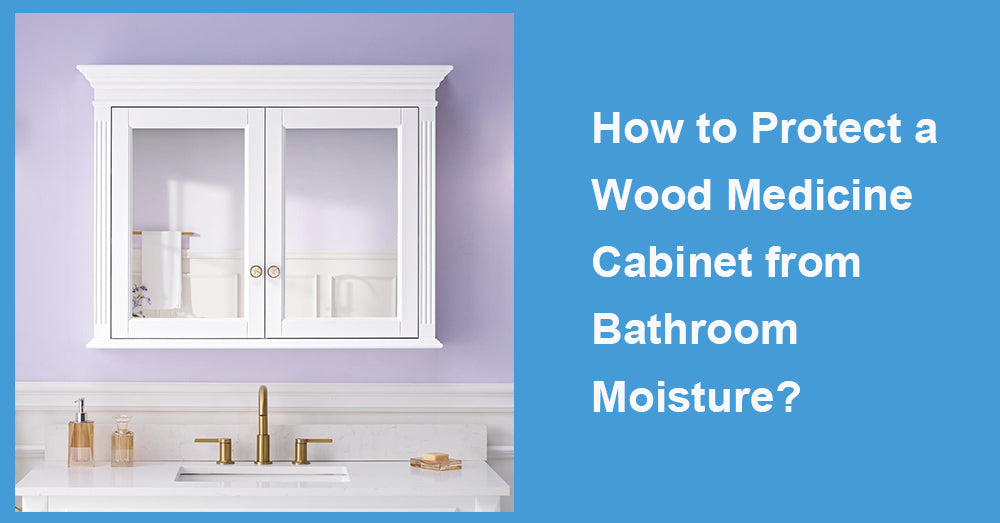
In modern bathroom design, wood medicine cabinet are increasingly favored by designers and consumers due to their warm texture and natural beauty. However, as a high-humidity space, the bathroom also poses a long-standing challenge for wooden products - the impact of humid environments on wood.
From an industry perspective, the durability of wooden medicine cabinets does not depend on whether wood is used, but on whether humidity risks are reduced through scientific design, rational material selection, and correct use. This article will start from industry practice and systematically analyze how to effectively protect wood medicine cabinets to maintain stability and aesthetics in bathroom environments.
1. The selection stage determines the moisture-resistant foundation: not all "woods" are suitable for bathrooms
In the industry, a wood medicine cabinet is not equivalent to "any solid wood".
Wood suitable for bathroom environments typically has a dense structure, high stability, and moderate oil content. For example, hardwood generally has better dimensional stability than cork wood and is less prone to significant deformation due to humidity changes.
In addition, the industry extensively uses engineered solid wood panels rather than whole logs. This type of material significantly reduces the probability of wood cracking or warping in humid environments through lamination, drying, and structural optimization, and is an essential technical foundation for modern wood medicine cabinets.
2. Surface treatment process is the first line of defense for moisture resistance
From practical cases, surface treatment processes have a significant impact on the durability of wood medicine cabinets.
High-quality products usually use a multi-layer closed-coating system that blocks the direct infiltration of water vapor into the wood's interior through primer, sealing paint, and a surface protective layer.
Industry experience shows that open or poorly coated wooden surfaces are more prone to moisture absorption and expansion in bathroom environments. Therefore, when choosing a wood medicine cabinet, whether to use mature, complete surface treatment processes is an essential criterion for determining whether it is suitable for the bathroom environment.
3. Structural design is more critical than the material itself
In humid environments, the durability of wood medicine cabinets depends not only on the material but also on whether the structural design is sound.
The following points are widely valued in the industry:
Reserve a reasonable ventilation space between the cabinet back panel and the wall
The joint adopts a moisture-proof structure design to reduce water vapor retention
There is a reasonable expansion margin between the door panel and the cabinet
These detailed designs help wood breathe naturally when humidity changes, avoiding cracking or deformation caused by stress concentration.
4. The installation method directly affects the long-term use status
Improper installation is one of the common causes of moisture issues in wood medicine cabinets.
From an industry perspective, avoiding exposing wooden medicine cabinets directly to the range of water vapor impact in the shower area is a fundamental principle. Meanwhile, a reasonable installation height and position can help reduce direct water splashing and condensation accumulation.
For recessed installations, the industry recommends ensuring that the interior of the wall has basic moisture-proof treatment and avoiding the medicine cabinet from tightly adhering to unprotected cold wall structures to reduce the risk of long-term moisture.
5. The overall ventilation conditions of the bathroom determine the living environment of wooden products
Any moisture-proof design of a wood medicine cabinet cannot exist independently of the overall bathroom environment.
The industry generally believes that a sound ventilation system is one of the key factors for the long-term stability of wooden products. Whether it is mechanical ventilation or natural ventilation, timely reduction of bathroom humidity can significantly extend the service life of wooden furniture.
In practical applications, many wooden medicine cabinets have problems not due to defects in the product itself, but rather due to long-term exposure to high humidity and lack of ventilation.

6. Daily use and maintenance determine the lifespan of details
From a usage perspective, reasonable daily maintenance can effectively mitigate moisture-related issues.
For example, promptly turning on the exhaust system after showering, avoiding water accumulation on the surface of the cabinet, and regularly cleaning and keeping it dry are all basic operations recommended by the industry.
In addition, regular inspections of cabinet corners, hinges, and door panel status can also help detect potential problems early and prevent minor issues from escalating into structural damage.
7. Comprehensive judgment from an industry perspective: Is a wood medicine cabinet suitable for bathrooms?
From the overall practice of the industry, as long as a complete system is formed in the four aspects of material selection, design, installation, and use, a wood medicine cabinet can fully adapt to the humid environment of the bathroom.
The problem is not whether the wood is usable, but whether the correct methods have been adopted to deal with the long-term variable of humidity.
Modern wood medicine cabinets are no longer simply wooden box structures, but mature products that integrate material engineering, structural design, and environmental adaptability.
Conclusion
In a space like a bathroom that requires extremely high environmental conditions, the performance of a wood medicine cabinet is not accidental, but the result of system design. By scientifically selecting materials, improving surface treatment, rational structural design, and coordinating with a good usage environment, wooden medicine cabinets can not only resist the challenges brought by moisture but also maintain stability and beauty in long-term use. From an industry perspective, what is truly worth paying attention to is never whether to choose wood, but whether to choose the right wood solution.









































Leave a comment
This site is protected by hCaptcha and the hCaptcha Privacy Policy and Terms of Service apply.