






















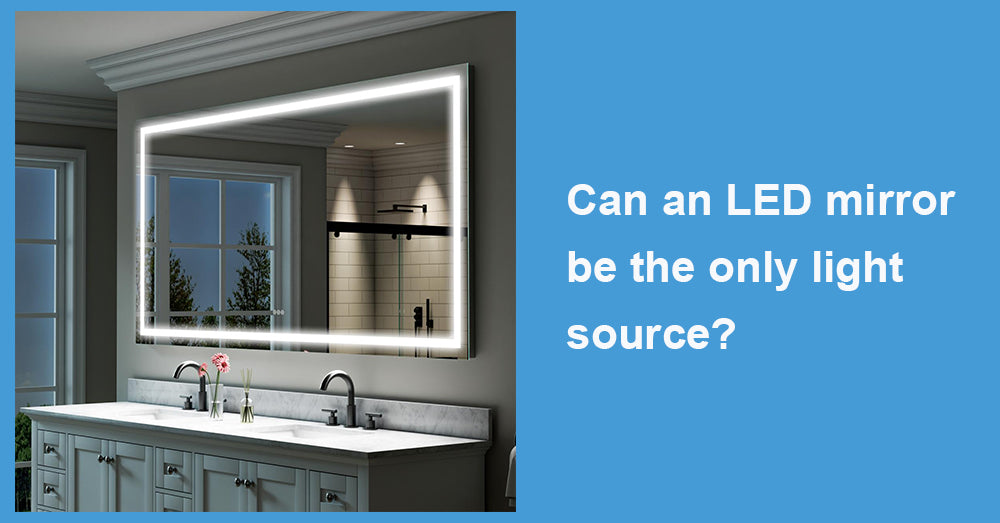
In modern bathroom design, LED mirror are gradually evolving from "functional accessories" to "core roles in space lighting". More and more decorative schemes are relying solely on mirror headlights to complete the main lighting task in the washing area. But the question also arises: can a mirror with a light really meet the lighting needs of the entire bathroom? From the perspective of lighting intensity, spatial scale, usage scenarios, and industry standards, this question is not simply a "yes" or "no", but more like a conditional design choice.
1. The basic demand for bathroom lighting is much higher than imagined
According to industry standards, the grooming area is not just about being able to see your face clearly. Daily shaving, makeup, skincare, and styling are all delicate activities that require extremely high levels of light quality. It is generally recommended in design specifications that the basic illumination of the washing area should be 300-500 lux or higher, while the ideal brightness for the mirror area used for fine operations is often 500-700 lux.
Taking the standard 36 inch wide bathroom mirror as an example, if only relying on the built-in light source in the mirror body, to form uniform illumination in the entire facial area, the output power of the light strip usually needs to reach 18-24 watts or more, and it must be matched with a reasonable optical diffusion structure to avoid the situation of bright in the middle and dark edges.
This means that not all LED mirrors have the "main light capability" in terms of brightness specifications. The original design intention of many products is still "fill light" rather than "main lighting".
2. The advantage of mirror front light: efficient illumination that is closer to the face
Compared with traditional ceiling lights, the most significant advantage of mirror front lighting is that the light position is more reasonable. When the overhead light shines from above, it is easy to form shadows below the eye sockets, nose wings, and chin; LED mirrors are usually located in front of the face, with a light angle closer to natural frontal light.
Industry test data shows that under the same brightness conditions, a uniform light source in front of the mirror can reduce facial shadow areas by more than 30 percent, significantly improving makeup accuracy and shaving comfort. This is also why more and more high-end hotels and residences are adopting mirror headlights as the "first light source" for their grooming areas.
From a functional perspective, as long as the light design is reasonable, the mirror front light can handle the "facial work lighting" aspect independently.
3. Space size determines whether it is "sufficient"
Whether the entire bathroom can be illuminated solely by LED mirrors largely depends on the space's scale.
In small shared bathrooms with an area of 40-60 square feet, if the mirror width is 30-40 inches and equipped with a front or two-way light-emitting structure, the mirror's front light can cover the wash area and the local passage area. In this type of space, setting only mirror lights and removing the overhead light does not visually appear significantly dim.
But in medium-sized or main bathroom spaces over 80 square feet, the light from mirror lights usually covers only a 3-4 foot range in front of them. The shower area, toilet area, and rear wall can easily form a dark area. If the ceiling lights are completely removed in such spaces, the overall illumination is often lower than the comfort standard, especially for nighttime use.
Therefore, from a spatial perspective, "relying solely on mirror lighting" is more suitable for small, guest, and semi-bathrooms, but not for large main bathrooms.
4. Color temperature and color rendering index directly affect the user experience
Brightness is only the first step; the quality of light determines the real experience.
The industry generally recommends that the color temperature of mirror headlights should be controlled between 3000K and 4000K. Excessively warm lighting can cause skin tone to turn yellowish, affecting makeup application; icy light can make skin appear pale and distorted.
Color rendering index (CRI) is equally crucial. Most design standards recommend a minimum CRI of 90 for mirror headlights. Test data show that when the CRI is increased from 80 to more than 90, the accuracy of skin color restoration can be improved by about 15 percent–20 percent, and the judgment of mouth red and foundation makeup depth is more closely aligned with the natural light environment.
If the LED mirror is used only as an auxiliary light, the poor light quality can still be compensated for by the overhead light. Still, if used as the sole light source, the quality of color temperature and color rendering performance will be magnified infinitely.
5. Three criteria for determining whether there is "full space lighting capability"
Based on practical project experience, whether an LED mirror can serve as a unique light source usually depends on three core parameters.
Firstly, whether the light output capability is sufficient, it is generally recommended that the total luminous flux of the mirror lamp be no less than 1200-1800 lumens to achieve basic illumination in a space of 50 square feet or less.
Secondly, whether the light-emission method is uniform: mirrors with only a backlight structure can mostly only create ambient light; a front-emitting or bidirectional-emitting structure can truly illuminate the face and surrounding walls.
Thirdly, whether it has dimming and multi-color temperature functions, adjustable brightness, and 3 color temperature switching, enabling the same mirror to adapt to different needs in the morning, at night, and during care, is a necessary condition for the design of the "main light source".
Without any of them, it is better suited as supplementary light rather than as the leading light.
6. Design trend: from "single lighting" to "layered lighting"
From the trend of bathroom design in recent years, the truly mature solution is not "only mirror lights" or "only ceiling lights", but "layered lighting systems".
Mirror headlights are responsible for illuminating facial features; the ceiling light provides basic ambient brightness; local light strips or wall lamps are used for night guidance and atmosphere shaping. This combination ensures functionality while also balancing comfort and layering.
Data shows that in bathrooms with tiered lighting schemes, user satisfaction with lighting has increased by an average of over 25 percent, and the complaint rate of nighttime glare has decreased by about 40 percent.
This also indicates that, even if LED mirrors have independent lighting capabilities, in higher-quality spaces, they are often only "one of the main characters" rather than "the only character".

7. Conclusion: yes, but not unthinkingly
Overall, LED mirrors can indeed be used as the sole light source under specific conditions:
Small space and sufficient mirror size
High brightness output and reasonable light-emitting structure
Color temperature and color rendering performance meet the standard
The main activities are focused on the grooming area itself
However, in most complete bathroom spaces, relying solely on mirror lights often makes it challenging to balance overall illumination and spatial hierarchy. A more rational approach is to consider LED mirrors as the "core functional light source" rather than the "only light source".
Truly excellent bathroom lighting is not about using the least amount of lights to solve problems, but about using the most reasonable light to make the space appear natural, comfortable, and valuable at all times.









































Leave a comment
This site is protected by hCaptcha and the hCaptcha Privacy Policy and Terms of Service apply.