















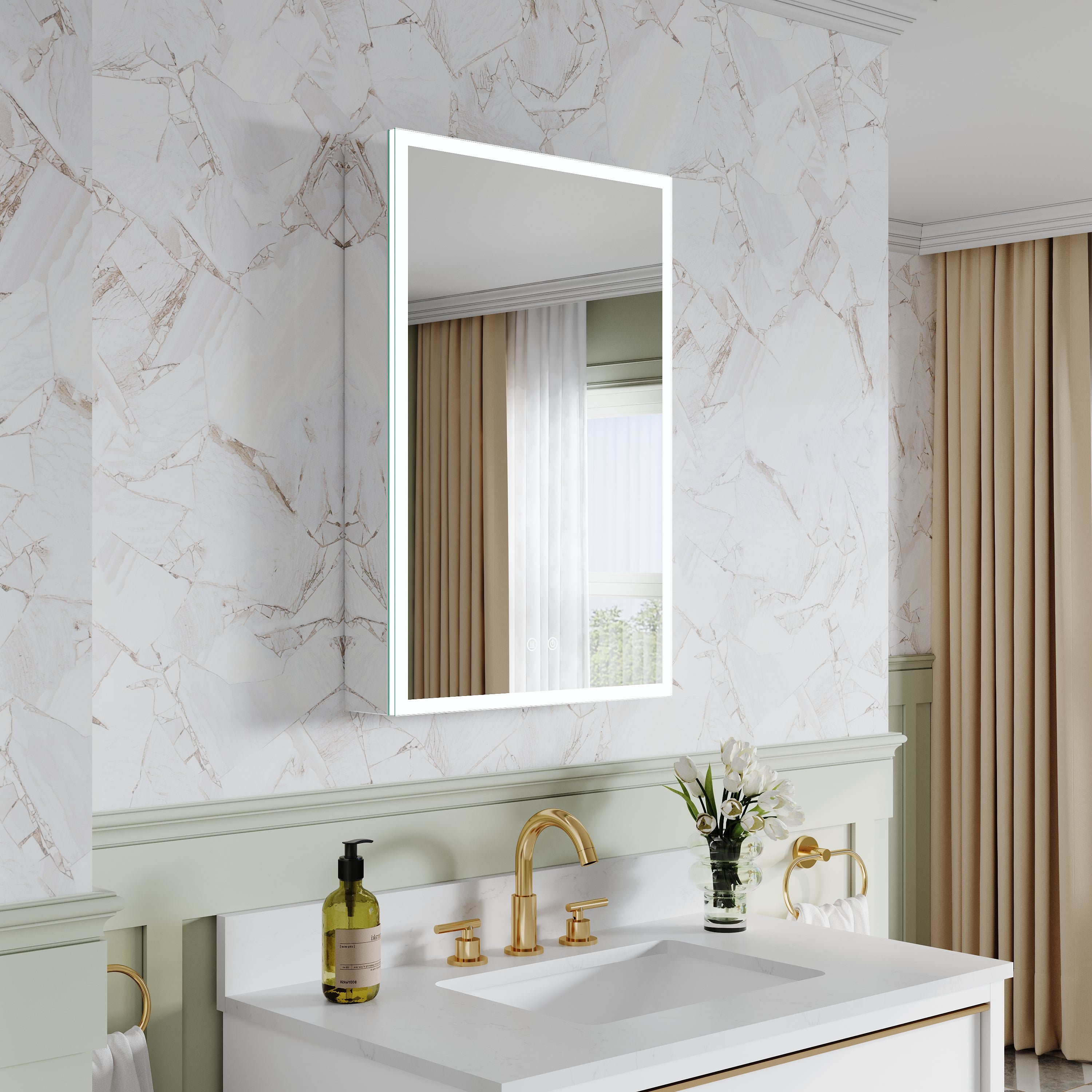
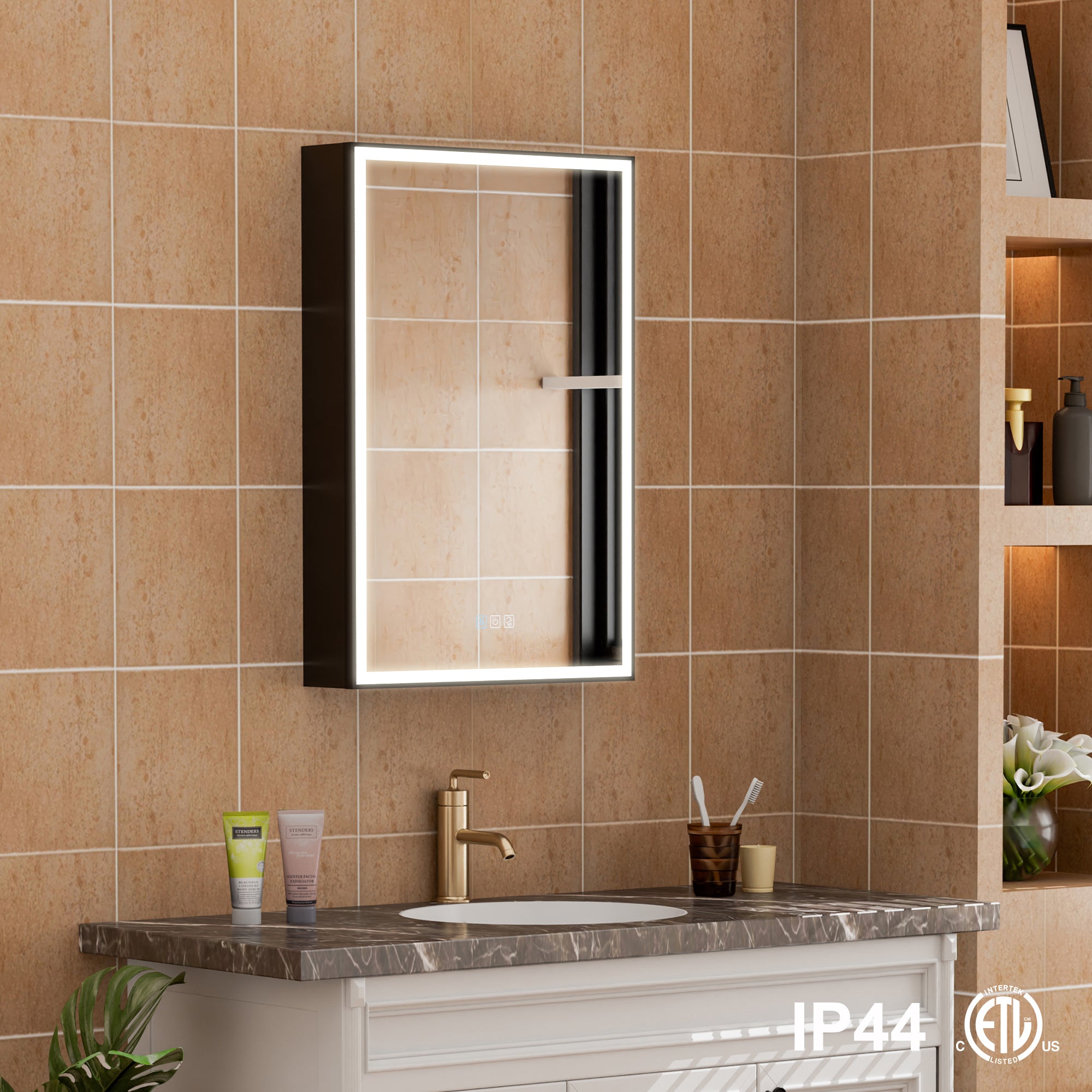










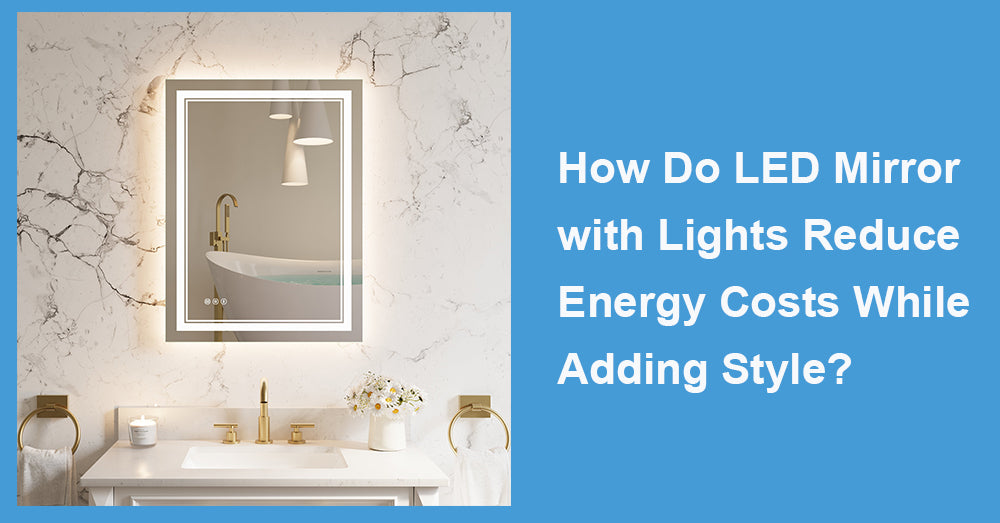
An LED mirror with lights can reduce bathroom lighting energy use while creating a cleaner, more contemporary vanity area. Instead of relying entirely on separate sconces or high-wattage traditional bulbs, integrated LEDs place efficient task lighting directly around the mirror. The Department of Energy states that LED lighting uses at least 75% less energy than incandescent lighting and can last up to 25 times longer. The design direction is also gaining traction: Houzz reports that lighted mirrors now appear in 22% of bathroom renovations, up 3 percentage points, while lighting overall is upgraded in 82% of projects.
1. LED Technology Uses Less Electricity
The primary energy advantage comes from the efficiency of LEDs. They convert a greater share of electricity into useful light and waste less energy as heat than traditional incandescent sources.
Department of Energy guidance says LEDs use at least 75% less energy than incandescent bulbs and last about 25 times longer. For a bathroom mirror used every morning and evening, that efficiency can reduce the electricity required for task lighting over the product’s life.
Actual savings depend on the mirror’s wattage, brightness setting, and daily operating time, so buyers should compare power specifications rather than assuming every LED mirror consumes the same amount.
Industry judgment: energy efficiency is becoming more persuasive when it is built into a feature people already use every day.
2. Integrated Lighting Can Reduce the Need for Extra Fixtures
Traditional vanity layouts often combine a mirror with separate sconces or a fixture above it. An illuminated mirror can perform part of that task-lighting role itself.
This does not mean ceiling or ambient lighting should disappear. Instead, the mirror can reduce dependence on multiple high-output fixtures around the vanity.
Houzz reports that LED bulbs are the most common sustainable bathroom feature, selected in 55% of projects that include sustainability measures. Dimmers appear in 30%, while energy-efficient fixtures are chosen in 28%.
Industry judgment: integrated lighting is attractive because it can simplify the fixture plan while improving energy performance.
3. Dimming Can Cut Unnecessary Energy Use
Full brightness is not required for every bathroom routine. Makeup application or shaving may need stronger task lighting, while nighttime handwashing or skincare may require much less.
A dimmable LED mirror allows users to adjust output rather than operating the lighting at maximum brightness every time.
NKBA reports that 80% of surveyed industry professionals are incorporating nighttime-specific lighting into bathroom design. Lighting quality is considered a top priority by 91%, while 92% agree that task lighting should always be included in the primary bath.
Industry judgment: lighting control is becoming as important as light output because efficient bathrooms should provide only the illumination needed at a particular moment.
4. Long LED Life Can Reduce Replacement Costs
Energy bills are only one part of operating costs. Lamp replacement and maintenance also matter.
DOE guidance states that LEDs can last up to 25 times longer than traditional incandescent bulbs. In an integrated bathroom mirror, a longer-lasting light source can reduce how frequently lighting components require attention.
This becomes more valuable with large mirrors around 36, 48, or 60 inches wide, where replacing several separate decorative bulbs could otherwise become part of routine maintenance.
Buyers should still review whether the LED driver or lighting components can be serviced because product construction varies.
Industry judgment: long service life strengthens the value proposition of LED mirrors by reducing maintenance as well as electricity consumption.

5. Lighted Mirrors Support Cleaner Modern Design
The visual advantage is equally important. Built-in illumination removes some of the hardware normally surrounding a vanity mirror, creating a cleaner wall.
That direction fits current bathroom preferences. Houzz reports that contemporary style accounts for 18% of bathroom renovations and modern style 16%, with both gaining ground. NKBA also found that 47% of professionals favor integrated lighting in mirrors over the next three years.
For a 36-inch vanity, a mirror around 30 to 34 inches wide can maintain balanced proportions. Larger 48- or 60-inch vanities can support wider illuminated mirrors that become architectural focal points.
Industry judgment: LED mirrors are gaining design value because technology is disappearing into the product rather than becoming another visible fixture.
6. Better Light Distribution Can Improve Grooming
Efficiency means little if the mirror produces poor illumination.
LED strips positioned along the sides or perimeter of the mirror can bring light closer to the face and reduce shadows created by ceiling fixtures. This improves visibility for shaving, makeup, skincare, and contact-lens routines.
NKBA’s finding that 92% of professionals consider task lighting essential reinforces the importance of this function.
When comparing products, buyers should look beyond decorative backlighting. Front-facing illumination is generally more useful for detailed grooming than lighting designed primarily to create a glow on the wall.
Industry judgment: the strongest LED mirrors combine efficient wattage with usable facial illumination rather than treating light as a visual effect.
7. Color Quality Matters as Much as Brightness
A stylish mirror should also reproduce colors accurately. This is particularly important for makeup, skin tone, clothing, and grooming.
Look for a color rendering index, or CRI, around 90 or higher when accurate color is a priority. Color temperature also influences the experience. A warm-neutral range around 3000K can create comfortable bathroom lighting, while products with adjustable temperature provide greater flexibility.
High-quality illumination can reduce the temptation to switch on several additional fixtures simply to see more clearly.
Industry judgment: premium LED mirrors increasingly compete on light quality rather than simply advertising maximum brightness.
8. Larger Mirrors Can Make the Bathroom Feel Brighter
A mirror does not generate daylight, but its reflective surface can distribute available light around the room.
A wide LED mirror above a 48- or 60-inch vanity can visually expand the vanity wall while integrated LEDs create a continuous illuminated edge. This combination works particularly well with white countertops, pale tile, and natural wood cabinetry.
NKBA’s latest research reflects the broader emphasis on brighter bathrooms, with 88% of respondents identifying natural lighting as a top priority.
Industry judgment: large illuminated mirrors are becoming part of the room’s lighting architecture rather than accessories added after the vanity is selected.
9. Sustainability Is Becoming Part of the Buying Decision
Houzz reports that 83% of bathroom renovation projects include some form of sustainable feature. Among those projects, long-term cost savings are cited by 65% as a motivation, while environmental impact is cited by 55%.
An LED mirror fits that direction particularly well because efficiency does not require a visible design compromise. The same technology that reduces lighting energy use can also create a thinner, cleaner, and more contemporary vanity wall.
Industry judgment: sustainable bathroom products gain wider appeal when efficiency improves the design instead of asking buyers to sacrifice it.
10. Conclusion
An LED mirror with lights can reduce energy costs primarily through efficient LED technology, lower power demand, dimming capability, and longer service life. At the same time, integrated lighting can eliminate visual clutter and create a more refined vanity area.
The strongest models should be evaluated by more than shape or price. Look at energy consumption, dimming capability, CRI, color temperature, light direction, mirror dimensions, electrical requirements, and serviceability.
For a smaller vanity, a carefully sized illuminated mirror can combine grooming light and contemporary styling without overcrowding the wall. On a wider 48- or 60-inch vanity, it can become a major architectural feature.
The category’s appeal is ultimately straightforward: better lighting no longer has to mean more fixtures or higher energy use. When efficient LEDs, useful controls, and clean design are integrated into one mirror, style and operating efficiency can reinforce each other rather than compete.




































Leave a comment
This site is protected by hCaptcha and the hCaptcha Privacy Policy and Terms of Service apply.