






















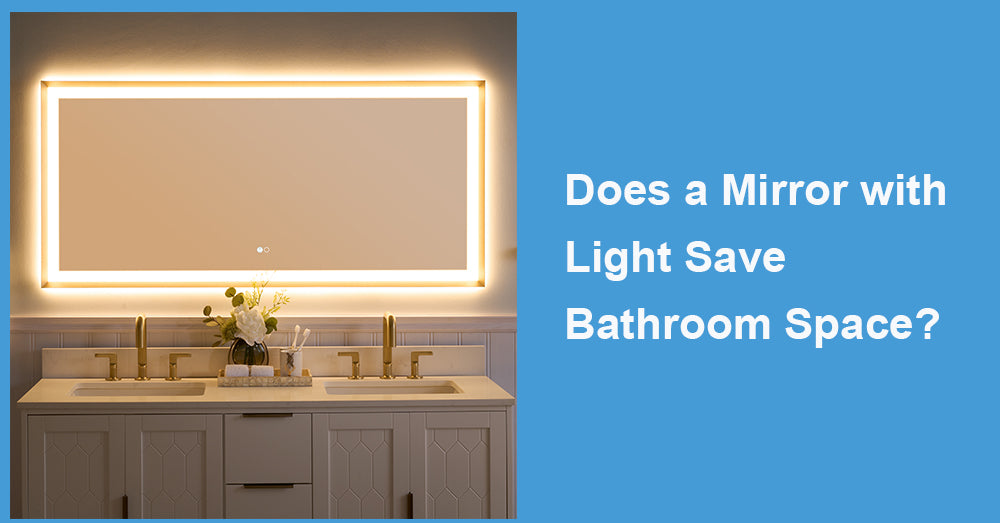
A mirror with light is increasingly seen in compact bathroom design, not just as a lighting upgrade, but as a space strategy. Instead of treating mirror, wall light, and grooming zone as separate elements, modern layouts combine them into a single unit that frees up wall area and reduces visual clutter.
In practice, the question is less about whether it “adds features” and more about whether it removes the need for extra fixtures. In smaller bathrooms, that difference is where real space savings show up.
1. The real space issue is wall congestion, not floor size
Most bathroom layouts struggle with wall overload rather than actual square footage. Sconces, mirrors, cabinets, and switches compete for the same limited wall zone above the vanity.
A mirror with integrated LED lighting removes at least one full fixture layer. Instead of installing two side sconces (typically spaced 28 in to 36 in apart) plus a central mirror, everything is consolidated into a single frame.
Houzz bathroom trend data consistently shows that integrated lighting and storage solutions are among the most preferred upgrades in compact renovations, especially when simplifying wall layouts is a priority. Source: Houzz
The industry direction is clear: fewer separate components on the wall leads to cleaner spatial perception, even when dimensions stay unchanged.
2. Perceived space matters as much as physical space
A key design reality: bathrooms feel smaller when walls are visually fragmented.
Traditional mirror + sconces setups create multiple visual anchors. A mirror with built-in lighting removes that fragmentation, producing a single continuous surface. That matters more than it sounds, especially in bathrooms under 50 sq ft.
From an industry perspective, this is often called “visual compression reduction.” When fewer objects break up the wall, the space feels wider and less constrained.
This is why frameless mirrors with LED integration are frequently paired with floating vanities and wall-mounted storage systems.
3. Integrated lighting reduces fixture overlap
A typical vanity lighting setup may include:
· two wall sconces (each 4 in to 6 in width)
· mirror frame or standalone mirror
· separate wall switch placement
A mirror with light combines illumination and reflection into one footprint. That reduces not just clutter, but installation complexity behind the wall as well.
DOE lighting efficiency discussions highlight that LED systems can significantly reduce energy use compared to traditional lighting while maintaining higher lumen output over long lifespans, often in the 30,000–50,000 hour range depending on driver quality. Source: DOE
From a layout standpoint, fewer electrical fixtures also means fewer junction boxes and less crowded wall wiring zones.

4. Storage interaction: fewer fixtures, more usable wall
Even when a bathroom is not extremely small, wall real estate is often overused. Once lighting is integrated into the mirror, that freed space can be reallocated to:
· medicine cabinets
· open shelving
· towel hooks
· decorative tile zones
This shift is subtle but important. Designers increasingly treat the mirror wall as a “functional hub” instead of a collection of separate fixtures.
Industry judgment here is straightforward: once lighting becomes part of the mirror, the wall stops being a multi-device zone and becomes a unified surface.
5. Installation footprint is smaller than it looks
A mirror with light does not necessarily reduce the physical size of the mirror itself, but it reduces installation spread.
Instead of spacing sconces 30 in apart and planning electrical clearance zones on both sides, installers only need one central mounting and one power connection point.
Typical LED mirror depth ranges around 1.5 in to 2 in, compared to wall sconces that project significantly more and require lateral spacing clearance.
In remodel projects, this consolidation often matters more than product dimensions. Fewer fixtures means fewer alignment issues and fewer spacing constraints against vanities that are already tight (often 18 in to 21 in deep).
6. Where it does NOT save space
It is important to be realistic: a mirror with light does not magically enlarge a bathroom.
It does not help if:
· wall storage is still overcrowded
· the mirror is oversized for the vanity width
· lighting is poorly matched to room brightness needs
· wiring constraints force awkward placement
In some cases, poorly chosen LED mirrors can actually feel bulky if the frame design is too thick or visually heavy.
Industry observation: space efficiency depends more on integration quality than product category alone.
7. The strongest benefit is layout simplification
The real advantage is not a measurable inch-by-inch gain. It is simplification.
When lighting, reflection, and grooming illumination are combined into one unit:
· wall planning becomes easier
· visual clutter decreases
· countertop zones feel less crowded
· the bathroom reads as more open
That combination is why LED mirrors are increasingly treated as baseline fixtures rather than optional upgrades.
Final takeaway
A mirror with light does save bathroom space, but not in the literal sense of shrinking dimensions. The savings come from consolidation—fewer fixtures, fewer wall interruptions, and fewer competing visual elements.
In smaller bathrooms especially, this consolidation changes how the room feels more than how it measures. Once lighting moves into the mirror, the wall becomes simpler, cleaner, and easier to organize around.
Industry direction is consistent: bathrooms are shifting toward integrated systems rather than separate components. And in that shift, LED mirrors are becoming one of the most efficient ways to reclaim usable visual and functional space without changing the footprint at all.









































Leave a comment
This site is protected by hCaptcha and the hCaptcha Privacy Policy and Terms of Service apply.