














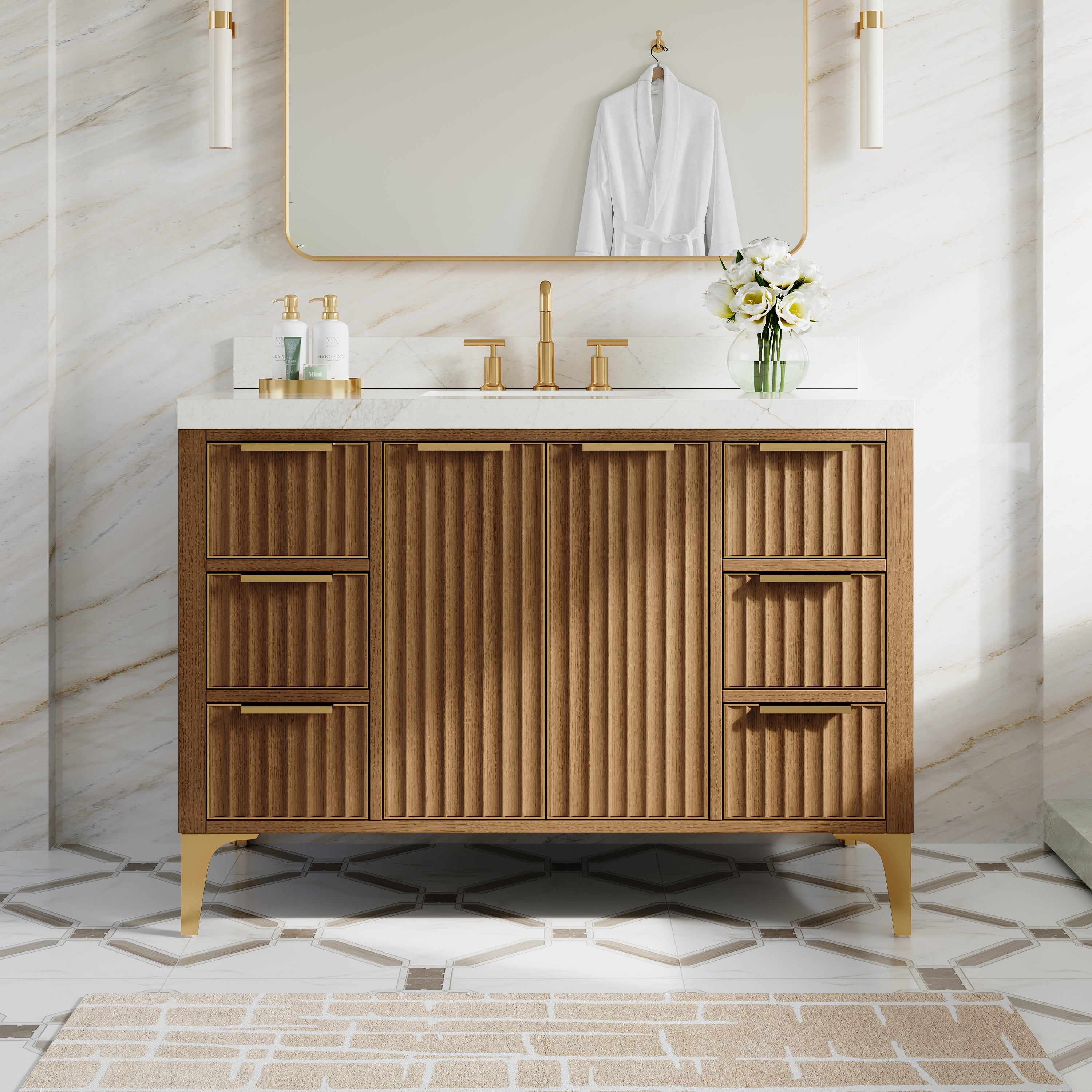


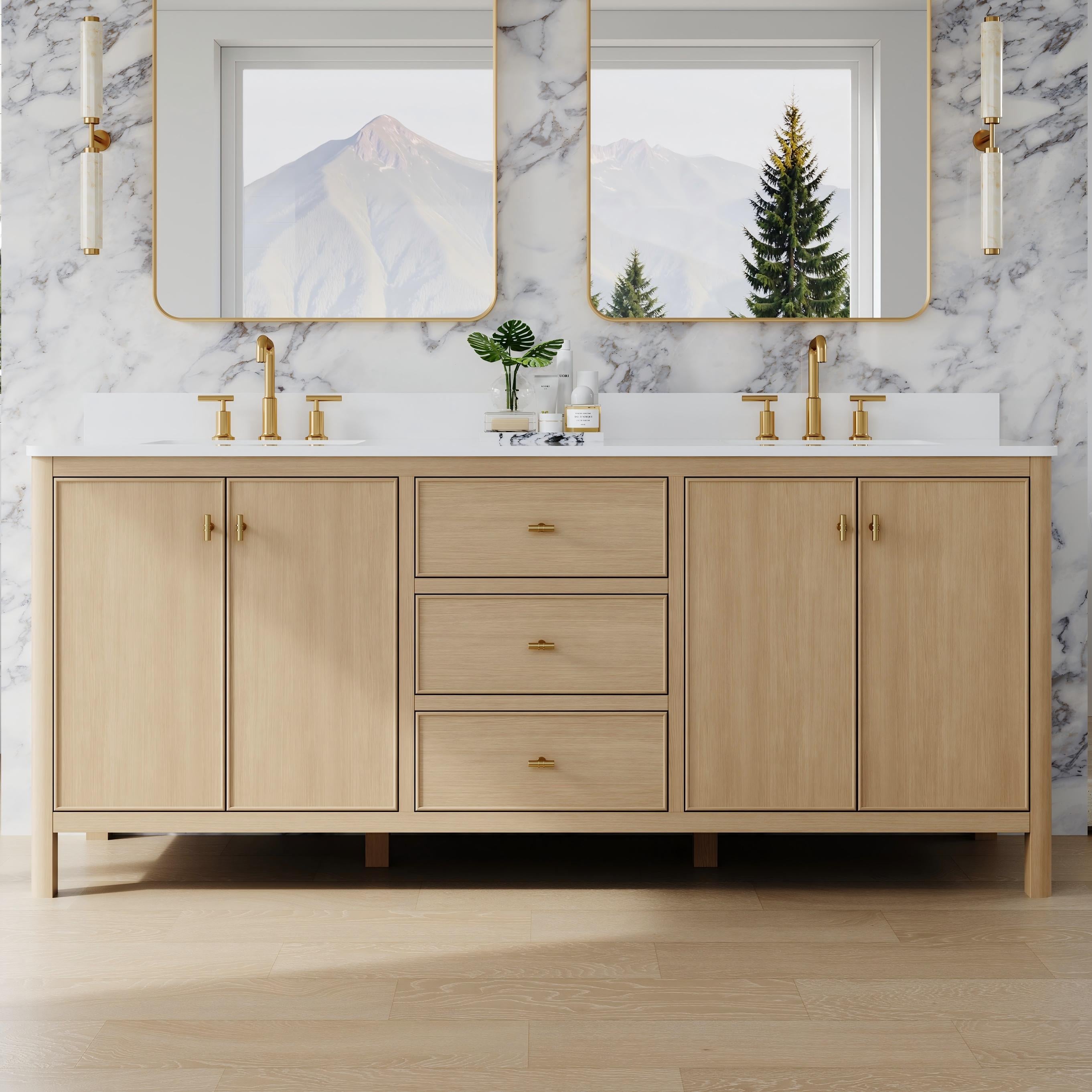


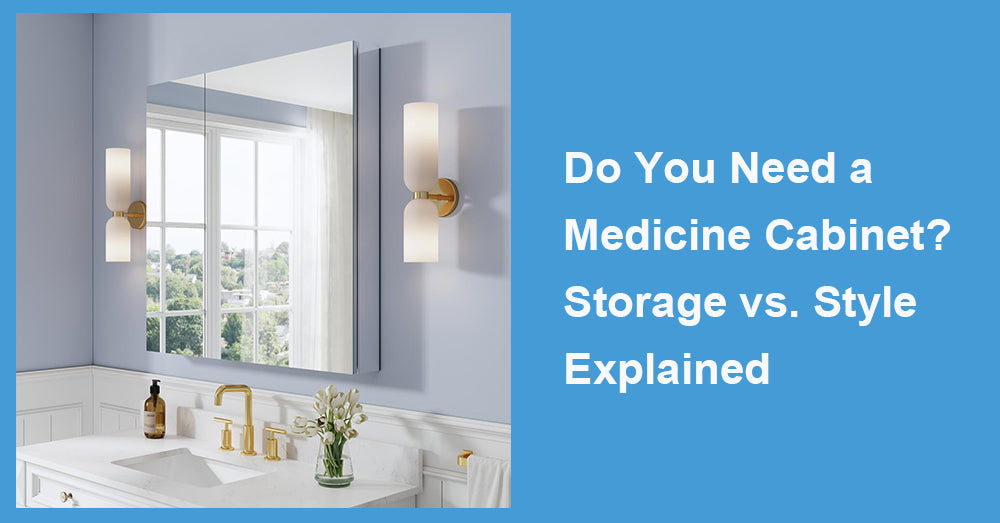
In contemporary bathroom design, medicine cabinet are gradually evolving from "optional functional components" to essential elements that balance storage efficiency and spatial aesthetics.
The disagreement over whether to install a mirror cabinet centers on two questions: whether the storage is necessary and whether it will damage the overall style.
In fact, with changes in living habits and bathroom usage habits, the role of mirror cabinets has already undergone a substantial transformation.
1. Why 'Do we need a mirror cabinet' has become a new question
In early bathroom designs, toiletries were relatively simple, and the storage space under the sink was generally sufficient.
However, industry data over the past decade has shown a significant increase in the number of items stored in the bathroom for long periods, expanding from basic toiletries to electric toothbrushes, shaving equipment, skincare tools, spare towels, and medicines.
A survey shows that over 60% of households experience cluttered countertops in the bathroom, and one of the main reasons is the lack of "accessible but not exposed" storage space.
The mirror cabinet precisely fills this position hierarchy: it does not occupy the ground or squeeze the flow line, yet can significantly increase storage capacity.
2. From a storage perspective, what problems can mirror cabinets solve
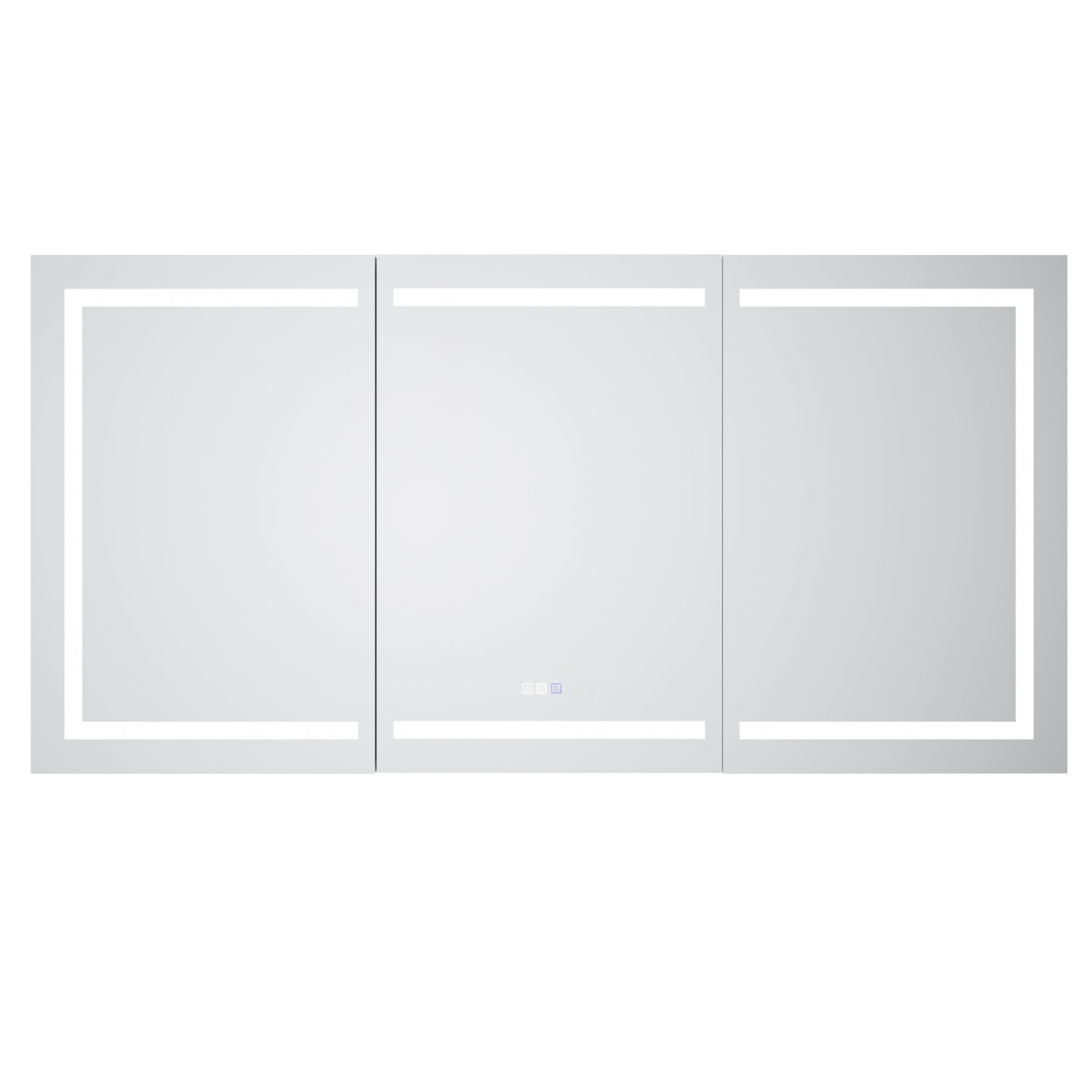
A standard-sized mirror cabinet typically has a width of 24 to 48 inches and an internal depth of 4 to 6 inches.
Despite its small size, after reasonable layering, it can accommodate the vast majority of small items used frequently in daily life.
Compared with basin cabinets, the advantage of mirror cabinets lies not in "loading more", but in "handling it smoothly".
Data show that during washing, the most commonly used items are concentrated in the height range between the eyes and the waist.
The mirror cabinet is at this golden height, reducing the need to bend over, squat, or walk back and forth.
In addition, mirror cabinets with adjustable shelves are significantly better than fixed structures in adapting to different bottle heights, which has also been a key direction in high-end mirror cabinet design in recent years.
3. Will mirror cabinets really sacrifice style?
The common concern is that the mirror cabinet may not look high-end enough, but this judgment is often based on impressions of older products.
In fact, the exterior design of the mirror cabinet has undergone significant changes.
The proportion of embedded mirror cabinets in current mainstream products continues to rise.
This type of design hides the cabinet within the wall, retaining only the mirror surface itself, making the front view almost indistinguishable from a regular mirror.
From the perspective of spatial feedback, the rating of embedded mirror cabinets for visual simplicity is almost on par with that of non-storage mirrors.
Even for surface-mounted mirror cabinets, their presence has been dramatically weakened by the narrowing of borders, the simplification of lines, and the popularity of handleless or concealed-opening structures.
In other words, whether the mirror cabinet affects the style depends more on the design choices than on the mirror cabinet itself.
4. Size selection determines whether it is "easy to use" or "chicken ribs."
The mirror cabinet's size should be selected based on both the wall proportion and usage habits.
In a single-basin configuration, the width of the mirror cabinet is usually the same as the basin or bathroom cabinet, commonly 24, 30, 36, or 48 inches.
This approach is visually most balanced and can also avoid the impact of a small mirror on the user experience.
In terms of height, most mirror cabinets are concentrated in the 24-30-inch range.
If the installation height is reasonable and the upper edge forms a comfortable proportion with the line of sight area, it will neither lower the space nor require frequent lifting during use.
It should be noted that although the thickness of the mirror cabinet is usually only 4-6 inches, it is still necessary to evaluate the door opening or opening method in narrow bathrooms to avoid interference with faucets or side walls.

5. When the mirror cabinet is not just a mirror cabinet: the trend of functional superposition
In recent years, mirror cabinets have gradually become multifunctional integrated platforms.
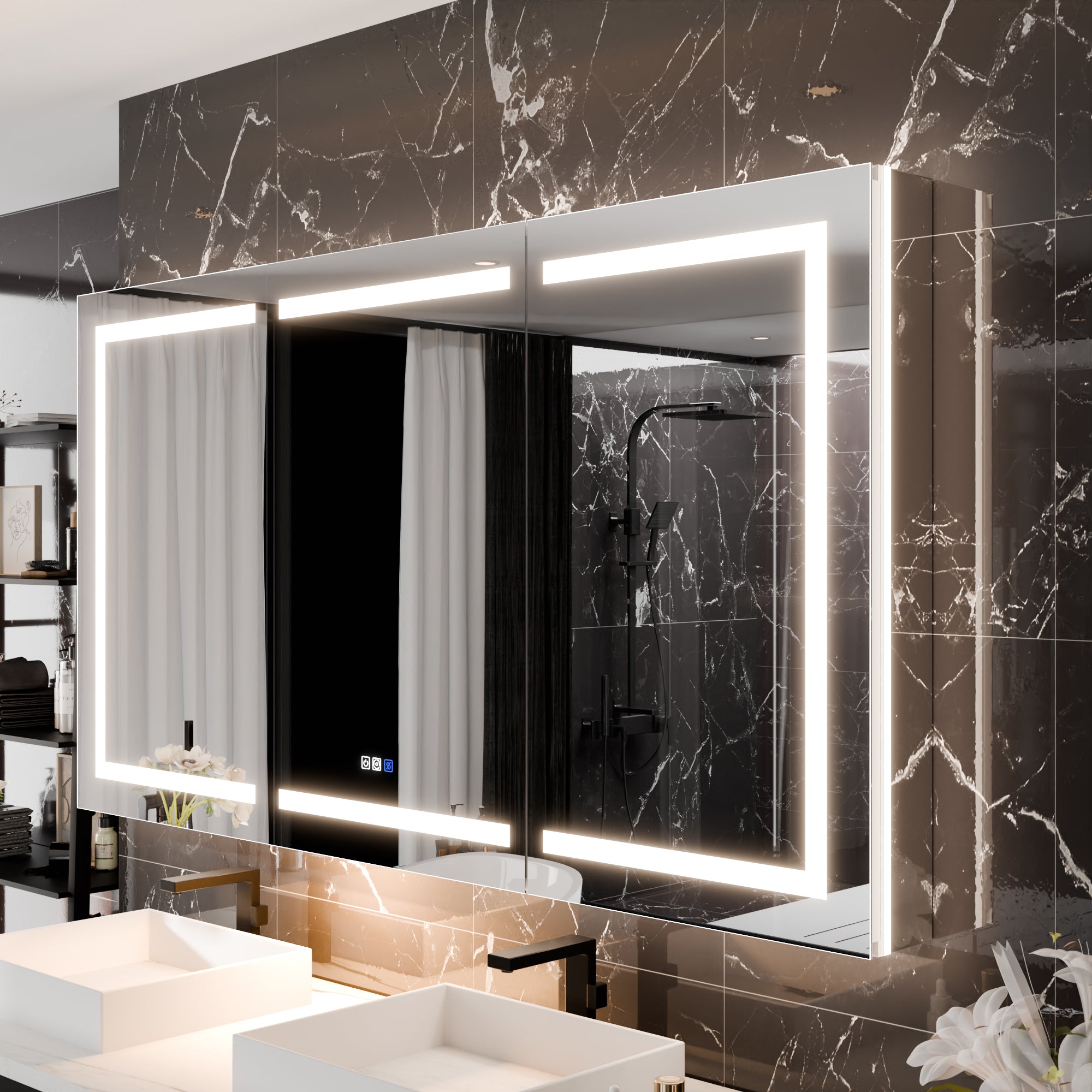
Industry data shows that the proportion of mirror cabinets with built-in lighting continues to increase.
Lights are integrated around the perimeter or inner edges of the mirror to supplement facial illumination, rather than simply serving as decoration.
At the same time, anti-fog function, power sockets, and dimmable design are also becoming standard configurations for high-end mirror cabinets.
These functions do not change the appearance of the mirror cabinet but significantly enhance its convenience for daily use.
It is worth noting that truly mature designs often hide functionality within the structure rather than showcasing technology through complex external elements.
6. When can I not choose a mirror cabinet?
A mirror cabinet is not necessary.
If the bathroom already has sufficient wall storage or is used less frequently and serves only as a guest bathroom, then choosing a pure mirror is equally reasonable.
In addition, giving up mirror cabinets is a design choice for spaces that highly emphasize decoration and do not want any dividing lines.
But such situations often assume sufficient storage solutions are available.
7. There is no need to choose between storage and style
From the overall trend, "whether a mirror cabinet is needed" is being redefined.
It is no longer a compromise between storage and aesthetics, but a mature solution that can satisfy both simultaneously.
When the size is appropriate, the installation is proper, and the design is restrained, the mirror cabinet will neither dominate nor become an unnecessary configuration.
On the contrary, it is often the key step in transitioning the bathroom from "looking neat" to "being easy to use".

































Leave a comment
This site is protected by hCaptcha and the hCaptcha Privacy Policy and Terms of Service apply.