






















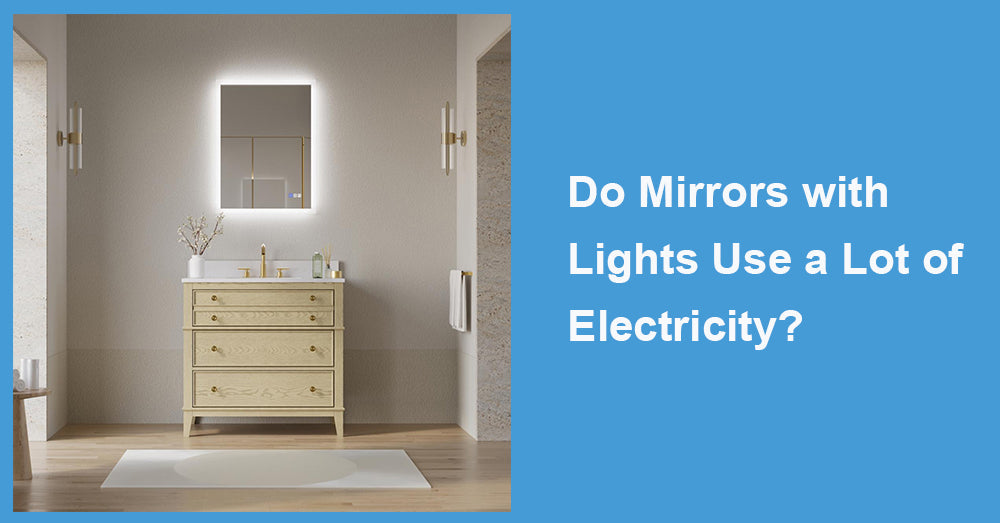
Mirrors with lights are now a standard feature in modern bathroom upgrades, especially in spaces where integrated lighting and minimal design are preferred. But one question keeps coming up during purchase decisions: do mirrors with lights actually consume a lot of electricity, or is their impact negligible compared to traditional lighting setups?
The short answer is that most modern LED-based mirrors use very little electricity. Industry direction is clear: lighting is steadily moving toward low-wattage integrated systems, and LED mirrors are part of that shift rather than an exception.
1. LED mirrors use significantly less power than traditional vanity lighting
Most mirrors with lights today rely on LED strips or LED light panels instead of incandescent or halogen bulbs. This alone drastically reduces energy consumption.
Typical power ranges:
· Small LED mirror (24 in to 30 in): 20W–35W
· Medium LED mirror (36 in to 48 in): 30W–60W
· Large LED mirror (60 in+): 60W–90W
By comparison, a traditional vanity lighting setup with multiple bulbs can easily range from 150W to 300W depending on configuration.
According to the U.S. Department of Energy, LED lighting uses at least 75% less energy and can last 25 times longer than incandescent lighting systems under comparable usage conditions.This gap is the main reason LED mirrors are increasingly replacing multi-fixture lighting setups rather than adding extra load.
2. Real electricity cost is typically very low in daily use
Energy consumption becomes meaningful when translated into actual cost, and LED mirrors are surprisingly inexpensive to operate.
Example calculation:
· 40W LED mirror
· Used 1 hour per day
· Electricity rate: ~$0.16 per kWh (EIA residential average range)
Step-by-step:
· 40W = 0.04 kWh
· Daily use = 0.04 kWh
· Monthly use ≈ 1.2 kWh
· Monthly cost ≈ $0.19
Even doubling usage to 2 hours per day keeps monthly cost under $0.40.
For comparison, many bathroom exhaust fans or heated accessories consume more energy over the same period than LED mirror systems.
3. The LED driver plays a hidden but important role
Inside every LED mirror is a driver system that converts 110–120V household AC power into low-voltage DC power for the LEDs.
This component is often overlooked, but it directly affects:
· energy efficiency
· flicker stability
· heat generation
· long-term lifespan
DOE lighting efficiency research notes that driver quality is a key determinant of overall LED system performance, especially in low-voltage applications where conversion efficiency impacts total energy loss. (Source: U.S. Department of Energy)
In practice, a high-quality driver reduces wasted energy and keeps performance stable over time, while low-quality drivers can introduce minor inefficiencies or flicker issues.
4. Usage time matters more than wattage
A common misunderstanding is assuming wattage alone determines electricity cost. In reality, duration of use is equally important.
Bathrooms typically operate on short cycles:
· 10–20 minutes per use
· 1–3 uses per day
· often turned off immediately after grooming
This intermittent usage pattern keeps total energy consumption extremely low even for larger mirrors.
DOE residential lighting studies show that bathroom lighting accounts for a relatively small percentage of total household electricity use due to short duty cycles compared to other home systems.

5. Integrated lighting often reduces total energy use
Another overlooked factor is the substitution effect.
An LED mirror often replaces:
· wall sconces (40W–80W each)
· vanity light bars (100W+)
· additional ambient lighting in the vanity area
Instead of adding energy load, the mirror frequently consolidates multiple fixtures into a single system.
So while the mirror itself consumes electricity, the total bathroom lighting demand often decreases after installation.
Industry observation: LED mirrors are more of a system replacement than a new consumption source.
6. Extra features add minimal power draw
Modern LED mirrors may include:
· anti-fog heating pads
· touch sensors
· Bluetooth speakers
· memory lighting presets
These features do consume power, but at relatively low levels:
· anti-fog pads: 15W–30W (only active when on)
· standby electronics: usually <1W
· Bluetooth audio: ~2W–5W during use
Even combined, these features rarely exceed the energy use of a single traditional bulb.
The perception of high consumption usually comes from feature complexity rather than actual electrical load.
7. Standby consumption is small but measurable
Some LED mirrors remain in standby mode for touch control or memory functions. However, modern systems are designed for ultra-low standby consumption, typically under 1W.
Over a month, this is usually equivalent to only a few cents of electricity usage.
While not zero, it is negligible compared to most other always-plugged-in household electronics.
8. Why LED mirrors feel more “energy-heavy” than they are
There is a perception issue at play. Because LED mirrors are visually prominent and often feature-rich, they feel like high-energy devices. In reality, they are closer to decorative lighting systems than appliances.
The contrast becomes clear when comparing:
· visual brightness → high perception
· actual wattage → very low consumption
Industry judgment: LED mirrors look powerful but behave like low-load lighting devices.
Final takeaway
Mirrors with lights do not use a lot of electricity in practical terms. Most modern LED mirrors operate at low wattage, short usage durations, and high energy efficiency levels compared to traditional vanity lighting systems.
When converted into real-world cost, their monthly electricity usage is typically measured in cents rather than dollars.
The key insight is simple: LED mirrors are not an additional energy burden. In most bathroom setups, they replace multiple older lighting fixtures with a single efficient system.
In today’s lighting landscape, the question is no longer whether mirrors with lights consume too much power. It is whether traditional lighting setups still make sense at all.









































Leave a comment
This site is protected by hCaptcha and the hCaptcha Privacy Policy and Terms of Service apply.