






















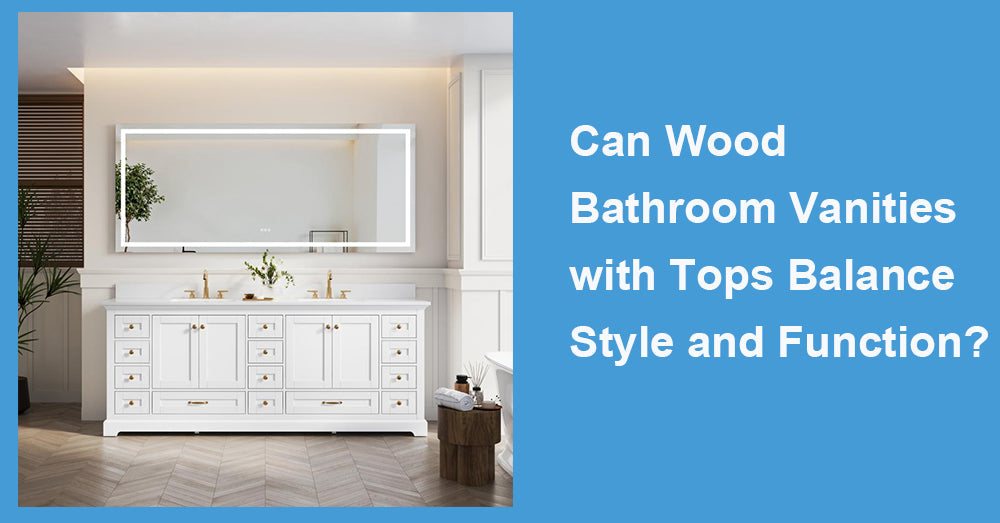
Wood bathroom vanities with tops can balance style and function when the cabinet, countertop, sink, and storage layout are treated as one complete system. Natural grain gives the bathroom warmth and visual depth, while a factory-matched top reduces the risk of incompatible dimensions or finishes. This combination is increasingly relevant as bathroom design moves toward natural materials, efficient storage, easier maintenance, and products that simplify remodeling decisions.
Recent renovation data supports the appeal of wood cabinetry. Solid wood is selected for 74% of upgraded bathroom vanities, with maple accounting for 29% and white oak for 23%. Wood tones also lead vanity colors at 28%, ahead of white, off-white, gray, and other painted finishes.
1. Wood Adds Warmth Without Limiting the Design Style
A wood vanity can soften bathrooms dominated by tile, glass, mirrors, and metal fixtures. Light oak and maple make compact spaces feel open and relaxed, while walnut and medium-tone finishes create a more tailored focal point.
The design advantage is flexibility. Wood bathroom vanities with tops can support modern, transitional, organic, farmhouse, and spa-inspired rooms depending on the door profile and surrounding materials. Flat-panel fronts feel contemporary, while Shaker-style doors add familiar architectural detail.
Current industry research shows that transitional and timeless design is expected to remain popular, supported by 70% of professionals surveyed by the National Kitchen & Bath Association. Organic and natural design follows closely at 65%, while contemporary, modern, and minimalist styles receive 57% support.
Industry judgment: wood is becoming a safer long-term specification because it crosses multiple style categories without appearing neutral or unfinished.
2. An Included Top Creates a More Coordinated Appearance
Selecting a vanity cabinet and countertop separately can produce unexpected differences in color, scale, and proportion. A complete vanity package allows the cabinet, top, and sink to be reviewed as one composition before purchase.
White and off-white tops remain practical partners for natural wood. White accounts for 48% of upgraded vanity countertops, while off-white represents another 20%. Engineered quartz is the leading countertop material at 45%, followed by quartzite, granite, and marble.
A pale top brightens the sink area and creates contrast against oak, maple, birch, or walnut. Subtle veining usually works better than a large dramatic pattern when the vanity is only 30 or 36 inches wide. On a 60- or 72-inch vanity, the larger surface can support more visible movement.
Industry judgment: coordinated tops increase perceived value because the vanity looks intentionally designed rather than assembled from unrelated components.
3. Standard Sizes Support Better Space Planning
Wood vanities with tops are available in widths that suit powder rooms, guest bathrooms, and larger primary suites. A 24-inch model can serve a compact powder room, while 30- and 36-inch vanities offer more useful storage without occupying an entire wall.
A 48-inch vanity provides generous counter space for a single sink. Double-sink configurations are commonly found at 60 and 72 inches. Nearly half of upgraded vanities, 47%, measure 48 inches or less. Another 19% measure 60 inches, while 14% are 72 inches wide.
Depth must also be considered. Standard midsize vanities are generally about 21 to 22 inches deep, although shallower designs may be appropriate near a doorway or narrow passage.
Industry judgment: the best balance between style and function comes from selecting the correct footprint, not simply choosing the widest cabinet that fits the wall.
4. Factory-Matched Tops Improve Installation Efficiency
A vanity top purchased separately requires accurate cabinet measurements, sink-cutout details, faucet drilling, edge selection, and fabrication scheduling. A factory-matched top removes many of these coordination steps.
The countertop has already been sized for the cabinet, and the sink opening is prepared before delivery. Some models include a preinstalled undermount or integrated sink, further reducing work at the jobsite.
This convenience matters because countertops and sinks are among the most frequently replaced bathroom features. Faucets are upgraded in 87% of bathroom renovations, countertops in 76%, and sinks in 73%.
Buyers should still confirm whether the sink, backsplash, side splash, faucet, and drain are included. The faucet configuration may be a single hole, a 4-inch centerset pattern, or an 8-inch widespread arrangement.
Industry judgment: a complete vanity package delivers functional value by reducing compatibility errors, not simply by placing several products in one box.

5. Thoughtful Storage Makes the Vanity Work Harder
Exterior appearance attracts attention, but the internal layout determines whether the vanity remains convenient after installation. Drawers can organize cosmetics, grooming tools, and smaller toiletries, while door cabinets provide room for towels, cleaning products, and taller containers.
The plumbing position should be checked before choosing a drawer-heavy design. A centered drain may interfere with full-width drawers, while offset plumbing can support a different cabinet configuration. U-shaped drawers, adjustable shelves, and interior dividers can improve storage without increasing the vanity width.
NKBA research identifies configurable vanity modules, electrical integration, charging stations, custom organizers, and dedicated storage for hair tools, makeup, and medications as important directions in bathroom cabinetry.
Industry judgment: well-planned storage adds more lasting value than extra decorative doors that do not improve usable capacity.
6. Construction Quality Protects the Wood Finish
A bathroom vanity must withstand humidity, water splashes, cleaning products, and frequent drawer use. The wood species alone does not determine durability. Finish quality, sealed edges, stable construction, and reliable hardware are equally important.
Buyers should look for protected cabinet interiors, moisture-resistant surfaces, adjustable hinges, and soft-close drawers. Areas around the sink, faucet, and plumbing openings deserve special attention because repeated exposure can damage poorly sealed material.
Solid wood remains the leading vanity material, but a well-made combination of solid wood framing, quality plywood, and durable veneer can also perform effectively. The goal is structural stability rather than relying on a material label as the only sign of quality.
Industry judgment: the durability of a wood vanity depends more on engineering and moisture protection than on how expensive the grain looks in product photography.
7. The Top Can Improve Daily Maintenance
The countertop and sink configuration influence how quickly the vanity can be cleaned. An undermount sink creates a smooth transition from the countertop into the basin, allowing water and debris to be wiped directly into the sink.
An integrated top offers even fewer seams, which can be useful in family bathrooms or frequently used guest spaces. Vessel sinks create a stronger decorative statement but use more visible counter area and may require a taller faucet.
Quartz and solid-surface tops are often selected for their consistent appearance and relatively simple maintenance. Natural stone can add character, but buyers should understand sealing requirements and variation before ordering.
A backsplash approximately 4 inches high can protect the wall without visually overwhelming the vanity. When the cabinet sits against a side wall, a compatible side splash may also reduce water exposure.
Industry judgment: easy-clean details increasingly influence product value because buyers expect visual quality without demanding daily upkeep.
8. Efficient Faucets Complete the Functional Package
A vanity with top creates an opportunity to coordinate a water-efficient faucet with the sink and drilling pattern. WaterSense-labeled bathroom faucets use no more than 1.5 gallons per minute at 60 pounds per square inch. This can reduce flow by at least 30% compared with the standard rate of 2.2 gallons per minute without sacrificing performance.
Faucet proportions should suit the basin. A spout that is too short may direct water toward the rear edge, while an oversized faucet can increase splashing. Handle clearance should also be checked when the sink is positioned close to a backsplash.
Brushed nickel, matte black, satin brass, and bronze can all work with natural wood. Repeating the finish on cabinet hardware, lighting, or towel accessories creates continuity without requiring every metal element to match exactly.
Industry judgment: efficiency becomes more persuasive when it is integrated into a coordinated product package rather than presented as an isolated technical feature.
9. Wood Vanities Support Current Material Preferences
The shift toward wood is connected to a broader interest in natural, durable, and low-maintenance bathrooms. NKBA reports that wood-faced vanities are supported by 62% of surveyed professionals, compared with 53% for painted cabinetry. Light neutral colors also dominate current forecasts, including off-white at 58% and light brown or tan at 54%.
These preferences work naturally with oak, maple, and other visible-grain finishes. A light wood vanity can be paired with warm white walls and pale stone, while darker walnut can be balanced with ivory tile and strong lighting.
The included top helps control this palette. Instead of adding another competing material, it can act as a quiet bridge between the wood cabinet, sink, mirror, and wall finish.
Industry judgment: successful vanity collections will increasingly combine natural character with restrained countertops that are easy to coordinate across multiple projects.
10. Conclusion
Wood bathroom vanities with tops can successfully balance style and function when the package is selected for more than appearance. Natural grain brings warmth and design flexibility, while the included countertop can simplify coordination, installation, cleaning, and faucet selection.
The strongest options combine a properly sized cabinet, useful drawers, moisture-resistant construction, a durable top, and clearly documented plumbing space. Before ordering, buyers should confirm the full width, depth, height, sink dimensions, faucet-hole pattern, countertop overhang, backsplash details, and included components.
A well-designed wood vanity does not force a choice between visual appeal and everyday performance. It can provide both, especially when the cabinet and top have been engineered as a complete system. That balance gives the product stronger remodeling value and makes it easier for buyers to move confidently from comparison to purchase.









































Leave a comment
This site is protected by hCaptcha and the hCaptcha Privacy Policy and Terms of Service apply.