






















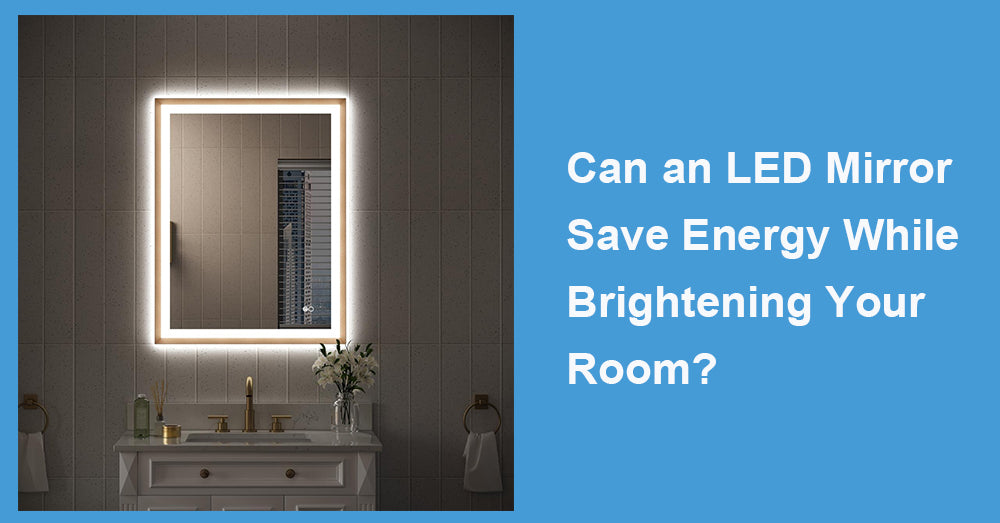
An LED mirror can do more than make a bathroom look brighter. In the right setting, it combines task lighting and a mirror into one fixture, reducing the need for separate vanity lights while giving you more controlled illumination for shaving, makeup, skin care, and everyday grooming. From a practical standpoint, that combination is where the real value lies. The energy savings may seem small on a single day, but efficient LED lighting, lower heat output, and focused illumination make these mirrors a sensible upgrade for many modern bathrooms.
1. How an LED Mirror Uses Energy Efficiently
LEDs are efficient because they produce useful light without generating as much wasted heat as older incandescent bulbs. In a bathroom, that means you can have bright lighting around the mirror without adding several high-wattage bulbs above the vanity.
That difference matters most when the bathroom lights are used frequently. A family bathroom may have the mirror lighting on several times every morning and evening. Over time, using lower-energy LEDs instead of traditional bulbs can reduce electricity consumption.
There is another benefit that is often overlooked: LEDs typically last much longer than conventional bulbs. Fewer replacements mean less maintenance and fewer trips to buy new bulbs.
Still, an LED mirror is not automatically the lowest-energy option in every bathroom. A small, well-designed fixture with one efficient bulb may use less electricity than a large illuminated mirror running at full brightness. Size and usage matter.
2. Why an LED Mirror Can Make a Room Feel Brighter
A well-positioned mirror naturally reflects light around a room. Add integrated LEDs, and the effect becomes much more noticeable.
Instead of directing light only downward from a ceiling fixture, an LED mirror places illumination near face level. That helps reduce shadows under the eyes, nose, and chin. It is one reason these mirrors work particularly well in bathrooms where grooming is part of the daily routine.
In smaller spaces, the reflected light can also make the room feel more open. You are not physically increasing the room size, of course, but brighter surfaces and fewer dark corners change how the space is perceived.
Front-Lit vs. Backlit Designs
Front-lit mirrors direct more light toward the user, making them a better choice for makeup, shaving, and detailed grooming.
Backlit models create a softer glow against the wall. They look elegant and can contribute to ambient lighting, but some users expect them to provide enough illumination for precision tasks and end up disappointed.
For practical daily use, I usually recommend looking at actual light output and positioning rather than choosing based only on appearance.
3. The Features That Actually Matter
LED mirrors have become more feature-rich, but more features do not always mean a better product.
Dimming is one of the most useful functions. Full brightness may be helpful in the morning, while softer lighting is more comfortable late at night.
Adjustable color temperature can also be worthwhile. Warmer light creates a softer atmosphere, while cooler or more neutral light is often better for grooming because it shows details more clearly.
Defogging is convenient in bathrooms where hot showers frequently cover the mirror with condensation. Keep in mind that the defogger uses additional electricity, so there is little reason to leave it running when it is not needed.
Touch controls and memory settings are useful too, provided they are intuitive. A mirror should simplify your routine, not turn basic lighting into a complicated process.
4. Where LED Mirrors Work Best
An LED mirror makes the most sense in bathrooms with limited vanity lighting, smaller rooms that need additional brightness, or spaces designed around a clean, contemporary look.
They are also useful when wall space is limited. Combining the mirror and lighting into one unit can eliminate the need for separate sconces.
I have also found them effective in guest bathrooms because they create a polished look without requiring many decorative elements.
When an LED Mirror May Not Be the Best Choice
There are situations where traditional lighting is more practical.
If your bathroom already has excellent side sconces and ceiling lighting, adding another illuminated mirror may provide little functional benefit. You may simply be adding another electrical fixture to the room.
Replacement and repair should also be considered. With a standard mirror and separate light fixture, either component can usually be changed independently. An integrated LED mirror may require more specialized repair if the internal lighting system fails.
5. Installation Requires More Planning Than a Standard Mirror
Many buyers focus on mirror dimensions and forget about electrical requirements.
Hardwired models should be positioned with the electrical connection in mind, and installation should follow local electrical requirements. In bathrooms, where moisture and electricity share the same space, proper installation is especially important.
Measure carefully before ordering. Check not only width and height, but also the relationship between the mirror, vanity, faucet, backsplash, outlets, and nearby cabinets.
At Wellfor, sizing should be treated as part of the design rather than an afterthought. A mirror that is too small can look disconnected from the vanity, while an oversized model can crowd wall fixtures.
6. Maintenance Is Usually Straightforward
LED mirrors are relatively easy to maintain.
Use a soft microfiber cloth for regular cleaning and avoid spraying excessive cleaner directly onto edges, touch controls, or electrical components. Spray the cloth first, then wipe the glass.
If the bathroom stays humid for long periods, use the exhaust fan. Good ventilation helps protect not only the mirror but also cabinetry, paint, metal hardware, and surrounding finishes.
Do not leave the light or defogging feature running unnecessarily. Energy efficiency still depends partly on how the product is used.

7. Choosing an LED Mirror That Makes Sense for Your Bathroom
Start with lighting needs, not features. Decide whether you need strong task lighting, soft ambient light, or both. Then consider dimming, color temperature adjustment, and defogging based on your actual routine.
Check dimensions carefully, confirm the installation method, and make sure the light output is appropriate for the room. A premium-looking mirror is not useful if it leaves your face poorly lit.
For many bathrooms, the right LED mirror can improve visibility, reduce reliance on separate fixtures, and create a brighter space without excessive energy use. Choose the size and lighting style for the way you actually use the room, and it becomes a practical upgrade rather than just a decorative one.








































Leave a comment
This site is protected by hCaptcha and the hCaptcha Privacy Policy and Terms of Service apply.