






















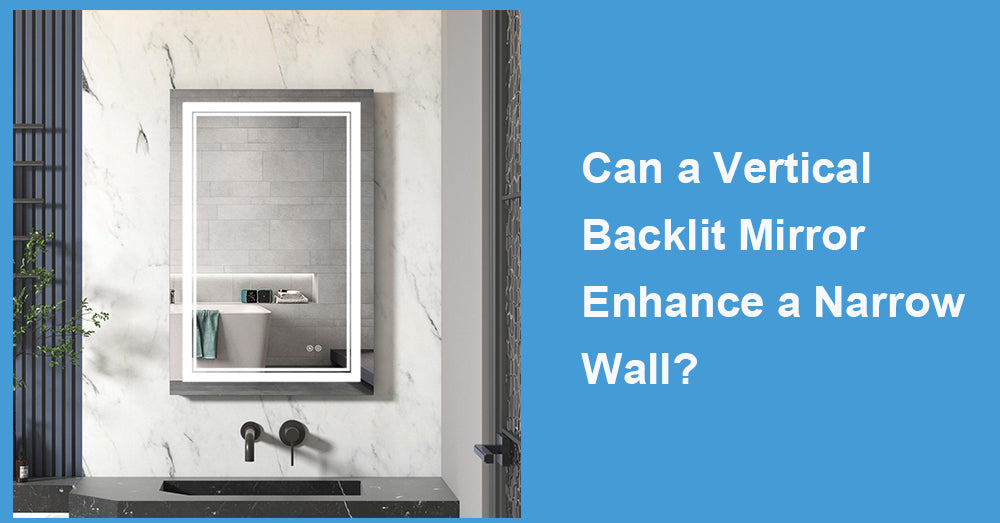
Narrow walls have always been a headache for designers and homeowners when designing bathrooms, corridors, or functional grooming areas. Space constraints, imbalanced proportions, and limited decorative methods often make these areas appear cramped and monotonous. However, in recent years, a design concept has gradually been accepted by the industry, reshaping the visual experience of narrow walls through vertical backlight mirrors. It is not only a mirror, but also an essential tool for adjusting proportions, guiding vision, and enhancing spatial aesthetics. So, can vertical backlit mirrors really make narrow walls look more beautiful? From an industry perspective, the answer is not simple, but it is worth exploring in depth.
1. Why do narrow walls easily appear 'unsightly'
The problem with narrow walls is not fundamentally due to insufficient area, but rather an imbalance in visual proportions. When the width of the wall is limited, but the height is normal or even high, traditional decoration methods can easily magnify the disadvantage of being "narrow. Horizontal decorative elements will further compress the width, while improperly sized decorations can easily appear abrupt.
This issue is particularly evident in bathroom environments. The areas next to the washbasin, on the side of the shower partition, and on the outside of the niche often lack sufficient space but are located in a concentrated view. Once mishandled, narrow walls can become a "weakness" in the overall design.
2. Why is a vertical mirror naturally suitable for narrow spaces
From the perspective of spatial psychology and interior design, vertical lines have the function of reinforcing height and weakening insufficient width. The vertical backlit mirror utilizes this principle to guide the line of sight upwards through the proportion of vertically extending mirrors, thereby "elongating" the wall in perception.
Unlike horizontal mirrors, vertical mirrors do not emphasize the width limit of the wall, but instead focus attention on height and depth. This processing method makes the originally crowded area visually more upright and neat.
3. How to further amplify spatial advantages in backlight design
If vertical proportion solves the "form problem, then backlight design solves the "atmosphere problem. Backlit mirror creates a subtle sense of hierarchy between the wall and the mirror body through the soft halo behind the mirror, making the mirror seem to "emerge" from the wall.
For narrow walls, this light and shadow effect has a dual significance. On the one hand, the backlight weakens the wall boundary, making the space no longer appear clearly cut; On the other hand, soft and uniform lighting avoids strong shadows, making narrow areas appear cleaner and more transparent.
4. The practical application value in the bathroom
In bathroom decoration, vertical backlight mirror for narrow wall are often applied to the following types of narrow walls:
One is the auxiliary mirror area next to the single basin.
The second is the vertical space above the wall-mounted washbasin;
The third solution is to replace traditional large-sized mirror cabinets in guest bathrooms or compact bathrooms.
In these scenarios, vertical backlit mirrors not only serve the functions of lighting and grooming but also effectively avoid the spatial pressure caused by the thickness of the mirror cabinet. Especially in bathrooms with limited space, this "lightweight" design is becoming increasingly popular.
5. Compatibility advantage in design style
From the perspective of industry trends, vertical backlight mirrors have strong style adaptability. Simplicity, modernity, light luxury, and even some transitional style spaces can be naturally integrated into the overall design through different border treatments and light color choices.
On narrow walls, excessive decoration can actually increase the sense of crowding, and vertical backlit mirrors, with their clean contours and low presence lighting effects, have become a "restrained and effective" design method. This non-intrusive characteristic makes it particularly suitable in functional spaces.

6. Comparison with traditional decoration schemes
Compared to murals, decorative lights, or open shelves, the advantage of vertical backlight mirrors is that they meet both practicality and aesthetics. Decorative elements often only solve visual problems, while mirrors provide real value while enhancing spatial awareness.
In addition, mirror reflection can also introduce ambient light, indirectly enhancing the brightness of narrow areas. This is particularly important in bathrooms or hallway spaces with insufficient natural lighting.
7. Installation and proportional control are equally crucial
It is worth noting that a vertical backlight mirror does not "look good when installed. In industry practice, the height, installation position, and relationship with surrounding elements of mirrors will directly affect the final effect.
An installation that is too high or too low will weaken its ability to stretch the space.
Improper selection of a light color may disrupt the overall atmosphere.
Therefore, the advantages of vertical backlight mirrors are based on reasonable proportions and precise design, rather than the single product itself.
Conclusion
From an industry perspective, vertical backlight mirrors do provide a solution that combines functionality and aesthetics for narrow walls. Through vertical proportion visual guidance and soft backlight spatial decoration, it effectively alleviates the sense of oppression caused by narrow walls, transforming previously overlooked areas into design highlights. Of course, its actual value does not lie in "universal adaptation", but in whether it forms a good fit with spatial conditions, usage needs, and overall style. When these factors are fully considered, vertical backlit mirrors not only make narrow walls look more beautiful, but also significantly enhance the overall completion and quality of the space.







































Leave a comment
This site is protected by hCaptcha and the hCaptcha Privacy Policy and Terms of Service apply.