






















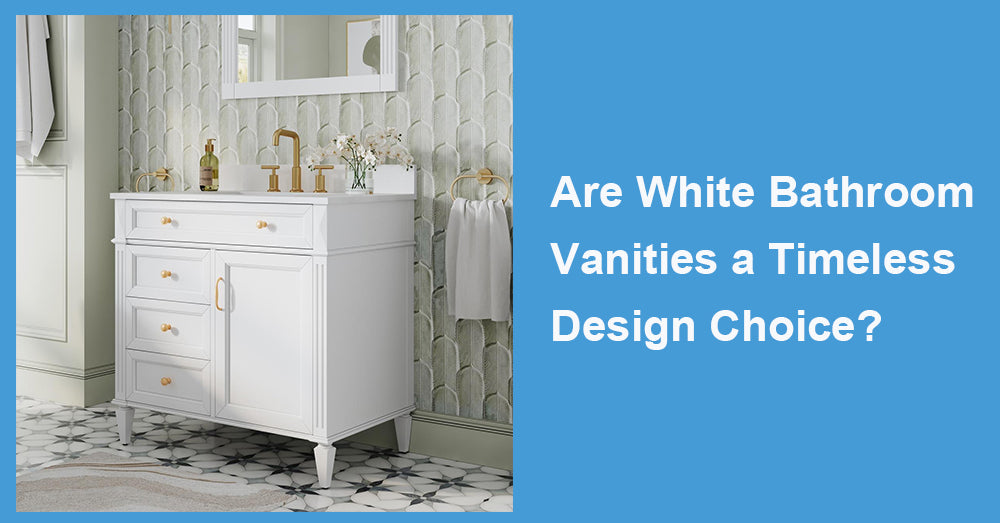
In the past decade of bathroom renovation and overall space upgrade discussions, white bathroom vanities have almost always been in a high-frequency position. Whether it's a new or an old house renovation, or a standardized configuration of rental properties, white bathroom cabinets are considered a "safe but not mediocre" choice. From an industry perspective, this long-term, stable trend is not accidental. Still, it is built on the comprehensive advantages of spatial adaptability, visual psychology, material craftsmanship, and long-term use costs.
1. Adaptation advantages of white bathroom cabinets from a spatial scale perspective
In mainstream residential design, the standard height of the washbasin countertop is typically 30 to 36 inches, while high-end master bathrooms or double-basin sinks can reach 72 inches or wider. The white cabinet has strong adaptability within this size range:
When the cabinet width is between 30 and 36 inches, white can significantly alleviate the sense of compactness in the space, making small bathrooms visually more spacious.
When the cabinet is expanded to a large size of 48-72 inches, white can balance the cabinet volume and avoid visual pressure.
Industry research shows that under the same cabinet-size conditions, light-colored cabinets can visually increase perceived space by about 10%-15%. This is also why the adoption rate of white bathroom cabinets has remained high in apartment projects and renovated residences.
2. Long-term practicality from the perspective of light and reflection efficiency
The bathroom lighting is usually achieved through a combination of ceiling lights, mirror lights, and ambient light. The white cabinet has a high diffuse reflectance, effectively enhancing light uniformity in the countertop area.
In common 24-32 inch height mirror cabinet combinations, the white tabletop and cabinet door can reduce the shaded area, making facial lighting more stable and particularly friendly for high-precision operations such as makeup, shaving, and care.
From the perspective of energy consumption, under the same brightness configuration, a light colored cabinet environment can allow the power of the lamps to be reduced by about 8%-12%, resulting in significant energy optimization over the long-term use period.
3. From the perspective of color psychology and long-term aesthetic stability
In the study of home color psychology, white has long been considered a representative color of "neutral and highly durable aesthetics". Compared to dark and trendy colors, white has a significantly longer aesthetic fatigue cycle.
Industry research shows that the average replacement cycle for bathroom cabinets is 10 to 15 years, and the "aesthetic satisfaction retention rate" of white cabinets during this cycle is about 20 percentage points higher than for other color schemes.
This means that during a complete renovation cycle, white bathroom cabinets are more likely to consistently meet residents' aesthetic expectations and not be phased out prematurely due to style changes.
4. Maintenance cost from the perspective of materials and surface technology
Modern white bathroom cabinets are no longer limited to traditional spray-painted surfaces, but are covered with various process systems:
High gloss baking paint: high surface flatness, easy to clean
Matte coating: reduces fingerprints and water residue
Coated or stain-resistant glaze surface: enhances impermeability and dye resistance performance
In the typical combination of 34-36 inch height floor cabinets and 21-22 inch countertop depth, the visibility of water stains and soap marks on white surfaces is actually lower than that on dark surfaces. Industry data shows that, at the same frequency of use, the deep-cleaning cycle for white cabinets is extended by an average of about 30%.
This is also why the white solution is easier to maintain long-term and low-maintenance for high-frequency use in the main bathroom and the shared bathroom at home.
5. Long-term transformation flexibility from the perspective of style compatibility
The style changes in bathroom spaces often focus on mirrors, hardware, lighting fixtures, and wall materials, while the cost of replacing the cabinet itself is the highest. The advantage of white bathroom cabinets in terms of style compatibility is particularly prominent:
Highly compatible with quartz, artificial stone, and marble countertops
Can adapt to various systems such as modern, light luxury, traditional, Nordic, minimalist, etc
Easy to match with hardware such as gold, black, nickel, brushed stainless steel, etc
In the mainstream cabinet size range of 48-60 inches, white cabinets have almost no restrictions on mirror cabinet replacement, lighting upgrades, or hardware color changes in later upgrades, greatly enhancing the "secondary design freedom" of space.
6. Market recognition from the perspective of property value and resale
In residential transactions and rental markets, bathroom configuration plays a vital role in overall value assessment. Industry statistics show that under the same area and configuration conditions, residential buildings with neutral-color bathroom solutions have an average shortened transaction cycle of about 12%-18%.
Among them, white bathroom cabinets have long ranked high in the "universal acceptance" index, significantly reducing the risk of aesthetic differences among potential buyers or tenants.
Especially in small- to medium-sized bathroom configurations ranging from 30 to 48 inches, the white scheme has almost become the default safety feature, helping maintain the property's long-term liquidity.

7. Is there a situation where white bathroom cabinets are not suitable
Although white has strong universality, caution is still needed in certain specific scenarios:
In areas with high-quality mineral water, long-term water stains may accelerate surface aging.
Customized projects that pursue a strong personal style may appear too neutral in white.
When customizing oversized cabinets (over 80 inches), it is necessary to enhance the sense of hierarchy through countertops, baseboards, or hardware.
In these cases, white can still be used as the base color, but it is usually necessary to enhance the spatial hierarchy through material texture and detailed design.
8. Conclusion: Is white really "timeless"
From spatial scale to light efficiency, aesthetic cycle, maintenance cost, style compatibility, to property value, white bathroom cabinets exhibit strong stability across almost every key indicator.
It is not the most avant-garde choice, nor may it be the most personalized design, but it is precisely this attribute of "not excessively interfering with life for a long time" that makes it a truly "time-friendly design".
In a core furniture category with an average usage cycle of over 10 years, white bathroom vanities are not simply a popular element but a rational choice validated by the long-term market.









































Leave a comment
This site is protected by hCaptcha and the hCaptcha Privacy Policy and Terms of Service apply.