






















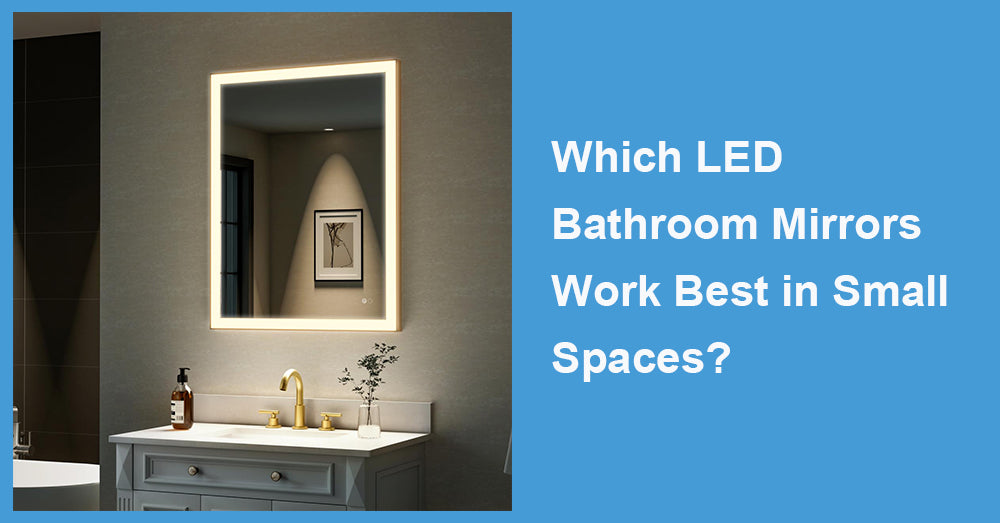
In discussions on the design and renovation of compact bathrooms, LED bathroom mirrors are gradually becoming a key configuration for improving space efficiency and user experience. Compared to ordinary mirrors or external wall lamps, bathroom mirrors with lights not only provide lighting but also serve a systematic role in magnification, flow optimization, and storage integration. From an industry perspective, a small space is not a "scaled-down version of a large space", but a completely different set of lighting and proportional logic. Understanding which LED bathroom mirrors are genuinely suitable for small spaces is one of the most important decisions when making limited area upgrades.
1. The core issue with small space bathrooms lies in the "usable interface" rather than the area itself
Industry research shows that in bathrooms with an area of 40-50 square feet or less, users' main complaints about inconvenient use are not limited space but uneven lighting, limited mirror view, and countertops occupied by lighting fixtures. In traditional schemes, the combination of ceiling lights and small mirrors can easily create shadow areas on the face while compressing the available wall height.
LED bathroom mirrors integrate the lighting system directly into the mirror surface, merging lighting and functional interfaces to free up wall and countertop space. Test data show that under the same wall-width conditions, the integrated light mirror provides about 20-30% more usable interfaces than the "mirror+external lighting" solution.
2. Mirror size is the first determining factor for the success or failure of small spaces
In small-space applications, the choice of mirror size is far more important than the appearance style. Industry experience shows that the ideal width of LED bathroom mirrors should be set to 80-100% of the washbasin width, with a height of 24-32 inches.
When the mirror width is less than 20 inches, the side face and hairline areas are prone to falling into the blind spot of illumination; however, large mirrors over 36 inches on narrow walls will actually weaken the proportion. For standard 24-30-inch sink configurations, the most common and stable mirror sizes are 24 x 30 inches, 28 x 32 inches, and 30 x 32 inches.
Research has shown that when the mirror covers the face to the collarbone and leaves a visual buffer of 6-8 inches above, its effect is most pronounced in enlarging the vertical sense of space.
3. Thin structures are more suitable for small spaces than complex shapes
In small bathrooms, the influence of mirror thickness on visual pressure is often underestimated. Industry statistics show that when the thickness of the mirror frame exceeds 1.8-2.0 inches, the "front convexity" of the wall will be significantly enhanced, making the space feel more cramped.
Currently, LED bathroom mirrors suitable for small spaces often adopt frameless or ultra-thin frame designs, with an overall thickness of 1.0-1.4 inches. This type of structure not only reduces the sense of volume but also reduces obstruction in the side view, improving traffic comfort.
Meanwhile, ultra-thin light mirrors are better suited for installation alongside mirror cabinets or storage modules, leaving space for subsequent functional upgrades.
4. Front emitting and double-sided emitting structures are more conducive to narrow space lighting
In a small-space lighting system, the direction of light is more important than brightness. Industry tests have shown that in front-of-the-mirror makeup or shaving scenes, the Front or double-sided light-emitting structure can reduce the dark area of the face by about 35-45%, significantly better than the simple backlight structure.
Although backlit mirrors create a softer atmosphere, they can make a contrast between "bright contours and dark faces" in spaces with shorter wall distances and insufficient natural light, which is not conducive to acceptable use.
Therefore, in small bathrooms with a width less than 36 inches and limited natural lighting, it is more reasonable to prioritize Front-illuminated or front-back combination-illuminated fixtures.
5. Reasonable range of brightness and uniformity
For small space bathrooms, higher peak brightness is not necessarily better. Industry recommendations suggest that under typical usage distances of 20-28 inches, it is ideal to control the illumination in Front of the mirror within the range of 500-700 lux.
When the brightness is below 400 lux, the error in detail judgment increases significantly; when it exceeds 900 lux, the probability of high light reflection and glare significantly increases, amplifying skin blemishes and exacerbating visual fatigue.
High-quality LED bathroom mirrors are usually controlled within a ±10 % range of illumination uniformity through multi-point lighting and a diffusion cover structure. In small spaces, this uniformity is particularly crucial for enhancing the overall texture.
6. The practical value of color temperature adjustment in small spaces
Small bathrooms often lack natural lighting and require higher color-temperature adaptation. Industry data shows that under fixed color temperature conditions, the probability of deviation between makeup and skin tone at different time points can reach 25-30%.
The adjustable color temperature LED bathroom mirror allows for switching between 3000K and 6000K, making the light in Front of the mirror closer to natural daylight or indoor lighting at night. Warm white light is better for evening grooming and relaxation scenes; neutral white light is better for basic care; and cool white light is better for fine makeup and shaving.
In windowless bathrooms, adjustable color temperature schemes can reduce environmental adaptation errors by about 30%.

7. The comprehensive advantages of mirror cabinet-type LED mirrors in small spaces
In small bathrooms with high storage pressure, mirror cabinet-type LED mirrors have gradually become the mainstream choice. Industry statistics show that approximately 55% of projects in hand-washing areas with a width of less than 36 inches use light mirror solutions with storage.
The depth of standard mirror cabinets is typically controlled within the 4-5-inch range, providing practical storage space without significantly encroaching on the traffic width. Compared to independent storage cabinets, the mirror cabinet solution can eliminate at least one wall component, thereby freeing up more longitudinal interfaces.
At the same time, the built-in socket and induction light strip design are more commonly used in small spaces, significantly improving daily convenience.
8. The influence of installation method on spatial perception
In a small bathroom, the installation method directly affects visual continuity. Embedded or semi-embedded installation can create a flush effect between the mirror and the wall, effectively reducing boundary shadows and contour protrusions.
Industry experience shows that the overall proportion is most effective when the lower edge of the mirror is 6-8 inches from the tabletop and the upper edge is at least 6 inches from the ceiling. Installing too low will compress the facial illumination angle, while installing too high will weaken the visual center position.
9. Rational conclusion: Mirrors suitable for small spaces are not "smaller", but "more systematic."
From an industry perspective, LED bathroom mirrors suitable for small spaces are not simply reduced-size versions, but rather a system solution that revolves around size ratios, structural thickness, lighting methods, brightness uniformity, and functional integration.
When the mirror size matches the proportions of the wall, the structure is thin enough, and the storage function is taken into account, even within a limited area, the lighting quality and spatial perception can be significantly improved.
In the rational logic of bathroom upgrading, a suitable LED bathroom mirror often determines the final quality of a small space more than increasing the area itself.









































Leave a comment
This site is protected by hCaptcha and the hCaptcha Privacy Policy and Terms of Service apply.