






















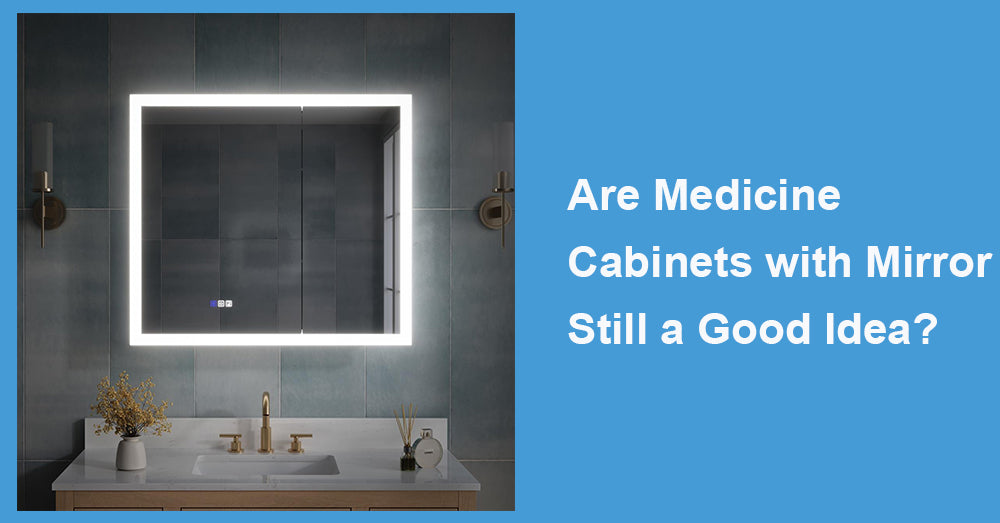
In the context of evolving bathroom design, whether medicine cabinets with mirror are still worth incorporating into renovation plans has become a frequently discussed topic. With the popularity of minimalist style, standalone mirrors, and open storage, traditional mirror cabinets were once considered "outdated. However, from an industry perspective, these products have not disappeared; instead, they continue to evolve in terms of functional integration, structural design, and user logic. The key to determining whether it is still a good idea lies not in popular trends, but in whether it can still solve real-world usage problems.
1. High usage frequency determines the value of the configuration
Among all bathroom components, mirrors and their surrounding areas are among the most frequently used. Regardless of the size or style of the bathroom, people perform daily grooming, care, and tidying tasks in front of the mirror. Industry data shows that sink usage frequency is significantly higher than that of the bathtub or shower system.
The core value of the mirror cabinet lies precisely in this high-frequency area, where "reflection" and "storage" are integrated into the exact location, thereby reducing the movement line for back-and-forth retrieval. This efficiency improvement is particularly evident over the long term.
2. Space efficiency remains an irreplaceable advantage
Although open shelving units are visually lighter, they impose higher demands on space and organizational habits. In practice, open storage tends to get cluttered more easily, especially when the quantity of daily necessities does not decrease significantly.
Industry research indicates that in small- to medium-sized bathrooms, concentrating storage behind the mirror can significantly improve space utilization. The depth of a typical mirror cabinet is usually set at 5–6 inches, providing stable, concealed storage without significantly encroaching on usable space. This aspect is challenging to replicate with just a mirror and countertop storage.
3. The change of design language, rather than the retirement of functions
The view that mirror cabinets are "outdated" largely stems from impressions of early product forms. In the past, mirror cabinets often had thick frames and bulky appearances, which do not match the more concise bathroom design language of today.
However, from an industry perspective, modern mirror cabinets have undergone significant changes in appearance. Narrower frames, thinner structures, and cleaner lines make the mirror cabinets visually closer to an ordinary mirror. The popularity of embedded design has further diminished their "cabinet-like feel.
4. Compatibility with modern bathroom functions
The functional demands of modern bathrooms extend far beyond "looking in the mirror. Features such as anti-fogging, integrated lighting, and built-in sockets are becoming standard equipment for high-frequency use. Compared to dispersing these functions on the wall, a mirror cabinet, as an integrated carrier, offers advantages in terms of structure and safety.
Industry experience shows that centralizing electrical and functional modules within the mirror cabinet makes it easier to achieve circuit management and moisture-proofing, while also helping maintain the overall simplicity of the wall surface.
5. Size and proportion determine success or failure
Whether a mirror cabinet is "user-friendly" largely depends on whether its size is appropriately chosen. The width of standard washbasins typically ranges from 30 to 48 inches. If the width of the matching mirror cabinet is close to that of the countertop, the overall proportion will be more harmonious.
In terms of height, the mirror cabinet typically ranges from 26 to 32 inches, covering the main line of sight while providing ample internal space. The disproportionate mirror cabinet is the main reason for poor user experience, rather than the mirror cabinet's form itself.
6. Embedded design redefines presence
The emergence of built-in mirror cabinets has changed people's perception of them as "space-consuming. By embedding the cabinet into the wall structure, the mirror cabinet's front is almost flush with the wall, visually resembling an independent mirror.
Industry practice has shown that in overall renovation projects, built-in mirror cabinets often meet both functional and aesthetic requirements, which is a significant reason for their renewed popularity in high-quality bathroom solutions.
7. An open-ended approach is not suitable for everyone
Although open-style mirror and countertop storage appear visually simpler, this solution demands a higher level of daily organization skills. Industry research indicates that in practical use, many households gradually accumulate items on the countertops, making it difficult to maintain the initial design effect over the long term.
The mirror cabinet maintains a sense of order in the space through "hidden storage" without increasing the cost of organization. This advantage is significant in long-term living environments.
8. Re-evaluate from the perspective of maintenance and durability
Mirror cabinets are fixed components with a low replacement frequency. Once installed, their structural stability and durability directly affect the service life. Industry data indicates that high-quality mirror cabinets often last for over ten years under normal usage conditions.
Compared to frequently adjusting open storage or replacing individual mirrors, opting for a structurally reliable mirror cabinet in one go is more conducive to long-term maintenance.
9. The core judgment of whether mirror cabinets are still a good idea
From an industry perspective, whether medicine cabinets with mirrors are still a good idea depends on where they are placed and the intended use. They are not suitable for all styles and spaces, but their value remains clear in bathroom renovations that emphasize space efficiency, functional integration, and long-term orderliness.
The real issue is not whether the mirror cabinet is outdated, but whether its design, size, and structure have been chosen to align with current usage patterns.

10. Conclusion from an industry perspective
Vanity cabinets have never truly disappeared from bathroom design; they have merely evolved. As design languages, functional requirements, and construction conditions change, the form of vanity cabinets adjusts accordingly. As long as they can balance storage, reflection, and space efficiency in high-frequency use areas, they remain a rational and mature choice.
From this perspective, the issue with medicine cabinets with mirrors is not whether they are still "worth it, but whether they are being "used correctly.







































Leave a comment
This site is protected by hCaptcha and the hCaptcha Privacy Policy and Terms of Service apply.