






















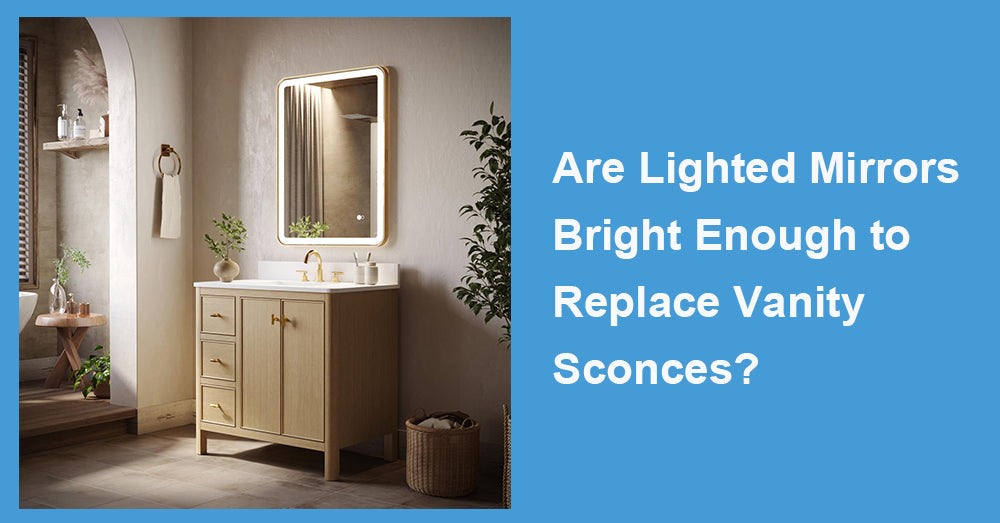
As the residential renovation market continues to heat up, bathroom lighting is experiencing a major upgrade trend. More families are choosing integrated lighted mirrors over traditional vanity sconces, a switch that not only creates a sleek, modern aesthetic but also elevates daily grooming, makeup application, and shaving routines. However, this raises an important question: Is a lighted mirror actually bright enough to replace traditional vanity wall lamps?
From the current development of the lighting industry, the answer is not simply "yes" or "no", but requires a comprehensive judgment based on brightness, illuminance, bathroom area, and usage scenarios.

Bathroom lighting enters the era of "integration"
According to the latest research on the North American lighting market, LED bathroom mirrors have become one of the fastest-growing products in residential renovation. In mid- to high-end residential projects, more and more designers are adopting a combination of "mirror lighting+basic ambient lighting" instead of the traditional mirror front wall light scheme.
Industry insiders point out that there are three main reasons why consumers choose to wear light mirrors:
More uniform facial illumination;
A more concise modern appearance;
Lower energy consumption and maintenance costs.
Especially in modern minimalism and hotel-style bathroom design, the elimination of traditional wall lamps has become a popular trend.
To determine whether it can be replaced, the first thing to consider is the brightness.
Many consumers believe that as long as the mirror is bright enough, it can definitely replace wall lamps.
In fact, what the industry really focuses on is lumens and lux.
The practice of lighting engineering usually recommends:
Small bathroom (approximately 30-35 square feet): total luminous flux of approximately 1500-2500 lumens;
Ordinary household bathroom (approximately 45-75 square feet): approximately 3000-4500 lumens;
Main bathroom (over 80 square feet): typically requires 4500 lumens or more.
And currently, the LED mirrors with lights on the market:
32-36 inch products typically output 1200-2000 lumens;
48-60 inch products typically achieve 2500-3500 lumens.
From this, it can be seen that for smaller bathrooms, large-sized LED light mirrors can already undertake the main lighting task; However, for larger main rooms, relying solely on mirrors still has certain limitations.
Why is it more comfortable to bring a lamp mirror to illuminate people than a wall lamp?
Brightness is not the only standard.
What truly affects the experience is the direction of light.
Traditional wall lamps are usually installed above mirrors, with light shining from the top of the head, which can easily create:
Eye socket shadow;
Shadow of the nasal bridge;
Shadow on the chin.
For makeup and shaving, this shadow can affect the judgment of details.
In contrast, LED illuminated mirrors adopt a surround or front illuminated design, with light closer to the human face and significantly reducing shadows.
Industry research shows that when the light source is close to the human line of sight, facial shadows can be reduced by about 20% to 30%, which is also the reason why more and more professional makeup mirrors are using surround lighting.
Therefore, even if the lumen is slightly lower, the illuminated mirror with a lamp often outperforms traditional wall lamps in terms of facial lighting effect.
Color temperature and color rendering index are equally important.
Consumers often mistake "bright" for "clearly illuminated".
In fact, lighting designers pay more attention to:
Color Temperature
Color rendering index (CRI)
Industry advice:
3000K: Slightly warm, suitable for relaxing at night;
4000K~4500K: most suitable for daily grooming and makeup;
Above 5000K: The details are clear, but it is easy to appear cold.
At the same time, it is best to choose a CRI ≥ 90 for bathroom mirrors, so as to truly restore skin tone, makeup, and hair color, and reduce color difference.
Therefore, an illuminated mirror with high color rendering index and adjustable color temperature often has a better actual user experience than a regular fixed color temperature wall lamp.
WELLFOR with light mirror meets the lighting needs of modern homes
As a bathroom brand that has continued to develop in the North American market in recent years, WELLFOR's LED smart bathroom mirror is in line with this trend.
For example, some WELLFOR smart mirror products are equipped with:
Three color temperature adjustments (approximately 3000K, 4000K, 6000K);
10% to 100% stepless dimming;
CRI ≥ 90 high color rendering lighting;
Anti-fog heating function;
Memory mode, which can save the user's commonly used brightness settings.
For ordinary family bathrooms with an area of about 40-60 square feet (about 3.7-5.6 square meters), these products can provide uniform facial lighting and meet daily needs for washing, skincare, and makeup. In many households, they have replaced traditional mirror wall lamps.
When Is It Still Recommended to Keep Vanity Wall Sconces?
Although LED mirrors are becoming increasingly powerful, interior designers generally agree that 'layered lighting' remains the best solution.
It is still recommended to pair wall lights or ceiling lights in the following situations:
Firstly, a large-scale main light.
When the bathroom area exceeds 85 square feet, relying solely on mirror lighting can result in insufficient brightness in spaces such as bathtubs and shower areas.
Secondly, a double basin bathroom.
For bathrooms wider than 60 inches, adding wall sconces can help create more balanced, even lighting throughout the space.
Thirdly, emphasize atmospheric design.
High-end residential buildings often use a combination of chandeliers, wall lights, mirror lights, and tube lights to achieve different scene switching, such as night mode, morning mode, and SPA mode.
It is generally believed in the industry that mirror lights are mainly responsible for facial functional lighting, while ceiling lights and wall lights are responsible for environmental lighting, each with its own advantages.
Industry Outlook
From the perspective of the development trend of the comprehensive lighting industry, illuminated mirrors have been upgraded from auxiliary light sources in the past to important lighting equipment in modern bathrooms. For small and medium-sized bathrooms, a high-quality, high-lumen LED strip mirror that supports dimming and color temperature adjustment can fully meet daily grooming needs and successfully replace traditional vanity wall lights in many households.
However, for larger main bathrooms or residences that pursue a higher sense of spatial hierarchy, the layered lighting scheme of "with mirror lights, ceiling lights, and wall lights" is still the most recommended configuration by designers. In the future, as LED light efficiency continues to improve, intelligent control becomes more mature, and brands like WELLFOR continue to launch new products that integrate high brightness, energy efficiency, anti-fog, and intelligent dimming, illuminated mirrors will play an increasingly core role in the North American bathroom lighting market.







































Leave a comment
This site is protected by hCaptcha and the hCaptcha Privacy Policy and Terms of Service apply.