
















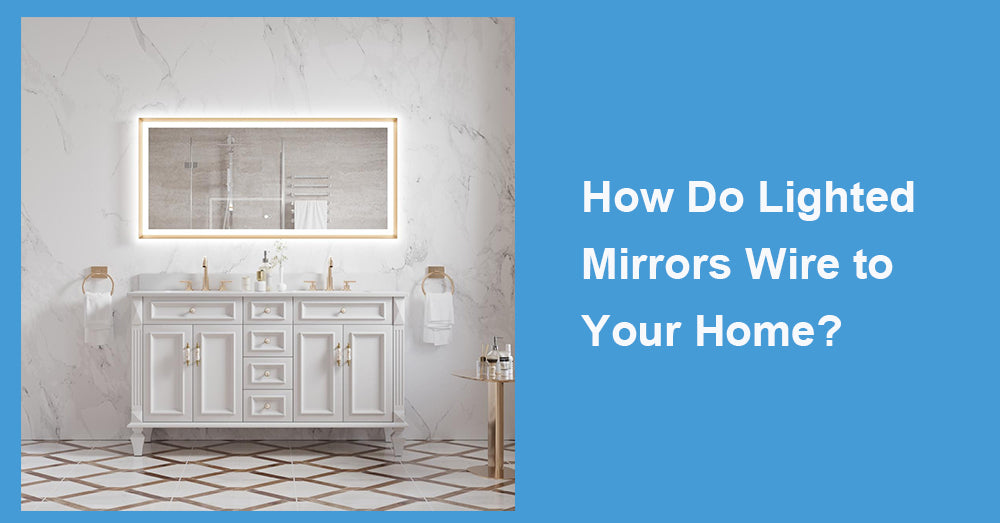
Many people only realize after buying lighted mirrors that the real “trouble” is not hanging them on the wall, but connecting them to the home circuit.
Do you want a plug? Can I connect the wall switch? Can anti-fog and lighting be controlled separately? Is there a risk of electric leakage?
The conclusion should be made clear: there are mainly two types of wiring methods for glasses with lights - plug-in and hardwired. As long as the product is suitable for humid environments, the home circuit protection is in place, and it is installed according to specifications, it is a mature and safe practice overall.
Below, explain it clearly in the format of “you can understand and also take it to talk to the electrician”.
1. First, recognize the two power supply methods: plug-in vs. hard-wired.
A. Plug-in type
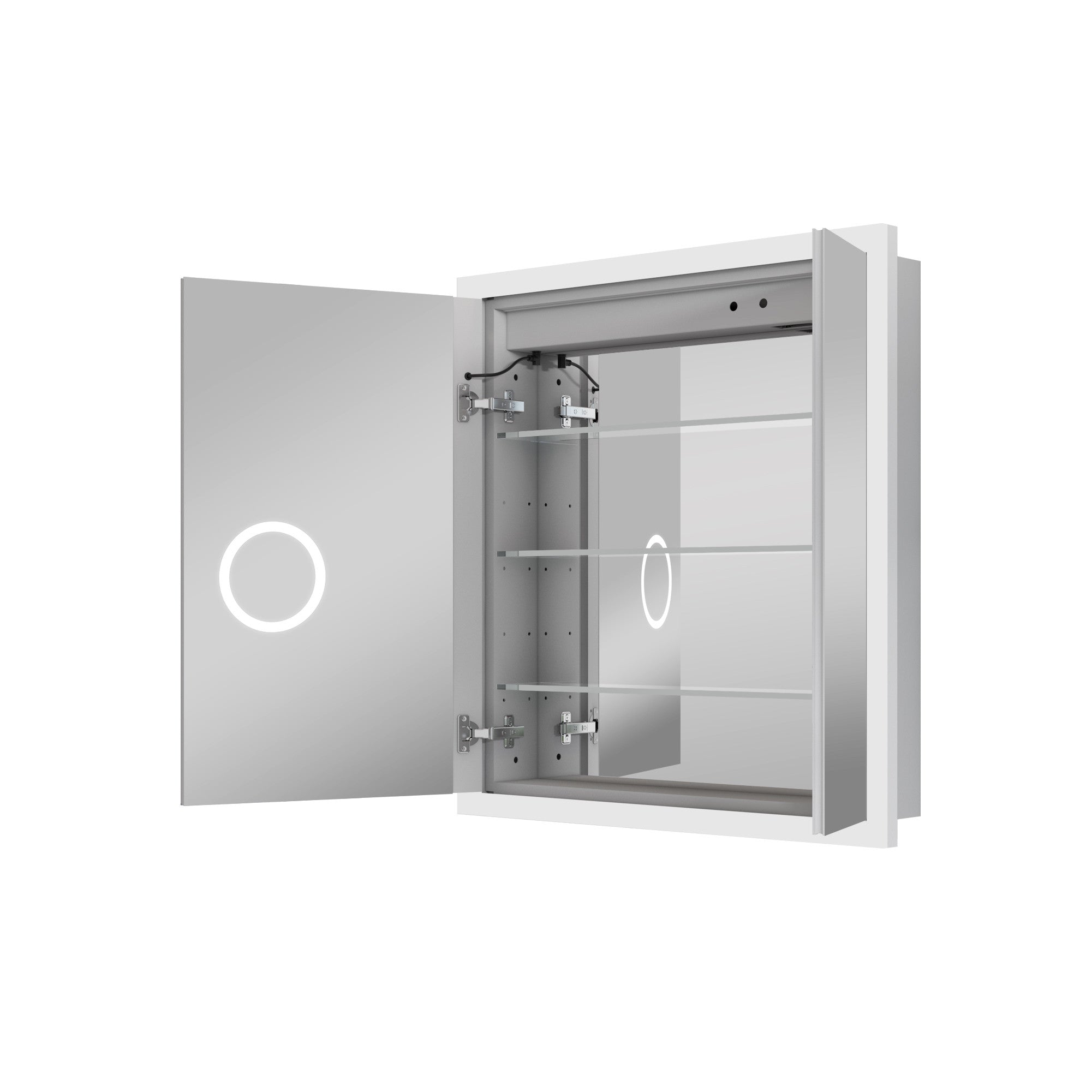
What does it look like: The mirror has a power cord and plug on the back or side, which can be directly plugged into a wall socket (many mirror cabinets may also be like this).
Advantages:
Quick installation with minimal modifications
In the future, replacement will also be convenient
Potential issues:
The socket position must be “just near the mirror”; the wire will be exposed
In a humid bathroom environment, the exposure of plugs and sockets poses a greater challenge to the layout and splash-proof details
Who is suitable for: Your home has already reserved sockets behind/on the side of the mirror, and you don’t want to open the wall or modify the wiring.
B. The second method to consider is hardwired installation.
Advantages:
The appearance is the cleanest, with completely hidden lines
More like a standard practice for “bathroom lighting fixtures.”
Potential issues:
Accurate positioning of the junction box is required
Need for stricter electrical specifications and construction quality (strongly recommended for professional electricians)
This option suits those who want a minimalist appearance, long-term stable use, or need to switch to hard wiring during bathroom renovations.
2. How to connect the hard wire? These are the only “key structures” you need to understand
Most mirrors with lights (including anti-fog, touch, dimming, etc.) are essentially connected to household circuits as a “fixed light fixture” when hard-wired.
You will see three types of wires on the back of the mirror:
Hot/Line (usually black): responsible for the power supply
Neutral (usually white): forms a loop
Ground wire (green line or bare copper): safety protection
Typical wiring logic:
Turn off the circuit breaker (do not just turn off the wall switch), then use a power meter to confirm that power is off.
Open the junction box inside the wall and find the live/neutral/ground wires for the power supply.
Connect the mirror wires to the house wires using wire caps or connectors (match black to black, white to white, ground to ground).
Put the wire into the junction box, fix the mirror, and cover the cover plate.
Closing test: whether the light, dimming, anti-fog, and memory functions are normal
You don’t have to do it yourself, but knowing how it works helps you talk with electricians and avoid confusion.
3. Once you understand wiring basics, it's important to choose how you'll control the lighted mirror: wall switch, mirror touch, or both.
The way you control your lighted mirror determines how you should plan for outlets or switch locations.
Here are three common options:
A. Only touch the mirror
Experience: The mirror is always powered, and the light is controlled by the mirror touch switch.
Advantages: Complete functions (dimming, color temperature adjustment, memory, timing) are easier to retain.
Attention: After power failure and restart, some products may return to default brightness/color temperature, while others may remember, depending on the product design.
B. Only use the wall switch
Experience: Switch on and off like a regular bathroom light.
Advantages: It is easier for family members to use and has intuitive logic.
Risk points:
Some mirrors with touch/smart modules may experience memory failures or poor user experience when used with wall switches to “hard power off” (not a safety issue, but a user experience issue).
If you want to dim the light, make sure your mirror is compatible with your dimmer switch type. Many LED lights don’t work with all dimmers.
C. Both wall switch and mirror touch together (best, but needs planning)
The wall switch gives main power, while the mirror switch controls brightness and settings. It’s best to decide this while renovating, because changing the wiring later is hard and more expensive.
4. Can the “anti-fog, light, and night light” be connected separately? See if you have the “multi loop” condition
Many people only realize a practical problem after buying anti-fog mirrors: the anti-fog heating element is power-hungry, and you may not want it permanently tied to the lamp.
Common control schemes include:
Lamp and anti-fog switch on and off at the same time: wiring is the simplest, but the experience may not be the best
Lamp and anti-fog separate control: more reasonable, but usually requires the mirror itself to support “separate control input” or requires additional switch/control line positions
Night light/ambient light independent: Similarly, it is best to confirm whether the mirror supports independent control channels
One sentence: The finer the control you want, the more you should check before purchasing whether it is a “single main power input” or a “multi input/multi-functional control module”.
5. The core of bathroom safety is not whether the mirror will leak electricity, but whether the home circuit protection is in place
The bathroom belongs to a humid area, and the bottom line of electrical safety usually includes:
Socket/circuit with leakage protection (GFCI) (especially when you are a plug-in or mirror cabinet with built-in socket)
Reliable grounding, standardized junction box, non-exposed wire ends, matching wire diameter/terminals
The product itself is clearly suitable for humid environments (marked with damage location, etc.) and has a third-party certification mark
If your home is an older house, the bathroom socket does not have a test/reset button, or it frequently trips abnormally, it is recommended to first address basic electrical safety before upgrading with a light mirror.
6. As you plan your wiring, also pay attention to installation height and routing position.
Making thoughtful reservations ensures the placement is functional and visually pleasing.
Here’s a standard approach:
If the mirror comes with a back junction box, try to reserve the junction box in the middle and upper part of the “occlusionable area” on the back of the mirror, to avoid the wire being too short and pulling.
When a wall lamp is needed, the reserved positions on both sides should be considered first, and the mirror should not be too wide to allow the wall lamp to fit.
The most stable method is to stick the outline of the mirror to the wall with decorative paper, mark the height you want, and then locate the junction box.

7. Before finalizing your installation, make sure to clarify the answers to these 6 questions with your electrician.
Doing so minimizes the chances of mistakes:
1. Is it better to plug this mirror in or hard-wire it? Do sockets/junction boxes need to be adjusted in position?
2. Does the circuit have leakage protection (GFCI)? Does the bathroom's overall electrical system need to be upgraded?
3. Do I want to use a wall switch to control the dimming/memory/anti-fog function of the mirror?
4. Can anti-fog be independently controlled? How many sets of switches or control channels are needed?
5. Are mirror markings suitable for humid environments? Is the certification label complete?
6. Will the junction box be completely covered by a mirror while remaining easy to maintain?
By asking these 6 questions clearly, you can turn “buying mirrors” from mysticism into controllable engineering: clean appearance, complete functionality, long-term stability, and safe use.












Leave a comment
This site is protected by hCaptcha and the hCaptcha Privacy Policy and Terms of Service apply.